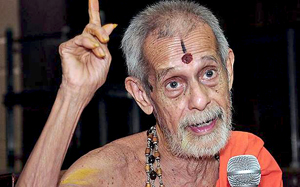
India is not only for Hindus; but Ram Mandir is right of Hindus: Pejawar seer

coastaldigest.com news network
July 9, 2017

Udupi, Jul 9: Expressing frustration over the recent demand by a section of ‘progressive thinkers’ to disassociate himself from Ram Janmabhoomi movement, Paryaya Pejawar Mutt seer Sri Vishwesha Theertha Swami said that Ram Mandir is the right of Hindus and it is impossible to give away the land to construct a mosque.pejawar

Speaking to media persons here, the seer, however, clarified that he did not envisage the country as purely the land of Hindus. “India belongs to all Indians and not for any particular community or religion,” he said.

The seer said Ram Mandir will be built at Sri Ram Janmabhoomi site as inscriptions prove the existence of temple on the spot. But consensus on the issue cannot be achieved through violence, he said.

Lamenting that progressive thinkers insist on achieving harmony at the cost of right, the seer said, “Is it possible to give away Kashmir to Pakistan for peace and prevent violence? Let the progressive thinkers reconsider their opinion by working out possibilities. Kashmir is India’s right. Similarly, Ram Mandir is the right of Hindus. The privilege of secularism should have limitations.” 

Earlier this week, Karnataka Komu Sauharda Vedike leader G Rajashekhar had challenged the seer to quit the leadership of the committee that works on Sri Ram Janmabhoomi and also oppose the idea of Hindu nation for India.

Speaking at a protest rally organised by Solidarity Youth Movement on communal terrorism, Rajashekhar said that the seer has done a commendable work by organising Iftar party to Muslims. But the seer should not forget that he is even now seen as the leader of Hindu community and he has to get rid of the image he has already developed being part of fanatical movement conceptualised by the hard core Hindu fundamentalists, he urged.

Comments

Sitara
 - 
Monday, 10 Jul 2017

If protecting cow is holy act for you then eating beef is holy act for us. RSS is in total delusion of owning franchise of Indian nationalism. This idiot (EVM master) took a month to understand human life is precious.

Shuaib
 - 
Monday, 10 Jul 2017

shobakkaa shame shame shame shame shame

shame on you

Shuaib
 - 
Monday, 10 Jul 2017

Madam,

Your own people (BJP) pelted stone to your Sharath funeral.

I am sure, your own people killed him also.

You BJP/RSS people are the worst politician on the earth.

Sahil
 - 
Monday, 10 Jul 2017

Good job Mangalore police.. Arrest the TRUE culprits whoever it is!!

shaharook
 - 
Monday, 10 Jul 2017

Aslamualeikum sir I would like to join hajj khidmat plz contact me I have passed UG AND I KNOW ENGLISH AND HINDI AND URDU

Abdul Munaf
 - 
Monday, 10 Jul 2017

Well... So should we call hindus as Terrorist now??? Or Is there any other explanation???

Fed up of everyone calling muslims as terrorist...now its a Hindu..

Terrorism is not based on religion.. All religions teaches peace.. a terrorist may belong to a religion but his religion is Not a Terrorist religion.

Add new comment

  • Coastaldigest.com reserves the right to delete or block any comments.
  • Coastaldigset.com is not responsible for its readers’ comments.
  • Comments that are abusive, incendiary or irrelevant are strictly prohibited.
  • Please use a genuine email ID and provide your name to avoid reject.
News Network
January 8,2020

Bengaluru, Jan 8: The Karnataka government on Tuesday decided to adopt a no-fail approach for Class 7 examinations for government and private schools following the state syllabus.

The report card of a student doesn’t carry ‘pass’ or ‘fail’ remark, but points to his or her strengths and weaknesses in each subject in the exams, which will now be called Common Evaluation Exam.

The quality cell of the Karnataka Secondary Education Examination Board (which conducts SSLC exams) will prepare question papers, which will be evaluated at the district level by government and private schoolteachers. The Class 7 exams will be held in March.

The Common Evaluation Exam follows the Continuous Comprehensive Evaluation (CCE) currently practised under the Right to Education Act. “The formative and summative assessments (tests, projects and quizzes) will be held as usual,”KG Jagadeesha, commissioner of public instruction, said.

Edu dept to launch helpline by March

For the March exam, summative assessment 2 will be held with half the syllabus. Other modalities (exam duration and total marks) will be announced next week,” said KG Jagadeesha. The CCE system will continue for classes 8 and 9. The government hopes the exam and subsequent interventions in classes 8 and 9 will boost students’ confidence for crucial board examinations.

Minister S Suresh Kumar said, “More than an exam, it’s an evaluation of a child’s knowledge. The Belagavi division has done something similar. The Kalaburagi zone found mathematics and science were areas of concern; language was an issue in Urdumedium schools.” The minister said zilla panchayat CEOs have observed that intervention should start from class 8. “Keeping this in mind, we’ve started necessary preparation for class 7 exam ,” he added.

The education department will start a helpline by March for students, teachers, school managements and educationists to 11 raise problems on day-to-day issues.

Comments

Add new comment

  • Coastaldigest.com reserves the right to delete or block any comments.
  • Coastaldigset.com is not responsible for its readers’ comments.
  • Comments that are abusive, incendiary or irrelevant are strictly prohibited.
  • Please use a genuine email ID and provide your name to avoid reject.
Ram Puniyani
February 10,2020

Noam Chomsky is one of the leading peace workers in the world. In the wake of America’s attack on Vietnam, he brought out his classic formulation, ‘manufacturing consent’. The phrase explains the state manipulating public opinion to have the public approve of it policies—in this case, the attack of the American state on Vietnam, which was then struggling to free itself from French colonial rule.

In India, we are witness to manufactured hate against religious minorities. This hatred serves to enhance polarisation in society, which undermines India’s democracy and Constitution and promotes support for a Hindu nation. Hate is being manufactured through multiple mechanisms. For example, it manifests in violence against religious minorities. Some recent ghastly expressions of this manufactured hate was the massive communal violence witnessed in Mumbai (1992-93), Gujarat (2002), Kandhamal (2008) and Muzaffarnagar (2013). Its other manifestation was in the form of lynching of those accused of having killed a cow or consumed beef. A parallel phenomenon is the brutal flogging, often to death, of Dalits who deal with animal carcasses or leather.

Yet another form of this was seen when Shambhulal Regar, indoctrinated by the propaganda of Hindu nationalists, burned alive Afrazul Khan and shot the video of the heinous act. For his brutality, he was praised by many. Regar was incited into the act by the propaganda around love jihad. Lately, we have the same phenomenon of manufactured hate taking on even more dastardly proportions as youth related to Hindu nationalist organisations have been caught using pistols, while police authorities look on.

Anurag Thakur, a BJP minster in the central government recently incited a crowd in Delhi to complete his chant of what should happen to ‘traitors of the country...” with a “they should be shot”. Just two days later, a youth brought a pistol to the site of a protest at Jamia Millia Islamia university and shouted “take Azaadi!” and fired it. One bullet hit a student of Jamia. This happened on 30 January, the day Nathuram Godse had shot Mahatma Gandhi in 1948. A few days later, another youth fired near the site of protests against the CAA and NRC at Shaheen Bagh. Soon after, he said that in India, “only Hindus will rule”.

What is very obvious is that the shootings by those associated with Hindu nationalist organisations are the culmination of a long campaign of spreading hate against religious minorities in India in general and against Muslims in particular. The present phase is the outcome of a long and sustained hate campaign, the beginning of which lies in nationalism in the name of religion; Muslim nationalism and Hindu nationalism. This sectarian nationalism picked up the communal view of history and the communal historiography which the British introduced in order to pursue their ‘divide and rule’ policy.

In India what became part of “social common sense” was that Muslim kings had destroyed Hindu temples, that Islam was spread by force, and that it is a foreign religion, and so on. Campaigns, such as the one for a temple dedicated to the Hindu god Rama to be built at the site where the Babri masjid once stood, further deepened the idea of a Muslim as a “temple-destroyer”. Aurangzeb, Tipu Sultan and other Muslim kings were tarnished as the ones who spread Islam by force in the subcontinent. The tragic Partition, which was primarily due to British policies, and was well-supported by communal streams also, was entirely attributed to Muslims. The Kashmir conflict, which is the outcome of regional, ethnic and other historical issues, coupled with the American policy of supporting Pakistan’s ambitions of regional hegemony, (which also fostered the birth of Al-Qaeda), was also attributed to the Muslims.

With recurring incidents of communal violence, these falsehoods went on going deeper into the social thinking. Violence itself led to ghettoisation of Muslims and further broke inter-community social bonds. On the one hand, a ghettoised community is cut off from others and on the other hand the victims come to be presented as culprits. The percolation of this hate through word-of-mouth propaganda, media and re-writing of school curricula, had a strong impact on social attitudes towards the minorities.

In the last couple of decades, the process of manufacturing hate has been intensified by the social media platforms which are being cleverly used by the communal forces. Swati Chaturvedi’s book, I Am a Troll: Inside the Secret World of the BJP’s Digital Army, tells us how the BJP used social media to spread hate. Whatapp University became the source of understanding for large sections of society and hate for the ‘Other’, went up by leaps and bounds. To add on to this process, the phenomenon of fake news was shrewdly deployed to intensify divisiveness.

Currently, the Shaheen Bagh movement is a big uniting force for the country; but it is being demonised as a gathering of ‘anti-nationals’. Another BJP leader has said that these protesters will indulge in crimes like rape. This has intensified the prevalent hate.

While there is a general dominance of hate, the likes of Shambhulal Regar and the Jamia shooter do get taken in by the incitement and act out the violence that is constantly hinted at. The deeper issue involved is the prevalence of hate, misconceptions and biases, which have become the part of social thinking.

These misconceptions are undoing the amity between different religious communities which was built during the freedom movement. They are undoing the fraternity which emerged with the process of India as a nation in the making. The processes which brought these communities together broadly drew from Gandhi, Bhagat Singh and Ambedkar. It is these values which need to be rooted again in the society. The communal forces have resorted to false propaganda against the minorities, and that needs to be undone with sincerity.

Combating those foundational misconceptions which create hatred is a massive task which needs to be taken up by the social organisations and political parties which have faith in the Indian Constitution and values of freedom movement. It needs to be done right away as a priority issue in with a focus on cultivating Indian fraternity yet again.


Comments

Add new comment

  • Coastaldigest.com reserves the right to delete or block any comments.
  • Coastaldigset.com is not responsible for its readers’ comments.
  • Comments that are abusive, incendiary or irrelevant are strictly prohibited.
  • Please use a genuine email ID and provide your name to avoid reject.
coastaldigest.com news network
May 14,2020

Kuwait: The COVID-19 pandemic has affected all sections of the community in Kuwait, hundreds of NRIs are stranded due to unavailability of flights to fly back home. Leaders of associations belonging to Karnataka state in Kuwait and other part of Gulf countries have initiated a collective effort to discuss the challenges and issues faced by Kannadigas in Gulf Countries during COVID-19 pandemic.    

Mr. Ramesh S Bhandary – President of Tulu Koota Kuwait and Mr. Rajesh Vittal KKK president along with Other Gulf Karnataka Association leaders held video conference meeting arranged by GULF NRI Forum with Hon. Chief Minister of Karnataka Sri B.S. Yediyurappa to discuss the issue of COVID19 in Kuwait.

During this video conference, association leaders briefly explained various issues, statistics of emergency cases which include pregnant women, Senior citizens, visit visa expired cases and urgent medical treatment requirement cases who wish to travel back to Karnataka.

Evacuation flights to Bengaluru and Mangalore from Kuwait and other Gulf countries, request for free airline tickets or free quarantine facility at Bengaluru and Mangaluru also requested during this video call.

Dedicated Covid - 19 Helpline number for Karanataka NRIs- Nominate One line Contact person in Karnataka to co-ordinates all Covid related issues of NRI.

Responding to leaders requests, B.S Yediyurappa promised to address GCC Kannadigas concerns during this humanitarian crisis.

On Behalf of Kannadigaru Dubai & KNRI Forum , Gulf Kannadigas & Gulf Karantaka associations leaders expressed the happiness with BS Yadiyurappa - Hon Chief Minister of Karnataka, Raghavendra Yadiyurappa - Member of Parliament - Shivamogga constituency, for hearing problems of NRI and giving assurance of immediate action plan to repatriate needy Kannadigas from Gulf region to Karnataka.

Video conference was attended by Karnataka association leaders of Gulf Countries.

Karnataka NRI  Forum Kuwait committee comprising  representatives of leading associations of Karnataka in Kuwait such as Tulu Koota Kuwait (TKK), Kuwait Canara Welfare Association (KCWA), Kuwait Kannada Koota (KKK), Buntara Sangha Kuwait (BSK), Billava Sangha Kuwait (BSK), KKMA Karnataka Branch , Indian Doctors Forum and Karnataka Muslim Welfare Association Kuwait (KMWA).

Comments

Add new comment

  • Coastaldigest.com reserves the right to delete or block any comments.
  • Coastaldigset.com is not responsible for its readers’ comments.
  • Comments that are abusive, incendiary or irrelevant are strictly prohibited.
  • Please use a genuine email ID and provide your name to avoid reject.