



New Delhi, Jul 2: India has pushed in more troops in a "non-combative mode" to strengthen its position in an area near Sikkim, where its soldiers have been locked in a standoff with Chinese troops for almost a month now in what has been the longest such impasse between the two armies since 1962.
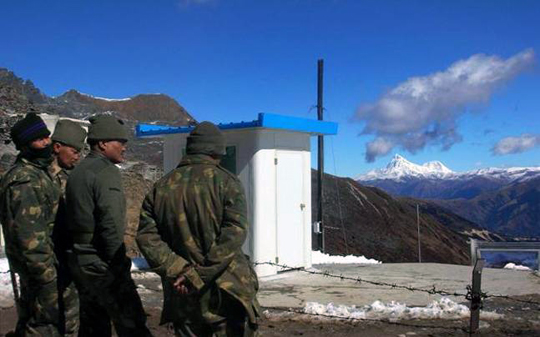
India brought in more troops after the destruction of two of its bunkers and "aggressive tactics" adopted by the Chinese People's Liberation Army (PLA), sources said. In a "non- combative mode", the nozzle of a gun is placed downwards.
Giving details for the first time about the events that preceded the face off between the two armies, the sources said the PLA on June 1 asked the Indian Army to remove the two bunkers set up in 2012 at Lalten in Doka La, which falls in the vicinity of Chumbi Valley at the corner of India-Bhutan- Tibet tri-junction.
The Indian Army, which had been patrolling this area for many years, decided in 2012 that two bunkers would be positioned there as a backup option, besides providing security to the Bhutan-China border.
The Indian Army forward positions informed Sukna-based 33 Corps Headquarter in North Bengal about the Chinese warnings on the bunkers, the sources said.
However, during the night of June 6, two Chinese bulldozers destroyed the bunkers, claiming that the area belonged to China and that India or Bhutan had no right over it, the sources said.
Indian troops on the ground prevented the Chinese men and machines from doing any further damage or transgressing into the area, they said.
Additional forces from nearby brigade headquarters, located 20 km from the face off point, were moved in on June 8 during which a scuffle led to soldiers on both sides suffering minor injuries.
PLA troops were rushed in from its 141 division located in the area, prompting the Indian Army to also strengthen its position.
This is the longest standoff between the two armies since 1962. The last one, which carried on for 21 days, occurred at Daulat Beg Oldie in the Ladakh division of Jammu and Kashmir in 2013, when Chinese troops entered 30 km into Indian territory till the Depsang Plains and claimed it to be a part of its Xinjiang province. They were, however, pushed back.
Sikkim, which became a part of India in May 1976, is the only state which has a demarcated border with China. The lines are based on a treaty signed with the Chinese in 1898.
After the India-China war of 1962, the area where the Indian troops are stationed was placed under the Indian Army and the ITBP, which is the border guarding force and has a camp 15 km from the international border.
As the scuffle broke out between the two sides, the Indian Army rushed an officer of the Major General rank to the area and a flag meeting was sought with the Chinese counterparts.
China rejected two such requests from the Indian side, but accepted the third call for a meeting, where it asked the Indian Army to withdraw its troops from the Lalten area, which falls in Doka La.
Doka La is the Indian name for the region which Bhutan recognises as Dokalam, while China claims it to be part of its Donglang region.
As a fallout of the standoff, the Chinese refused to allow the first batch of 47 pilgrims, who were to conduct the annual Kailash Mansarovar Yatra, into Tibet. They also conveyed to the Indian side that visas of another batch of 50 yatris had also been cancelled, the sources said, describing the move as an indication of "increased tempers" in Beijing.
The Sikkim route to Mansarovar, which is in Tibet, was opened in 2015, enabling pilgrims to travel the 1500-km long route from Nathu La to Kailash by buses.
It is not the first time that such a transgression has happened at Doka La. The Chinese forces had in November 2008 destroyed some makeshift Indian army bunkers there.
Defence experts believe China wants to exert its dominance over the Chumbi Valley, which is a part of the southern reaches of Tibet. By claiming the Doka La area, Beijing wants to maximise its geographical advantage so that it can monitor all movements along the India-Bhutan border.
China has also increased diplomatic pressure on India and lodged a protest over the alleged "crossing of boundary" by Indian troops in the Sikkim section.
They demanded their immediate withdrawal, as Beijing warned that future visits of Indian pilgrims to Kailash Mansarovar would depend on the resolution of the standoff.
"Our position to uphold our territorial sovereignty is unwavering. We hope the Indian side can work with China in the same direction and immediately withdraw the personnel who have overstepped and trespassed into Chinese border," Chinese Foreign Ministry spokesman Lu Kang had told the media in Beijing last week.
People's Liberation Army spokesman Col Wu Qian also spoke a tough language while making a reference to the 1962 Sino- India conflict, saying that New Delhi should "learn historical lessons".
Qian described Indian Army Chief General Bipin Rawat's remarks that India was ready for a "two-and-a-half front war" as "extremely irresponsible" and asked him to "stop clamouring for war".
Rawat had said India was prepared for security threats posed by China, Pakistan as well as by internal threats.
"Such rhetoric is extremely irresponsible. We hope that the particular person in the Indian Army could learn from historical lessons and stop such clamouring for war," he had said.
The Defence Minister,Arun Jaitley, made New Delhi's stand clear when he said the India of 2017 was different from that of 1962.
"If they are trying to remind us, the situation in 1962 was different and the India of 2017 is different," Jaitley had said when asked about China's warning.
Of the 3,488-km-long India-China border from Jammu and Kashmir to Arunachal Pradesh, a 220-km section falls in Sikkim.


Comments
Add new comment