



India pushes troops in Doka La in longest impasse since 1962

Agencies
July 2, 2017

New Delhi, Jul 2: India has pushed in more troops in a "non-combative mode" to strengthen its position in an area near Sikkim, where its soldiers have been locked in a standoff with Chinese troops for almost a month now in what has been the longest such impasse between the two armies since 1962.
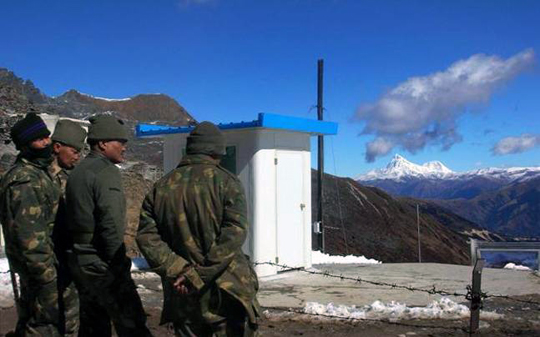
doka

India brought in more troops after the destruction of two of its bunkers and "aggressive tactics" adopted by the Chinese People's Liberation Army (PLA), sources said. In a "non- combative mode", the nozzle of a gun is placed downwards.

Giving details for the first time about the events that preceded the face off between the two armies, the sources said the PLA on June 1 asked the Indian Army to remove the two bunkers set up in 2012 at Lalten in Doka La, which falls in the vicinity of Chumbi Valley at the corner of India-Bhutan- Tibet tri-junction.

The Indian Army, which had been patrolling this area for many years, decided in 2012 that two bunkers would be positioned there as a backup option, besides providing security to the Bhutan-China border.

The Indian Army forward positions informed Sukna-based 33 Corps Headquarter in North Bengal about the Chinese warnings on the bunkers, the sources said.

However, during the night of June 6, two Chinese bulldozers destroyed the bunkers, claiming that the area belonged to China and that India or Bhutan had no right over it, the sources said.

Indian troops on the ground prevented the Chinese men and machines from doing any further damage or transgressing into the area, they said.

Additional forces from nearby brigade headquarters, located 20 km from the face off point, were moved in on June 8 during which a scuffle led to soldiers on both sides suffering minor injuries.

PLA troops were rushed in from its 141 division located in the area, prompting the Indian Army to also strengthen its position.

This is the longest standoff between the two armies since 1962. The last one, which carried on for 21 days, occurred at Daulat Beg Oldie in the Ladakh division of Jammu and Kashmir in 2013, when Chinese troops entered 30 km into Indian territory till the Depsang Plains and claimed it to be a part of its Xinjiang province. They were, however, pushed back.

Sikkim, which became a part of India in May 1976, is the only state which has a demarcated border with China. The lines are based on a treaty signed with the Chinese in 1898.

After the India-China war of 1962, the area where the Indian troops are stationed was placed under the Indian Army and the ITBP, which is the border guarding force and has a camp 15 km from the international border.

As the scuffle broke out between the two sides, the Indian Army rushed an officer of the Major General rank to the area and a flag meeting was sought with the Chinese counterparts.

China rejected two such requests from the Indian side, but accepted the third call for a meeting, where it asked the Indian Army to withdraw its troops from the Lalten area, which falls in Doka La.

Doka La is the Indian name for the region which Bhutan recognises as Dokalam, while China claims it to be part of its Donglang region.

As a fallout of the standoff, the Chinese refused to allow the first batch of 47 pilgrims, who were to conduct the annual Kailash Mansarovar Yatra, into Tibet. They also conveyed to the Indian side that visas of another batch of 50 yatris had also been cancelled, the sources said, describing the move as an indication of "increased tempers" in Beijing.

The Sikkim route to Mansarovar, which is in Tibet, was opened in 2015, enabling pilgrims to travel the 1500-km long route from Nathu La to Kailash by buses.

It is not the first time that such a transgression has happened at Doka La. The Chinese forces had in November 2008 destroyed some makeshift Indian army bunkers there.

Defence experts believe China wants to exert its dominance over the Chumbi Valley, which is a part of the southern reaches of Tibet. By claiming the Doka La area, Beijing wants to maximise its geographical advantage so that it can monitor all movements along the India-Bhutan border.

China has also increased diplomatic pressure on India and lodged a protest over the alleged "crossing of boundary" by Indian troops in the Sikkim section.

They demanded their immediate withdrawal, as Beijing warned that future visits of Indian pilgrims to Kailash Mansarovar would depend on the resolution of the standoff.

"Our position to uphold our territorial sovereignty is unwavering. We hope the Indian side can work with China in the same direction and immediately withdraw the personnel who have overstepped and trespassed into Chinese border," Chinese Foreign Ministry spokesman Lu Kang had told the media in Beijing last week.

People's Liberation Army spokesman Col Wu Qian also spoke a tough language while making a reference to the 1962 Sino- India conflict, saying that New Delhi should "learn historical lessons".

Qian described Indian Army Chief General Bipin Rawat's remarks that India was ready for a "two-and-a-half front war" as "extremely irresponsible" and asked him to "stop clamouring for war".

Rawat had said India was prepared for security threats posed by China, Pakistan as well as by internal threats.

"Such rhetoric is extremely irresponsible. We hope that the particular person in the Indian Army could learn from historical lessons and stop such clamouring for war," he had said.

The Defence Minister,Arun Jaitley, made New Delhi's stand clear when he said the India of 2017 was different from that of 1962.

"If they are trying to remind us, the situation in 1962 was different and the India of 2017 is different," Jaitley had said when asked about China's warning.

Of the 3,488-km-long India-China border from Jammu and Kashmir to Arunachal Pradesh, a 220-km section falls in Sikkim.

Comments

Add new comment

  • Coastaldigest.com reserves the right to delete or block any comments.
  • Coastaldigset.com is not responsible for its readers’ comments.
  • Comments that are abusive, incendiary or irrelevant are strictly prohibited.
  • Please use a genuine email ID and provide your name to avoid reject.
Agencies
March 6,2020

Thiruvananthapuram, Mar 6: A 12-member team from Telangana on Friday visited Kerala to study how the state contained the spread of novel coronavirus.

Interacting with the team, Kerala Health Minister KK Shailaja said, "The team will be given a presentation at National Health Mission and they will visit Alappuzha district to know how the health facilities are set up by Kerala Health Department on the grassroots level."

"The team comprising doctors and senior health officials will visit the control room set up by the Health Department and also will attend daily review meetings. They will also visit an isolation ward in the hospital and interact with doctors and nurses, " the minister said.

She added, "Kerala model is being followed by other states too. All states are working together and the country as a whole is fighting the coronavirus. They are sharing our experience. All of India is standing together. Contact tracing and isolation is the most important part."

Dr Mahaboob Khan, part of the Telangana team told media persons, that the discussion with the health minister was fruitful.

"Kerala was the first state in India where a positive coronavirus case was reported. All three positive cases reported have been discharged after testing negative. So we wanted to study how Kerala was able to contain it and the health system in place here, " he said.

Comments

Add new comment

  • Coastaldigest.com reserves the right to delete or block any comments.
  • Coastaldigset.com is not responsible for its readers’ comments.
  • Comments that are abusive, incendiary or irrelevant are strictly prohibited.
  • Please use a genuine email ID and provide your name to avoid reject.
News Network
January 28,2020

New Delhi, Jan 28: Kolkata Metro Rail Corp expects to complete its East-West project, which runs partly under the city’s iconic Hooghly river, by March 2022 after a delay of several years doubled costs.

The authority is awaiting a final installment of Rs 20 crore ($2.8 million) over the next two years from the Indian Railway Board, said Manas Sarkar, managing director at KMRC. A soft loan of Rs 4,160 crore from Japan International Cooperation Agency helps fund 48.5% of the project.

India’s oldest metro, which started in 1984 with a North-South service, was due to expand by 2014 but faced problems including squatters on the planned route. These issues have contributed to the total project cost rising to about Rs 8,600 crore for some 17 kilometers from Rs 4,900 crore for 14 km.

“About 40% of total transport demand will be tackled by these two metro services,” Sarkar said in an interview at his office in Kolkata. “It will be a relief for environmental pollution and the city should be much more decongested.”

The new line is expected to carry about 900,000 people daily, -- roughly 20% of the city’s population -- and will take less than a minute to cross a 520-meter underwater tunnel. Depending on the time of day, it takes some 20 minutes to use the ferry and anywhere upward of an hour to cross the Howrah bridge.

KMRC will repay the JICA loan over 30 years after an initial six-year moratorium. The interest rate is between 1.2% to 1.6%. The East-West metro project is 74% owned by the railway ministry and 26% by the ministry of housing and urban affairs.

“We don’t anticipate any further cost escalation now,” Sarkar said.

Comments

Add new comment

  • Coastaldigest.com reserves the right to delete or block any comments.
  • Coastaldigset.com is not responsible for its readers’ comments.
  • Comments that are abusive, incendiary or irrelevant are strictly prohibited.
  • Please use a genuine email ID and provide your name to avoid reject.
News Network
January 1,2020

Pune, Jan 1: Maharashtra Deputy Chief Minister Ajit Pawar and Vanchit Bahujan Aghadi president Prakash Ambedkar paid tributes at the 'Jay Stambh' near here on Wednesday on the 202nd anniversary of Koregaon Bhima battle.

Lakhs of people congregate every year at the 'Jay Stambh' (victory pillar) near Koregaon Bhima village to offer tributes on the anniversary of the battle, which was fought on January 1, 1818 between the British East India Company and the Peshwa faction of the Maratha Confederacy.

Violence broke out during the bicentenary celebrations of the Koregaon Bhima battle on January 1, 2018 in which one person was killed and several others were injured.

Police have made elaborate security arrangements to ensure no untoward incident takes place during the congregation at the victory pillar, an official said.

Talking to reporters after visiting the victory pillar, Pawar said he came to offer tributes on behalf of the people of Maharashtra.

"This pillar has history and every year lakhs of people come here. Some untoward incidents took place two years ago, but the government is taking utmost care and elaborate police bandobast has been made here to ensure that no untoward incident takes place," he said.

Pawar also urged people to visit the war memorial in a peaceful manner.

"I appeal to people to come here and offer their tributes, but maintain peace and do not believe in rumours," the NCP leader said.

Prakash Ambedkar also offered his tributes at the victory pillar.

Pune Police last week issued notices to several people, including right-wing leaders Milind Ekbote and Sambhaji Bhide, and members of Kabir Kala Manch, barring them from entering the district for four days from December 29.

The notices, as part of preventive action, were issued to all those against whom cases were registered in connection with the violence two years ago.

Ekbote was arrested in March 2018 for allegedly instigating and orchestrating the violence around Koregaon Bhima.

Bhide was also booked and named in the FIR, but never arrested.

The police attributed the violence to the Elgar Parishad conclave held here on December 31, 2017, where provocative speeches were allegedly made.

They are also probing the alleged "Maoist link" of some activists to the Elgar Parishad conclave.

Several Dalit groups observe the anniversary of the Koregaon Bhima battle, in which the British defeated the Peshwas of Maharashtra.

The memorial, located at Perne village on Pune- Ahmednagar road, was constructed by the British in the memory of soldiers who died in the battle.

Dalit leaders commemorate the British victory as soldiers from the Mahar community were part of the East India Company's forces.

The Peshwas were Brahmins, and the victory is seen as a symbol of assertiveness by Dalits.

Comments

Add new comment

  • Coastaldigest.com reserves the right to delete or block any comments.
  • Coastaldigset.com is not responsible for its readers’ comments.
  • Comments that are abusive, incendiary or irrelevant are strictly prohibited.
  • Please use a genuine email ID and provide your name to avoid reject.