



India pushes troops in Doka La in longest impasse since 1962

Agencies
July 2, 2017

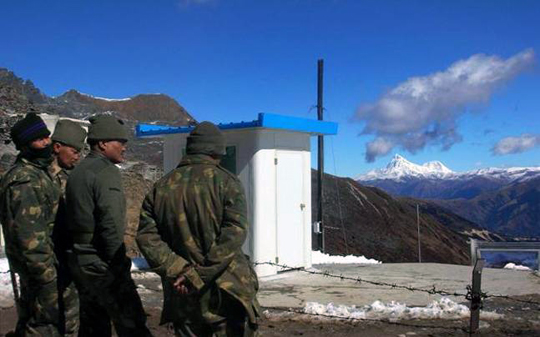
New Delhi, Jul 2: India has pushed in more troops in a "non-combative mode" to strengthen its position in an area near Sikkim, where its soldiers have been locked in a standoff with Chinese troops for almost a month now in what has been the longest such impasse between the two armies since 1962.
doka

India brought in more troops after the destruction of two of its bunkers and "aggressive tactics" adopted by the Chinese People's Liberation Army (PLA), sources said. In a "non- combative mode", the nozzle of a gun is placed downwards.

Giving details for the first time about the events that preceded the face off between the two armies, the sources said the PLA on June 1 asked the Indian Army to remove the two bunkers set up in 2012 at Lalten in Doka La, which falls in the vicinity of Chumbi Valley at the corner of India-Bhutan- Tibet tri-junction.

The Indian Army, which had been patrolling this area for many years, decided in 2012 that two bunkers would be positioned there as a backup option, besides providing security to the Bhutan-China border.

The Indian Army forward positions informed Sukna-based 33 Corps Headquarter in North Bengal about the Chinese warnings on the bunkers, the sources said.

However, during the night of June 6, two Chinese bulldozers destroyed the bunkers, claiming that the area belonged to China and that India or Bhutan had no right over it, the sources said.

Indian troops on the ground prevented the Chinese men and machines from doing any further damage or transgressing into the area, they said.

Additional forces from nearby brigade headquarters, located 20 km from the face off point, were moved in on June 8 during which a scuffle led to soldiers on both sides suffering minor injuries.

PLA troops were rushed in from its 141 division located in the area, prompting the Indian Army to also strengthen its position.

This is the longest standoff between the two armies since 1962. The last one, which carried on for 21 days, occurred at Daulat Beg Oldie in the Ladakh division of Jammu and Kashmir in 2013, when Chinese troops entered 30 km into Indian territory till the Depsang Plains and claimed it to be a part of its Xinjiang province. They were, however, pushed back.

Sikkim, which became a part of India in May 1976, is the only state which has a demarcated border with China. The lines are based on a treaty signed with the Chinese in 1898.

After the India-China war of 1962, the area where the Indian troops are stationed was placed under the Indian Army and the ITBP, which is the border guarding force and has a camp 15 km from the international border.

As the scuffle broke out between the two sides, the Indian Army rushed an officer of the Major General rank to the area and a flag meeting was sought with the Chinese counterparts.

China rejected two such requests from the Indian side, but accepted the third call for a meeting, where it asked the Indian Army to withdraw its troops from the Lalten area, which falls in Doka La.

Doka La is the Indian name for the region which Bhutan recognises as Dokalam, while China claims it to be part of its Donglang region.

As a fallout of the standoff, the Chinese refused to allow the first batch of 47 pilgrims, who were to conduct the annual Kailash Mansarovar Yatra, into Tibet. They also conveyed to the Indian side that visas of another batch of 50 yatris had also been cancelled, the sources said, describing the move as an indication of "increased tempers" in Beijing.

The Sikkim route to Mansarovar, which is in Tibet, was opened in 2015, enabling pilgrims to travel the 1500-km long route from Nathu La to Kailash by buses.

It is not the first time that such a transgression has happened at Doka La. The Chinese forces had in November 2008 destroyed some makeshift Indian army bunkers there.

Defence experts believe China wants to exert its dominance over the Chumbi Valley, which is a part of the southern reaches of Tibet. By claiming the Doka La area, Beijing wants to maximise its geographical advantage so that it can monitor all movements along the India-Bhutan border.

China has also increased diplomatic pressure on India and lodged a protest over the alleged "crossing of boundary" by Indian troops in the Sikkim section.

They demanded their immediate withdrawal, as Beijing warned that future visits of Indian pilgrims to Kailash Mansarovar would depend on the resolution of the standoff.

"Our position to uphold our territorial sovereignty is unwavering. We hope the Indian side can work with China in the same direction and immediately withdraw the personnel who have overstepped and trespassed into Chinese border," Chinese Foreign Ministry spokesman Lu Kang had told the media in Beijing last week.

People's Liberation Army spokesman Col Wu Qian also spoke a tough language while making a reference to the 1962 Sino- India conflict, saying that New Delhi should "learn historical lessons".

Qian described Indian Army Chief General Bipin Rawat's remarks that India was ready for a "two-and-a-half front war" as "extremely irresponsible" and asked him to "stop clamouring for war".

Rawat had said India was prepared for security threats posed by China, Pakistan as well as by internal threats.

"Such rhetoric is extremely irresponsible. We hope that the particular person in the Indian Army could learn from historical lessons and stop such clamouring for war," he had said.

The Defence Minister,Arun Jaitley, made New Delhi's stand clear when he said the India of 2017 was different from that of 1962.

"If they are trying to remind us, the situation in 1962 was different and the India of 2017 is different," Jaitley had said when asked about China's warning.

Of the 3,488-km-long India-China border from Jammu and Kashmir to Arunachal Pradesh, a 220-km section falls in Sikkim.

Comments

Add new comment

  • Coastaldigest.com reserves the right to delete or block any comments.
  • Coastaldigset.com is not responsible for its readers’ comments.
  • Comments that are abusive, incendiary or irrelevant are strictly prohibited.
  • Please use a genuine email ID and provide your name to avoid reject.
News Network
April 16,2020

Kochi, Apr 16: A middle-aged man carrying his ailing father on his shoulders walked close to one-kilometre in Kerala’s Punalur when the autorickshaw he was driving was allegedly stopped by the police over the ongoing lockdown. He was bringing back his father from the hospital after he was discharged on Wednesday.

In a video that has gone viral on social media, the man can be seen carrying his bare-bodied father on the shoulders and struggling to handle the weight while a woman carrying the hospital documents, prescriptions and other items, is running along with him.

The incident took place in Punalur town of Kollam district.

The 65-year-old man, a native of Kulathupuzha, was released from the Punalur Taluk Hospital and his son was taking him home when he was stopped on the road. The man has alleged that even after he produced hospital documents, the police refused to let him pass with the autorickshaw.

The vehicle was stopped about a kilometre from their house in the middle of a traffic jam and the family had to walk the rest of the path. He said even after he told the police and showed papers from hospital he was not allowed to go.

After the video went viral in Kerala, the state human rights commission took suo motu cognizance of the incident.

The nationwide lockdown has prevented all non-essential movement in the public space while medical emergencies have been allowed. The extended lockdown will now continue till May 3.

According to the police, the vehicle did not have the patient when it was stopped. The driver was asked to show a declaration document.

He stepped out of the vehicle and walked to the hospital which was 200 metres from the checkpoint and returned carrying his father on the back, said the police.

Comments

Add new comment

  • Coastaldigest.com reserves the right to delete or block any comments.
  • Coastaldigset.com is not responsible for its readers’ comments.
  • Comments that are abusive, incendiary or irrelevant are strictly prohibited.
  • Please use a genuine email ID and provide your name to avoid reject.
Agencies
January 20,2020

New Delhi, Jan 20: The BJP has got a brand new President in the form of JP Nadda. At around 2.30 pm, the announcement was made, bringing an end to the Amit Shah era in BJP. The party's Working President Jagat Prakash Nadda won unopposed, sparking celebrations outside the BJP headquarters here on Monday. 

Amit Shah himself was among the people who proposed Nadda's name along with Nitin Gadkari and Rajnath Singh. Soon after his annointment, BJP election returning officer Radha Mohan Singh told the media, "I announce JP Nadda as the new BJP President." Shah was also seen hugging Nadda.

The nomination process for the post of the BJP President began at 10 am and went on till 12.30 pm. For the next hour, the filed nomination paper, which was just one, was examined. Party members waitied till 2.30 pm for the candidate to withdraw if he wished to. It was after this that Nadda was declared as the man who would step into the shoes of Amit Shah.

Many in the BJP believe that although Nadda is the BJP chief now, Shah would still make all macro-level decisions like pre poll alliances or top organisational appointments. Nadda would be in charge of monitoring the day-to-day needs of the organisation. BJP sources say that Amit Shah himself wanted an arrangement like this one and personally wanted Nadda to take over. as he helped Shah formulate legislations like Triple Talaq and Citizenship Amendment Act.

The party constitution mandates completion of election of at least 50 per cent of state Presidents for the election of national President to happen. In the last few days, the BJP has completed the election of a slew of state Presidents like in West Bengal, Nagaland among others.

The process of election of the national BJP President is quite elaborate and has been described in detail in the party constitution, which says that the national president shall be elected by an electoral college, comprising members of the national council and the state councils.

"Any 20 members of the electoral college of a state can jointly propose the name of a person, who has been an active member for four terms and has 15 years of membership, for the post of national president. Such joint proposal should come from not less than five states where elections have been completed for the national council. The consent of the candidate is necessary," it says.

Who is JP Nadda?

Jagat Prakash Nadda, 59, who has his roots in the Rashtriya Swayamsevak Sangh (RSS) and its affiliates, was appointed the Bharatiya Janata Party (BJP) national President on Monday, replacing his 'mentor' and Union Home Minister Amit Shah.

Former environment, health and law minister from Himachal Pradesh, which has just four of the Lok Sabha's 543 seats, Nadda has tried to carve out his own space in national politics with his low profile and astute organisational skills, believe his party leaders.

He rose through the ranks from the Akhil Bharatiya Vidyarthi Parishad (ABVP), the student wing of the RSS, from where he has managed to build inroads from university to the state politics.

Nadda has been active on the national political scene since 2010 when he was picked by then BJP chief Nitin Gadkari to join his new team. He was made the party's national general secretary.

Born on December 2, 1960, Nadda did his graduation from Patna and holds a post-graduate degree in political science and Bachelor of Legislative Law (LL.B) from Himachal Pradesh University in Shimla.

Starting his political career as a student leader of the ABVP in 1978, Nadda had also worked both with Gadkari and Shah even in the party's youth wing -- the Bharatiya Yuva Morcha -- from 1991 to 1994.

His wife Mallika Nadda, who teaches history at the Himachal Pradesh University and is currently posted in university's campus in Delhi, was an ABVP activist too, and its national general secretary from 1988 to 1999.

In the previous BJP government (2007-12) in the state, Nadda was forced to resign as Forest Minister in 2010 owing to differences between him and then chief minister Prem Kumar Dhumal.

He was elected to the Rajya Sabha in 2012.

Nadda won his first Assembly election from Bilaspur (Sadar) in Himachal in 1993. In 1998, he again won from that seat and became the state Health Minister.

He lost the Assembly elections in 2003, but again won in 2007 and was appointed the Forest Minister in the Himachal Pradesh.

Nadda, as a forest minister, was the brain behind opening forest police stations to check forest crimes, launching community-driven plantation, setting up forest ponds and the massive plantation of deodars to boost the depleting green cover of the 'Queen of Hills', as Shimla was fondly called by the British.

A close confidant of Prime Minister Narendra Modi, Nadda was among those who were mentioned as likely aspirants to the BJP top post after Rajnath Singh was inducted into the Central government as the Home Minister in 2014.

Later, Nadda was inducted into the union cabinet in its first expansion in 2014 as the Health Minister.

Hailing Nadda's appointment, Chief Minister Jai Ram Thakur told IANS it is a proud moment that a leader belonging to a small state in the national politics is today the leader of the country's biggest national party.

His father N.L. Nadda, who was a Vice-Chancellor of the Ranchi University, resides in Bilaspur town.

Comments

Add new comment

  • Coastaldigest.com reserves the right to delete or block any comments.
  • Coastaldigset.com is not responsible for its readers’ comments.
  • Comments that are abusive, incendiary or irrelevant are strictly prohibited.
  • Please use a genuine email ID and provide your name to avoid reject.
Agencies
April 13,2020

With the beginning of Ramzan just about 10 days away, Maulana Khalid Rashid Firangi Mahali, the chairperson of the Islamic Centre of India and the Imam of Aishbagh Eidgah has issued an advisory to people on how to observe Ramzan during the lockdown.

In his appeal, the Sunni cleric, who is a member of the All India Muslim Personal Law Board (AIMPLB), has urged people that the holy month of Ramzan is likely to begin from April 25. The lockdown may also be extended beyond April 14.

"In this case, it is advised that people observe roza (fast) and do iftar (meal to break the fast) in the evenings at their homes. There should be no congregational prayers in the mosque but only at homes. Only those who stay or are staying at a mosque should pray there and that too while maintaining adequate social distance," said Maulana Khalid Rashid Firangi Mahali in a video message.

The cleric, in the 12-point advisory, has asked people to fast as is mandatory in Islam and to pray for the end of the pandemic, during the month of worship.

The advisory says that those who used to arrange for iftar of poor and needy persons at the mosque, should continue to do so this year as well but the food should be distributed to the needy.

"Those who conducted Iftar parties in Ramzan should give the money kept for it in charity. Not more than five people should be present at any time at a mosque," the cleric added.

Earlier for April 8 and April 9, both Shia and Sunni clerics had appealed to the people to stay indoors and pray on the occasion of Shab-e-Baraat, respectively. To ensure full compliance of the lockdown, the gates of several graveyards in the city were locked up by the caretakers since traditionally Muslims visit graves of their ancestors on Shab-e-Baraat--the night of Allah's forgiveness, to pray for their ancestors.

Comments

Add new comment

  • Coastaldigest.com reserves the right to delete or block any comments.
  • Coastaldigset.com is not responsible for its readers’ comments.
  • Comments that are abusive, incendiary or irrelevant are strictly prohibited.
  • Please use a genuine email ID and provide your name to avoid reject.