


India tops global slavery index with 18.35 mn people enslaved

May 31, 2016

Melbourne, May 31: India has the dubious distinction of having the highest number of people in the world trapped in modern slavery with 18.35 million victims of forced labour, ranging from prostitution and begging, according to a new report, which estimated that nearly 46 million people are enslaved globally.
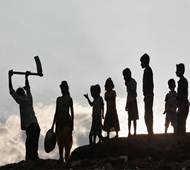
slavery copy copyAccording to the 2016 Global Slavery Index released by Australia-based human rights group Walk Free Foundation today, an estimated 45.8 million people, including women and children, are subject to some form of modern slavery in the world, compared to 35.8 million in 2014.

The report said India has the highest absolute numbers of people trapped in slavery with 18.35 million slaves among its 1.3 billion population while North Korea has the highest incidence (4.37 per cent of the population) and the weakest government response to deal with it.

In the last report in 2014, India had nearly 14.3 million people enslaved.
Incidences of slavery were found in all 167 countries in the index, with Asian countries occupy the top five for people trapped in slavery.

Behind India was China (3.39 million), Pakistan (2.13 million), Bangladesh (1.53 million) and Uzbekistan (1.23 million).

The index said that these five countries combined accounted for almost 58 per cent of the world's enslaved, or 26.6 million people.

The Index presents a ranking of 167 countries based on the proportion of the population that is estimated to be in modern slavery.

Modern slavery refers to situations of exploitation that a person cannot leave because of threats, violence, coercion, abuse of power or deception.

The research included over 42,000 interviews conducted in 53 languages across 25 countries, including 15 state-level surveys in India. These representative surveys covered 44 per cent of the global population.

The countries with the highest estimated prevalence of modern slavery by the proportion of their population are North Korea, Uzbekistan, Cambodia, Cambodia, India, and Qatar.

The countries with the lowest estimated prevalence of modern slavery by the proportion of their population are Luxembourg, Ireland, Norway, Denmark, Switzerland, Austria, Sweden and Belgium, the United States and Canada, and Australia and New Zealand.

The study also tracked the government actions and responses to the modern slavery and of the 161 assessed, 124 nations had criminalised human trafficking in line with the UN trafficking Protocol and 96 nations had developed national action plans to coordinate government response.

It noted that while India had more people enslaved than any other country, it had made significant progress in introducing measures to tackle the problem.

"It has criminalised trafficking, slavery, forced labour, child prostitution and forced marriage. The Indian government is currently tightening legislation against human trafficking, with tougher punishment for repeat offenders. It will offer victims protection and recovery support," it said.

It said that in addition to economic growth in India, ambitious programmes of legal and social reform are being undertaken right across the board, from regulation of labour relations to systems of social insurance for the most vulnerable.

Those governments taking the least action to combat modern slavery are North Korea, Iran, Eritrea, Equatorial Guinea, Hong Kong, Central African Republic, Papua New Guinea, Guinea, the Democratic Republic of the Congo and South Sudan.

The governments that have the strongest response to modern slavery are The Netherlands, the United States of America, the United Kingdom, Sweden, Australia, Portugal, Croatia, Spain, Belgium and Norway.

Seeking strong laws to abolish slavery, Andrew Forrest, Chairman and Founder of Walk Free Foundation, said eradicating slavery makes sense, morally, politically, logically and economically, and called on the governments of the world's leading economies to provide an example to others by enacting and implementing robust anti-slavery measures.

"We call on governments of the top 10 economies of the world to enact laws, at least as strong as the UK Modern Slavery Act 2015, with a budget and capability to ensure organisations are held to account for modern slavery in their supply chains, and to empower independent oversight."

Forrest said leaders of the world's major economies must bring the power of business to this issue, by requiring a focus on supply chain transparency.

"I believe in the critical role of leaders in government, business and civil society. Through our responsible use of power, strength of conviction, determination and collective will, we all can lead the world to end slavery," he said.

Forrest emphasised the key role that business needs to play in eradicating slavery.

"Businesses that don't actively look for forced labour within their supply chains are standing on a burning platform. Business leaders who refuse to look into the realities of their own supply chains are misguided and irresponsible," he said.

Comments

SK
 - 
Thursday, 2 Jun 2016

Since India is facing slavery, Naren has run away to Singapore to enjoy snake/ dog/cat/beef dishes......

Naren kotian
 - 
Tuesday, 31 May 2016

In that mostly 75% are from Muslim community as they enslave women as per their cult following .they have not changed since 6th century ...che papa ...ummah gang ge pitta netti geriruthe ..feku Anthe kumda ...for Muslims he might be feku ..but for nationalist Indians he is true hero who is transforming India .

Add new comment

  • Coastaldigest.com reserves the right to delete or block any comments.
  • Coastaldigset.com is not responsible for its readers’ comments.
  • Comments that are abusive, incendiary or irrelevant are strictly prohibited.
  • Please use a genuine email ID and provide your name to avoid reject.
News Network
March 27,2020

Kollam, Mar 27: A young IAS officer in Kerala has been booked by police after he left the state violating instructions to remain under home quarantine following his recent return from honeymoon abroad, officials said on Friday.

A First Information Report has been registered against Kollam sub-collector Anupam Mishra, who hails from Uttar Pradesh, based on a report from the Health department about the violation, Kollam Superintendent of Police T Narayanan said.

Describing the action of the officer as a “serious matter”, District Collector B. Abdul Nasser said Mishra had returned to Kerala on March 19 from his Malaysia-Singapore trip and was advised to remain under quarantine, as per the protocol for overseas returnees in the backdrop of coronavirus outbreak.

On his return to Kerala from the foreign trip, Mishra had undergone medical examination and did not show symptoms. His personal staff, including gunman, have also been kept under observation.

However, the officer had left for his brother’s place in Bengaluru without informing anyone, Nasser said.

When the Collector got in touch with him, Mishra informed him that he was in Bengaluru.

“He was on leave after his marriage and took permission to travel to Malaysia and Singapore. On his return I advised him to remain under home quarantine. Seems like he left to be with his family at Bengaluru,” Nasser told PTI.

However, police said Mishra’s mobile tower location shows Kanpur in Uttar Pradesh.

Authorities came to know on Thursday that Mishra, who had been staying alone in his quarters at Kollam, was not there after health department staff, who regularly visit people in quarantine, found the lights in his house switched off, police sources said.

“The officer has gone without prior permission or leave. He did not have any symptoms of the virus. Without informing us, he left. It is a serious matter, the collector said adding Mishra has been asked to provide his current address and travel details to Bengaluru.”

When an officer leaves his jurisdiction, he is supposed to inform the government, which Mishra did not do. He has also not taken prior permission for leaving the state, the later told reporters.

Coronavirus: Conflicts on hold for now as players face a common enemy
 China bars foreign visitors as imported COVID-19 cases rise
The state government has sought an explanation from the officer in this regard.

A case has been registered against him under various sections of the Indian Penal Code including 188 (disobedience to order duly promulgated by public servant), 269 (Negligent Act likely to spread infection of disease dangerous to life) and 271 (disobedience to quarantine rule), police said.

Kollam, is the only district in the state, which has not reported any positive case of COVID-19 so far. A total of 176 positive cases have been reported in the state so far.

Comments

Add new comment

  • Coastaldigest.com reserves the right to delete or block any comments.
  • Coastaldigset.com is not responsible for its readers’ comments.
  • Comments that are abusive, incendiary or irrelevant are strictly prohibited.
  • Please use a genuine email ID and provide your name to avoid reject.
coastaldigest.com news network
May 31,2020

Bengaluru, May 31: With places of worship expected to reopen on June 8, the Karnataka State Minorities Commission has released guidelines for mosques and dargahs, that include social distancing, temperature testing and compulsory hand washing.

Abdul Azeem, commission chairman said, "Everyone will have to maintain one-metre distance and carry their prayer mats. They will all be scanned and Farz prayers will be held for 10-15 minutes. Friday prayers should be completed within 20 minutes."

Distribution of tabarukh, shaking hands, and overcrowding inside mosques will not be allowed.  The Muzrai department also issued guidelines for temples, like mandatory face masks, sanitisation of sanctum sanctorum and thermal screening.

In a letter, the Hindu Religious Institutions and Charitable Endowment Department mentioned that while temple authorities and devotees should wear masks, priests, helpers and workers are exempt, in the core area of the temple.

"Devotees should be scanned using infrared thermometers at the temple entrance, and must be given hand sanitiser. The temple trust is expected to bear the expenses," it added.

Comments

Add new comment

  • Coastaldigest.com reserves the right to delete or block any comments.
  • Coastaldigset.com is not responsible for its readers’ comments.
  • Comments that are abusive, incendiary or irrelevant are strictly prohibited.
  • Please use a genuine email ID and provide your name to avoid reject.
News Network
April 11,2020

Bengaluru, Apr 10: Renowned ophthalmologist and Narayana Nethralaya Chairman Dr K Bhujang Shetty today advised those wearing contact lenses to switch to eyeglasses as a preventive measure.

“Though the facial mask is mandatory as a preventive measure against the dreaded Coronavirus, not many know that the virus can also enter the body through eyes. Wearing glasses or spectacles reduces the spread of the virus,” Dr Bhujang Shetty said.

Although it is more likely that people may catch Coronavirus infections through mouth and nose, there are chances of the virus also entering through eyes. “In a day, humans tend to touch their face and eyes almost 20 times an hour knowingly or unknowingly. Users of contact lenses end up touching their eyes and face frequently, increasing the risk of infections. Therefore, it is advisable that they switch to eyeglasses until the situation improves”, according to a release here on Friday.

Comments

Add new comment

  • Coastaldigest.com reserves the right to delete or block any comments.
  • Coastaldigset.com is not responsible for its readers’ comments.
  • Comments that are abusive, incendiary or irrelevant are strictly prohibited.
  • Please use a genuine email ID and provide your name to avoid reject.