



India tops global slavery index with 18.35 mn people enslaved

May 31, 2016

Melbourne, May 31: India has the dubious distinction of having the highest number of people in the world trapped in modern slavery with 18.35 million victims of forced labour, ranging from prostitution and begging, according to a new report, which estimated that nearly 46 million people are enslaved globally.
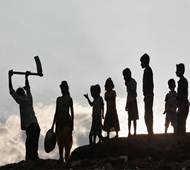
slavery copy copyAccording to the 2016 Global Slavery Index released by Australia-based human rights group Walk Free Foundation today, an estimated 45.8 million people, including women and children, are subject to some form of modern slavery in the world, compared to 35.8 million in 2014.

The report said India has the highest absolute numbers of people trapped in slavery with 18.35 million slaves among its 1.3 billion population while North Korea has the highest incidence (4.37 per cent of the population) and the weakest government response to deal with it.

In the last report in 2014, India had nearly 14.3 million people enslaved.
Incidences of slavery were found in all 167 countries in the index, with Asian countries occupy the top five for people trapped in slavery.

Behind India was China (3.39 million), Pakistan (2.13 million), Bangladesh (1.53 million) and Uzbekistan (1.23 million).

The index said that these five countries combined accounted for almost 58 per cent of the world's enslaved, or 26.6 million people.

The Index presents a ranking of 167 countries based on the proportion of the population that is estimated to be in modern slavery.

Modern slavery refers to situations of exploitation that a person cannot leave because of threats, violence, coercion, abuse of power or deception.

The research included over 42,000 interviews conducted in 53 languages across 25 countries, including 15 state-level surveys in India. These representative surveys covered 44 per cent of the global population.

The countries with the highest estimated prevalence of modern slavery by the proportion of their population are North Korea, Uzbekistan, Cambodia, Cambodia, India, and Qatar.

The countries with the lowest estimated prevalence of modern slavery by the proportion of their population are Luxembourg, Ireland, Norway, Denmark, Switzerland, Austria, Sweden and Belgium, the United States and Canada, and Australia and New Zealand.

The study also tracked the government actions and responses to the modern slavery and of the 161 assessed, 124 nations had criminalised human trafficking in line with the UN trafficking Protocol and 96 nations had developed national action plans to coordinate government response.

It noted that while India had more people enslaved than any other country, it had made significant progress in introducing measures to tackle the problem.

"It has criminalised trafficking, slavery, forced labour, child prostitution and forced marriage. The Indian government is currently tightening legislation against human trafficking, with tougher punishment for repeat offenders. It will offer victims protection and recovery support," it said.

It said that in addition to economic growth in India, ambitious programmes of legal and social reform are being undertaken right across the board, from regulation of labour relations to systems of social insurance for the most vulnerable.

Those governments taking the least action to combat modern slavery are North Korea, Iran, Eritrea, Equatorial Guinea, Hong Kong, Central African Republic, Papua New Guinea, Guinea, the Democratic Republic of the Congo and South Sudan.

The governments that have the strongest response to modern slavery are The Netherlands, the United States of America, the United Kingdom, Sweden, Australia, Portugal, Croatia, Spain, Belgium and Norway.

Seeking strong laws to abolish slavery, Andrew Forrest, Chairman and Founder of Walk Free Foundation, said eradicating slavery makes sense, morally, politically, logically and economically, and called on the governments of the world's leading economies to provide an example to others by enacting and implementing robust anti-slavery measures.

"We call on governments of the top 10 economies of the world to enact laws, at least as strong as the UK Modern Slavery Act 2015, with a budget and capability to ensure organisations are held to account for modern slavery in their supply chains, and to empower independent oversight."

Forrest said leaders of the world's major economies must bring the power of business to this issue, by requiring a focus on supply chain transparency.

"I believe in the critical role of leaders in government, business and civil society. Through our responsible use of power, strength of conviction, determination and collective will, we all can lead the world to end slavery," he said.

Forrest emphasised the key role that business needs to play in eradicating slavery.

"Businesses that don't actively look for forced labour within their supply chains are standing on a burning platform. Business leaders who refuse to look into the realities of their own supply chains are misguided and irresponsible," he said.

Comments

SK
 - 
Thursday, 2 Jun 2016

Since India is facing slavery, Naren has run away to Singapore to enjoy snake/ dog/cat/beef dishes......

Naren kotian
 - 
Tuesday, 31 May 2016

In that mostly 75% are from Muslim community as they enslave women as per their cult following .they have not changed since 6th century ...che papa ...ummah gang ge pitta netti geriruthe ..feku Anthe kumda ...for Muslims he might be feku ..but for nationalist Indians he is true hero who is transforming India .

Add new comment

  • Coastaldigest.com reserves the right to delete or block any comments.
  • Coastaldigset.com is not responsible for its readers’ comments.
  • Comments that are abusive, incendiary or irrelevant are strictly prohibited.
  • Please use a genuine email ID and provide your name to avoid reject.
Charan Kumar | coastaldigest.com
June 24,2020

Bengaluru, June 24: City-based I Monetary Advisory (IMA), which duped thousands of families, mostly Muslims, in the name of halal investment, has become a bitter reality of "we were robbed by our own people". All the accused except its CEO Mohammad Mansoor Khan have been released on bail in this ponzi scam worth thousands of crores of rupees.

The scam has not only been investigated by SIT and CBI, but it has reverberated many times in the Assembly, corridors of power, and in the courts.

Around 80,000 investors are in trouble after the Monetary Advisory (IMA) scam came to light. Many investors have left this world, many families have split, many marriages have broken down and many have become unemployed, homeless, helpless and hapless. One of the senior IAS office, who had faced arrest in the scam, reportedly killed himself just a day ago.

It has been more than a year since this multi-billion scam came to light. But the affected families still do not see any ray of hope. The government, led by senior IAS officer Harsh Gupta, has set up a special competent authority to address investor grievances in the matter.

According to information provided by Harsh Gupta, investors have to be paid Rs 2,900 crore. But the value of the company's assets seized so far could be around Rs 450 crore. The process of auctioning the assets has not started yet. The authority has developed an online portal for submission of claim forms from investors. But the process of taking applications has not started yet. Syed Gulab, a social worker overseeing the case, says that after all the claim forms have been submitted, we will get a clear picture about the exact number of investors and the total amount of arrears. But this process may take a few more months to complete.

Senior journalist Maqbool Ahmed Siraj says that IMA has systematically deceived people in the name of halal investment through capital scheme. In 2006, Muhammad Mansoor Khan, a one-time small businessman, set up a company. He began to attract large number of investors by creating the greed for more profit among middle class and poor people.

By 2015, the company had received money from more than 12,000 investors and continued to pay monthly profits. By the time the company closed in 2019, 80,000 people had invested their hard-earned money here. In Bengaluru, the company expanded its reach by investing in two major gold showrooms, hospitals, schools, several medical stores, a publishing center, a supermarket, and real estate firm.

Mr Siraj says that Mansoor Khan and his team not only lured the poor and middle class to pursue their own interests but also created a favourable atmosphere for their so called business by winning the hearts of politicians, government officials, clerics, religious institutions and media.

Unsuspecting people invested their money in a bid to make more profit in less time. When the company stopped making profits and Mansoor Khan suddenly fled on June 9, 2019, the investors woke up the to the reality.

Apart from residents of Bengaluru and other parts of Karnataka, people from Tamil Nadu, Andhra Pradesh, Telangana, Maharashtra other states also have invested their money.

Comments

Add new comment

  • Coastaldigest.com reserves the right to delete or block any comments.
  • Coastaldigset.com is not responsible for its readers’ comments.
  • Comments that are abusive, incendiary or irrelevant are strictly prohibited.
  • Please use a genuine email ID and provide your name to avoid reject.
News Network
May 30,2020

Istanbul: Mosques in Turkey reopened on Friday for mass prayers after more than two months as the government further eased strict restrictions to stop the spread of the new coronavirus.

Turkey has been shifting since May to a "new normal" by easing lockdown measures and opening shopping malls, barbershops and hair salons.

President Recep Tayyip Erdogan has said many other sites -- restaurants and cafes as well as libraries, parks and beaches -- will reopen from Monday.

Hundreds of worshippers wearing protective masks performed mass prayers outside Istanbul's historic Blue Mosque for the first time since mosques were shut down in March.

In the Ottoman-era Fatih mosque, worshippers prayed both inside and outside, with the municipality handing out disinfectants and disposable carpets.

"I have waited a lot for this, I have prayed a lot. I can say it's like a new birth, thanks to God, he has brought us back here," he said.

Another worshipper, Asum Tekif, 50, said: "It has a been a long time... we missed the mosques."

Turkey, a country of 83 million, has so far recorded 4,489 coronavirus-related deaths and 162,120 confirmed cases.

Prayers in Hagia Sophia

Muslim clerics on Friday recited prayers in the Hagia Sophia, the world famous Istanbul landmark which is now a museum after serving as a church and a mosque.

The prayers were held to celebrate the anniversary of the conquest of Constantinople, today's Istanbul, by the Ottomans in 1453.

"It is very important to commemorate the 567th anniversary of the conquest ... through prayers in the Hagia Sophia," said President Recep Tayyip Erdogan, who attended the ceremony via videoconference.

The stunning edifice was first built as a church in the sixth century under the Byzantine Empire as the centrepiece of its capital Constantinople.

After the Ottoman conquest, it was converted into a mosque before being turned into a museum during the rule of Mustafa Kemal Ataturk, the founder of modern Turkey, in the 1930s.

But there have been hints about reconverting the Hagia Sophia into a mosque. Last year, Erdogan himself mooted the possibility of turning Hagia Sofia museum into a mosque.

Such calls have sparked anger among Christians and raised tensions with neighbouring Greece.

In 2015, a Muslim cleric recited the Koran in the Hagia Sophia for the first time in 85 years to mark the opening of an exhibition.

After Friday prayers at the Blue Mosque, a small group of Muslim worshippers shouted: "Let the chains break and let the Hagia Sophia open".

The group was later dispersed by the police who stopped them from protesting near Hagia Sophia that sits immediately opposite the Blue Mosque.

Comments

Add new comment

  • Coastaldigest.com reserves the right to delete or block any comments.
  • Coastaldigset.com is not responsible for its readers’ comments.
  • Comments that are abusive, incendiary or irrelevant are strictly prohibited.
  • Please use a genuine email ID and provide your name to avoid reject.
coastaldigest.com news network
July 9,2020

Mangaluru, Jul 9: The coastal district of Dakshina Kannada today recorded death of two coronavirus patients.

Meanwhile, the district today also recorded 167 new covid cases taking the total number of cases to 1701.

Yesterday, the district had recorded 183 cases. Today more cases were reported from Bantwal and Ullal regions. 

According to sources, a 48-year-old man from Boloor, who was under treatment for covid-19 at designated covid hospital passed away today. 

A 62-year-old covid patient, who had SARI symptoms, breathed his last at a private hospital.

With this, the total number of deaths of covid-19 patients in the district reached 30 including two deaths caused by other reasons.

Of the 167 who tested positive on Thursday, 110 are males and 57 females including seven children.

Three have returned from Qatar and Dubai, one from Bengaluru, 42 are diagnosed with influenza-like illness (ILI), six are diagnosed with severe acute respiratory illness (SARI) and 64 are primary contacts of earlier patients. Contact tracing process of 38 patients is on, and 13 pre-surgery samples.

Comments

Add new comment

  • Coastaldigest.com reserves the right to delete or block any comments.
  • Coastaldigset.com is not responsible for its readers’ comments.
  • Comments that are abusive, incendiary or irrelevant are strictly prohibited.
  • Please use a genuine email ID and provide your name to avoid reject.