


India tops global slavery index with 18.35 mn people enslaved

May 31, 2016

Melbourne, May 31: India has the dubious distinction of having the highest number of people in the world trapped in modern slavery with 18.35 million victims of forced labour, ranging from prostitution and begging, according to a new report, which estimated that nearly 46 million people are enslaved globally.
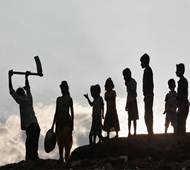
slavery copy copyAccording to the 2016 Global Slavery Index released by Australia-based human rights group Walk Free Foundation today, an estimated 45.8 million people, including women and children, are subject to some form of modern slavery in the world, compared to 35.8 million in 2014.

The report said India has the highest absolute numbers of people trapped in slavery with 18.35 million slaves among its 1.3 billion population while North Korea has the highest incidence (4.37 per cent of the population) and the weakest government response to deal with it.

In the last report in 2014, India had nearly 14.3 million people enslaved.
Incidences of slavery were found in all 167 countries in the index, with Asian countries occupy the top five for people trapped in slavery.

Behind India was China (3.39 million), Pakistan (2.13 million), Bangladesh (1.53 million) and Uzbekistan (1.23 million).

The index said that these five countries combined accounted for almost 58 per cent of the world's enslaved, or 26.6 million people.

The Index presents a ranking of 167 countries based on the proportion of the population that is estimated to be in modern slavery.

Modern slavery refers to situations of exploitation that a person cannot leave because of threats, violence, coercion, abuse of power or deception.

The research included over 42,000 interviews conducted in 53 languages across 25 countries, including 15 state-level surveys in India. These representative surveys covered 44 per cent of the global population.

The countries with the highest estimated prevalence of modern slavery by the proportion of their population are North Korea, Uzbekistan, Cambodia, Cambodia, India, and Qatar.

The countries with the lowest estimated prevalence of modern slavery by the proportion of their population are Luxembourg, Ireland, Norway, Denmark, Switzerland, Austria, Sweden and Belgium, the United States and Canada, and Australia and New Zealand.

The study also tracked the government actions and responses to the modern slavery and of the 161 assessed, 124 nations had criminalised human trafficking in line with the UN trafficking Protocol and 96 nations had developed national action plans to coordinate government response.

It noted that while India had more people enslaved than any other country, it had made significant progress in introducing measures to tackle the problem.

"It has criminalised trafficking, slavery, forced labour, child prostitution and forced marriage. The Indian government is currently tightening legislation against human trafficking, with tougher punishment for repeat offenders. It will offer victims protection and recovery support," it said.

It said that in addition to economic growth in India, ambitious programmes of legal and social reform are being undertaken right across the board, from regulation of labour relations to systems of social insurance for the most vulnerable.

Those governments taking the least action to combat modern slavery are North Korea, Iran, Eritrea, Equatorial Guinea, Hong Kong, Central African Republic, Papua New Guinea, Guinea, the Democratic Republic of the Congo and South Sudan.

The governments that have the strongest response to modern slavery are The Netherlands, the United States of America, the United Kingdom, Sweden, Australia, Portugal, Croatia, Spain, Belgium and Norway.

Seeking strong laws to abolish slavery, Andrew Forrest, Chairman and Founder of Walk Free Foundation, said eradicating slavery makes sense, morally, politically, logically and economically, and called on the governments of the world's leading economies to provide an example to others by enacting and implementing robust anti-slavery measures.

"We call on governments of the top 10 economies of the world to enact laws, at least as strong as the UK Modern Slavery Act 2015, with a budget and capability to ensure organisations are held to account for modern slavery in their supply chains, and to empower independent oversight."

Forrest said leaders of the world's major economies must bring the power of business to this issue, by requiring a focus on supply chain transparency.

"I believe in the critical role of leaders in government, business and civil society. Through our responsible use of power, strength of conviction, determination and collective will, we all can lead the world to end slavery," he said.

Forrest emphasised the key role that business needs to play in eradicating slavery.

"Businesses that don't actively look for forced labour within their supply chains are standing on a burning platform. Business leaders who refuse to look into the realities of their own supply chains are misguided and irresponsible," he said.

Comments

SK
 - 
Thursday, 2 Jun 2016

Since India is facing slavery, Naren has run away to Singapore to enjoy snake/ dog/cat/beef dishes......

Naren kotian
 - 
Tuesday, 31 May 2016

In that mostly 75% are from Muslim community as they enslave women as per their cult following .they have not changed since 6th century ...che papa ...ummah gang ge pitta netti geriruthe ..feku Anthe kumda ...for Muslims he might be feku ..but for nationalist Indians he is true hero who is transforming India .

Add new comment

  • Coastaldigest.com reserves the right to delete or block any comments.
  • Coastaldigset.com is not responsible for its readers’ comments.
  • Comments that are abusive, incendiary or irrelevant are strictly prohibited.
  • Please use a genuine email ID and provide your name to avoid reject.
News Network
May 19,2020

Bengaluru, May 19: Containment zones in Karnataka will be much smaller in size under the latest lockdown norms. However, rules and loopholes will be tightened and action against violators will be stringent in order to check the spread of the disease.

Revised guidelines issued by the Centre to the state, reveal containment zones are delineated based on mapping of cases and contacts. Intensive action will be carried out in these areas with the aim of breaking the chain of transmission. Therefore, the area of a containment zone should be appropriately defined by the district administration/local urban bodies with technical inputs at local level.

The health department is considering shrinking the size of containment zones from the existing 100 metres to open up more space for economic activities. Medical education minister K Sudhakar, also a member of the Covid taskforce, said additional chief secretary (health department) Javed Akthar will issue a new definition of a containment zone after the Covid-19 taskforce holds its next meeting.

“We are planning to further shrink it and restrict containment zones to an apartment complex, independent house or even a lane where the Covid-19 patient resides,” Sudhakar said. He went on to say bigger containment zones will impede businesses and normal activities in the vicinity, something which the government wants to avoid.

The minister said Karnataka will also do away with colour-coding districts. “With restrictions being relaxed for almost all activities, it does not make sense to pursue with colour codes. It is either containment zone or outside containment zone,” he said.

In rural areas, the minister said containment zones will be identified by the taluk heads. Government sources say it is difficult to restrict activities to certain areas or smaller location in rural areas as farmers and people will have to travel to the outskirts of their villages for their livelihood.

An official said, a containment operation (large outbreak or cluster) is deemed successful when no case is reported in 28 days from the containment zone.

Comments

Add new comment

  • Coastaldigest.com reserves the right to delete or block any comments.
  • Coastaldigset.com is not responsible for its readers’ comments.
  • Comments that are abusive, incendiary or irrelevant are strictly prohibited.
  • Please use a genuine email ID and provide your name to avoid reject.
News Network
April 17,2020

Bengaluru, Apr 17: Forty-four new cases of coronavirus have been reported in the State till now, said Karnataka's Health Department on Friday.

"44 new COVID-19 cases reported in the State from 5 pm Thursday to 5 pm on Friday. The total number of positive cases in the State is 359 including 13 deaths and 88 discharges," said the Health Department.

Meanwhile, a meeting was convened to review the situation on the rising cases of coronavirus in the State. According to Karnataka Chief Minister's Office (CMO), the meeting was attended by Chief Minister BS Yediyurappa, Home Minister Basavaraja Bommai, Health Minister B Sriramulu, and Deputy Chief Minister Ashwath Narayan.

The CMO said: "Earlier we used to do 500 tests per day. Now we are doing 2,000 tests. The suggestion was made to take care of the people who are in the ICU to prevent death. It was suggested and planned to work out a protocol for the treatment of COVID-19 patients all over the state."

The meeting also stressed the need for plasma treatment. Experts opined that people having influenza-like symptoms like fever, cold, breathlessness, etc., need to get tested for COVID 19.

The CMO said: "Officers were directed to conduct tests of the people with influenza-like symptoms in the districts where nil cases have been reported. ICMR has issued circular to set up two labs in each district and one lab in each medical college. In this direction, efforts are being made to set up 10 more labs in the State by the end of April."

"It was also decided to be prepared for treating an increased number of patients after relaxing in lockdown. It was also decided to issue guidelines to companies that would start working after relaxing lockdown. It was also decided to appeal to people to download Arogya Setu App. We will meet on April 21 again to decide further course of action," added the CMO.

Comments

Add new comment

  • Coastaldigest.com reserves the right to delete or block any comments.
  • Coastaldigset.com is not responsible for its readers’ comments.
  • Comments that are abusive, incendiary or irrelevant are strictly prohibited.
  • Please use a genuine email ID and provide your name to avoid reject.
News Network
May 6,2020

Dubai, May 6: The Indian nationals cleared by the UAE health authorities and found to be asymptomatic will only be allowed to fly back home in one of India's biggest ever repatriation exercises, the Indian Embassy in Abu Dhabi has said ahead of the first set of flights on Thursday.

On Monday, the Indian government announced plans to begin a phased repatriation of its citizens stranded abroad from May 7. Air India will operate 64 flights from May 7 to May 13 to bring back around 15,000 Indian nationals stranded abroad amid the COVID-19-induced lockdown, India's Civil Aviation Minister Hardeep Singh Puri said on Tuesday.

The first two special flights that will operate from Thursday to evacuate Indians stranded in the UAE due to the coronavirus pandemic will begin with applicants from Kerala, who formed the majority of the expatriates who have registered to be repatriated from here, Indian Ambassador to the UAE Pavan Kapoor has said.

"All departing passengers will have to undergo medical screening and IGM/IGG test at the departure airport and only those cleared by the UAE health authorities and found to be asymptomatic will be allowed to board the plane,” the Indian Embassy in Abu Dhabi said on Tuesday.

According to the embassy, all passengers will be required to sign an undertaking to undergo compulsory quarantine at the destination of arrival and bear the cost of the same.

“Each passenger, at the time of boarding would be handed over a safety kit containing 2 three-layered face masks, 2 pairs of gloves and pouches/small bottles of hand sanitizers. While on board the flight, the health protocol of the Ministry of Civil Aviation of India will be strictly followed,” said the embassy.

The passenger lists for the two flights on May 7 have been finalised by the Embassy / Consulate and sent to Air India Express for issue of tickets.

The Embassy / Consulate will continue conveying the details of further special flights as and when they are announced by the Government of India, over the next few days.

Less than 2,000 Indians wishing to return home from the UAE will be flown to six Indian states in the first week of India’s biggest ever repatriation exercise named Vande Bharat Mission—sans social distancing and COVID-19 tests, the Gulf News reported.

Only those cleared by the UAE health authorities and found to be asymptomatic will be allowed to board the plane.

The short-listed applicants, who were contacted by the Indian missions on Tuesday to purchase tickets for the first two flights to Kerala on Thursday, told the Gulf News that the tickets are priced around Dh 725 to Dh 750 (over Rs 15,000).

Sharjah resident Rasheed Thayyil said his 70-year-old mother Nepheeza Thottungal, who came on a visit to the UAE in February, received an email from the Indian Consulate in Dubai which quoted an airfare of around Dh725 (approx Rs 15,000), the report said.

Another applicant from Abu Dhabi Ambily Babu said she purchased a ticket at Dh 750 from Air India Express for her Abu Dhabi-Kochi flight scheduled to fly on Thursday evening, it said.

Air India Express which is set to operate the first two flights to Kerala on Thursday will operate its Boeing 737-800 aircraft, with a seating capacity of 186 economy class seats, the report added.

With nine seats reserved for isolation, only 177 passengers would be flown, it said.

The Indian expatriate community of approximately 3.42 million is reportedly the largest ethnic community in the UAE constituting roughly about 30 per cent of the country's population, according to information available on the Indian Embassy website.

Comments

Add new comment

  • Coastaldigest.com reserves the right to delete or block any comments.
  • Coastaldigset.com is not responsible for its readers’ comments.
  • Comments that are abusive, incendiary or irrelevant are strictly prohibited.
  • Please use a genuine email ID and provide your name to avoid reject.