


India tops global slavery index with 18.35 mn people enslaved

May 31, 2016

Melbourne, May 31: India has the dubious distinction of having the highest number of people in the world trapped in modern slavery with 18.35 million victims of forced labour, ranging from prostitution and begging, according to a new report, which estimated that nearly 46 million people are enslaved globally.
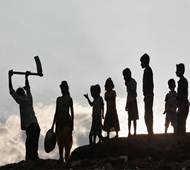
slavery copy copyAccording to the 2016 Global Slavery Index released by Australia-based human rights group Walk Free Foundation today, an estimated 45.8 million people, including women and children, are subject to some form of modern slavery in the world, compared to 35.8 million in 2014.

The report said India has the highest absolute numbers of people trapped in slavery with 18.35 million slaves among its 1.3 billion population while North Korea has the highest incidence (4.37 per cent of the population) and the weakest government response to deal with it.

In the last report in 2014, India had nearly 14.3 million people enslaved.
Incidences of slavery were found in all 167 countries in the index, with Asian countries occupy the top five for people trapped in slavery.

Behind India was China (3.39 million), Pakistan (2.13 million), Bangladesh (1.53 million) and Uzbekistan (1.23 million).

The index said that these five countries combined accounted for almost 58 per cent of the world's enslaved, or 26.6 million people.

The Index presents a ranking of 167 countries based on the proportion of the population that is estimated to be in modern slavery.

Modern slavery refers to situations of exploitation that a person cannot leave because of threats, violence, coercion, abuse of power or deception.

The research included over 42,000 interviews conducted in 53 languages across 25 countries, including 15 state-level surveys in India. These representative surveys covered 44 per cent of the global population.

The countries with the highest estimated prevalence of modern slavery by the proportion of their population are North Korea, Uzbekistan, Cambodia, Cambodia, India, and Qatar.

The countries with the lowest estimated prevalence of modern slavery by the proportion of their population are Luxembourg, Ireland, Norway, Denmark, Switzerland, Austria, Sweden and Belgium, the United States and Canada, and Australia and New Zealand.

The study also tracked the government actions and responses to the modern slavery and of the 161 assessed, 124 nations had criminalised human trafficking in line with the UN trafficking Protocol and 96 nations had developed national action plans to coordinate government response.

It noted that while India had more people enslaved than any other country, it had made significant progress in introducing measures to tackle the problem.

"It has criminalised trafficking, slavery, forced labour, child prostitution and forced marriage. The Indian government is currently tightening legislation against human trafficking, with tougher punishment for repeat offenders. It will offer victims protection and recovery support," it said.

It said that in addition to economic growth in India, ambitious programmes of legal and social reform are being undertaken right across the board, from regulation of labour relations to systems of social insurance for the most vulnerable.

Those governments taking the least action to combat modern slavery are North Korea, Iran, Eritrea, Equatorial Guinea, Hong Kong, Central African Republic, Papua New Guinea, Guinea, the Democratic Republic of the Congo and South Sudan.

The governments that have the strongest response to modern slavery are The Netherlands, the United States of America, the United Kingdom, Sweden, Australia, Portugal, Croatia, Spain, Belgium and Norway.

Seeking strong laws to abolish slavery, Andrew Forrest, Chairman and Founder of Walk Free Foundation, said eradicating slavery makes sense, morally, politically, logically and economically, and called on the governments of the world's leading economies to provide an example to others by enacting and implementing robust anti-slavery measures.

"We call on governments of the top 10 economies of the world to enact laws, at least as strong as the UK Modern Slavery Act 2015, with a budget and capability to ensure organisations are held to account for modern slavery in their supply chains, and to empower independent oversight."

Forrest said leaders of the world's major economies must bring the power of business to this issue, by requiring a focus on supply chain transparency.

"I believe in the critical role of leaders in government, business and civil society. Through our responsible use of power, strength of conviction, determination and collective will, we all can lead the world to end slavery," he said.

Forrest emphasised the key role that business needs to play in eradicating slavery.

"Businesses that don't actively look for forced labour within their supply chains are standing on a burning platform. Business leaders who refuse to look into the realities of their own supply chains are misguided and irresponsible," he said.

Comments

SK
 - 
Thursday, 2 Jun 2016

Since India is facing slavery, Naren has run away to Singapore to enjoy snake/ dog/cat/beef dishes......

Naren kotian
 - 
Tuesday, 31 May 2016

In that mostly 75% are from Muslim community as they enslave women as per their cult following .they have not changed since 6th century ...che papa ...ummah gang ge pitta netti geriruthe ..feku Anthe kumda ...for Muslims he might be feku ..but for nationalist Indians he is true hero who is transforming India .

Add new comment

  • Coastaldigest.com reserves the right to delete or block any comments.
  • Coastaldigset.com is not responsible for its readers’ comments.
  • Comments that are abusive, incendiary or irrelevant are strictly prohibited.
  • Please use a genuine email ID and provide your name to avoid reject.
News Network
January 1,2020

Bengaluru, Jan 1: Elaborate security arrangements have been made in view of Prime Minister Narendra Modi's two-day visit to Karnataka on January 2 and 3, officials said.

The Special Protection Group officials had a meeting with state government officials, especially the police regarding the security arrangements.

During his stay in Tumakuru, drones will not be allowed and anybody violating the direction will face stringent action, said a notification issued by Deputy Commissioner of the district Dr Rakesh Kumar.

According to the tour itinerary, the Prime Minister will reach Bengaluru on January 2 and fly to Tumakuru by a helicopter to visit Sri Siddaganga Math.

PM Modi will later take part in the Krishi Karman Awards function at the Junior College grounds where he will address a gathering and distribute fishing equipment, a government press release said.

The same evening he will return to Bengaluru to visit the Defence Research and Development Organisation. He will stay at the Raj Bhavan.

The next day, the Prime Minister will inaugurate the 107th Indian Science Congress at the Gandhi Krishi Vignana Kendra Campus at the University of Agricultural Sciences in Bengaluru, before flying to New Delhi in the afternoon.

To oversee the arrangements, Chief Minister BS Yediyurappa visited Tumakuru on Tuesday and held a meeting with officials.

Speaking to reporters later, Mr Yediyurappa said PM Modi will reach Siddaganga Math at 2.15 p.m where he will pay his obeisance to the seer there.

He will be in the town till 5.30 p.m on January 2, he added.

"Later, he will take part in the Krishi Karman and Krishi Samman Awards function which about 1.5 lakh people are likely to attend. He is going to give awards to 28 progressive farmers from 21 states," said the Chief Minister.

Comments

Add new comment

  • Coastaldigest.com reserves the right to delete or block any comments.
  • Coastaldigset.com is not responsible for its readers’ comments.
  • Comments that are abusive, incendiary or irrelevant are strictly prohibited.
  • Please use a genuine email ID and provide your name to avoid reject.
News Network
July 6,2020

Riyadh, July 6: The government of Saudi Arabia has announced health protocols to prevent the spread of the new coronavirus in the 2020 Hajj season, banning gatherings and meetings between pilgrims.

Saudi Arabia decided in June to limit the number of domestic pilgrims attending the Hajj to around 1,000 to prevent the spread of the coronavirus, after barring pilgrims abroad from the rite for the first year in modern times.

Touching the Kaaba, the holiest site in Islam, will be banned during the Hajj this year, and a social distancing space of a meter and a half between each pilgrim during the rituals including mass prayers and while in the Kaaba circling area will be imposed, a statement by the Center for Disease Prevention and Control (CDC) elaborated.

Also, access to holy Hajj sites at Mina, Muzdalifah and Arafat will be limited to those with Hajj permits starting Sunday July 19 till Aug. 2 2020, and wearing masks all the time will be mandatory for both pilgrims and organisers.

Comments

Add new comment

  • Coastaldigest.com reserves the right to delete or block any comments.
  • Coastaldigset.com is not responsible for its readers’ comments.
  • Comments that are abusive, incendiary or irrelevant are strictly prohibited.
  • Please use a genuine email ID and provide your name to avoid reject.
News Network
January 25,2020

Bengaluru, Jan 25: Several women have completed a 24-hour protest here against the Citizenship Amendment Act (CAA) and are going strong to stretch it to 48 hours.

"More than a thousand women gathered on the Masjid Road at Frazer Town to denounce the CAA and National Register of Citizens (NRC)," participant and Mount Carmel College student Noor Zahira told IANS.

The women protesters extended their support to the students in Jamia Millia Islamia, the Aligarh Muslim University, the Jawaharlal Nehru University and others who were recently roughed up allegedly by police and masked goons.

Zahira, 20, said the women's protest was planned only for 24 hours but is continuing to touch 48 hours.

Starting 3pm on Thursday, the women, several of them in burqas, niqabs and hijabs, are sitting on the road just outside the Haji Sait mosque in Frazer Town in a flash protest. Though they have informed the police, they did not wait for the permission. Around 11 pm, police arrived and shut off the protesters' loud speakers.

Zahira said already four such women's anti-CAA protests were taken out in Bengaluru. Women from all ages groups have joined the protest and are sloganeering.

As the women are protesting on the road, men are guarding them standing on the opposite road, ensuring all supplies such as food and others to them, she added.

"Muslim women were not alone in denouncing the CAA... we were joined by the transgenders, Hindu women, Christian women, Dalits and others, " she said.

Some of the protesters also indulged in creative work such as composing songs against the CAA and making placards.

Though four anti-CAA women's protests happened at the Town Hall and other landmarks in Bengaluru, they were only a few hours long.

The protesting women are also showing support to women protesters at Shaheen Bagh in Delhi who were accused of demonstrating for Rs 500. However, the protest did not align anti-CAA demonstration with any political party, keeping it apolitical.

Comments

Add new comment

  • Coastaldigest.com reserves the right to delete or block any comments.
  • Coastaldigset.com is not responsible for its readers’ comments.
  • Comments that are abusive, incendiary or irrelevant are strictly prohibited.
  • Please use a genuine email ID and provide your name to avoid reject.