


India tops global slavery index with 18.35 mn people enslaved

May 31, 2016

Melbourne, May 31: India has the dubious distinction of having the highest number of people in the world trapped in modern slavery with 18.35 million victims of forced labour, ranging from prostitution and begging, according to a new report, which estimated that nearly 46 million people are enslaved globally.
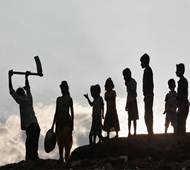
slavery copy copyAccording to the 2016 Global Slavery Index released by Australia-based human rights group Walk Free Foundation today, an estimated 45.8 million people, including women and children, are subject to some form of modern slavery in the world, compared to 35.8 million in 2014.

The report said India has the highest absolute numbers of people trapped in slavery with 18.35 million slaves among its 1.3 billion population while North Korea has the highest incidence (4.37 per cent of the population) and the weakest government response to deal with it.

In the last report in 2014, India had nearly 14.3 million people enslaved.
Incidences of slavery were found in all 167 countries in the index, with Asian countries occupy the top five for people trapped in slavery.

Behind India was China (3.39 million), Pakistan (2.13 million), Bangladesh (1.53 million) and Uzbekistan (1.23 million).

The index said that these five countries combined accounted for almost 58 per cent of the world's enslaved, or 26.6 million people.

The Index presents a ranking of 167 countries based on the proportion of the population that is estimated to be in modern slavery.

Modern slavery refers to situations of exploitation that a person cannot leave because of threats, violence, coercion, abuse of power or deception.

The research included over 42,000 interviews conducted in 53 languages across 25 countries, including 15 state-level surveys in India. These representative surveys covered 44 per cent of the global population.

The countries with the highest estimated prevalence of modern slavery by the proportion of their population are North Korea, Uzbekistan, Cambodia, Cambodia, India, and Qatar.

The countries with the lowest estimated prevalence of modern slavery by the proportion of their population are Luxembourg, Ireland, Norway, Denmark, Switzerland, Austria, Sweden and Belgium, the United States and Canada, and Australia and New Zealand.

The study also tracked the government actions and responses to the modern slavery and of the 161 assessed, 124 nations had criminalised human trafficking in line with the UN trafficking Protocol and 96 nations had developed national action plans to coordinate government response.

It noted that while India had more people enslaved than any other country, it had made significant progress in introducing measures to tackle the problem.

"It has criminalised trafficking, slavery, forced labour, child prostitution and forced marriage. The Indian government is currently tightening legislation against human trafficking, with tougher punishment for repeat offenders. It will offer victims protection and recovery support," it said.

It said that in addition to economic growth in India, ambitious programmes of legal and social reform are being undertaken right across the board, from regulation of labour relations to systems of social insurance for the most vulnerable.

Those governments taking the least action to combat modern slavery are North Korea, Iran, Eritrea, Equatorial Guinea, Hong Kong, Central African Republic, Papua New Guinea, Guinea, the Democratic Republic of the Congo and South Sudan.

The governments that have the strongest response to modern slavery are The Netherlands, the United States of America, the United Kingdom, Sweden, Australia, Portugal, Croatia, Spain, Belgium and Norway.

Seeking strong laws to abolish slavery, Andrew Forrest, Chairman and Founder of Walk Free Foundation, said eradicating slavery makes sense, morally, politically, logically and economically, and called on the governments of the world's leading economies to provide an example to others by enacting and implementing robust anti-slavery measures.

"We call on governments of the top 10 economies of the world to enact laws, at least as strong as the UK Modern Slavery Act 2015, with a budget and capability to ensure organisations are held to account for modern slavery in their supply chains, and to empower independent oversight."

Forrest said leaders of the world's major economies must bring the power of business to this issue, by requiring a focus on supply chain transparency.

"I believe in the critical role of leaders in government, business and civil society. Through our responsible use of power, strength of conviction, determination and collective will, we all can lead the world to end slavery," he said.

Forrest emphasised the key role that business needs to play in eradicating slavery.

"Businesses that don't actively look for forced labour within their supply chains are standing on a burning platform. Business leaders who refuse to look into the realities of their own supply chains are misguided and irresponsible," he said.

Comments

SK
 - 
Thursday, 2 Jun 2016

Since India is facing slavery, Naren has run away to Singapore to enjoy snake/ dog/cat/beef dishes......

Naren kotian
 - 
Tuesday, 31 May 2016

In that mostly 75% are from Muslim community as they enslave women as per their cult following .they have not changed since 6th century ...che papa ...ummah gang ge pitta netti geriruthe ..feku Anthe kumda ...for Muslims he might be feku ..but for nationalist Indians he is true hero who is transforming India .

Add new comment

  • Coastaldigest.com reserves the right to delete or block any comments.
  • Coastaldigset.com is not responsible for its readers’ comments.
  • Comments that are abusive, incendiary or irrelevant are strictly prohibited.
  • Please use a genuine email ID and provide your name to avoid reject.
News Network
February 19,2020

Bengaluru, Feb 19: Pointing out that there was a deliberate attempt to cover up police excesses by implicating innocent persons at whim, the Karnataka High Court on Tuesday granted conditional bail to 21 people who were accused by police of involving in violence during the protests against the Citizenship Amendment Act (CAA) in Mangaluru.

Allowing the bail petitions of Ashik and 20 others from Udupi and Dakshina Kannada districts, Justice John Michael Cunha said the overzealousness of the police is also evident from the fact that FIRs were registered under Section 307 of IPC against the persons killed by the police themselves.

“In an offence involving a large number of people, the identity and participation of each accused must be fixed with reasonable certainty. In the present cases, the identity appears to have been fixed on the basis of their affiliation to PFI and they being members of the Muslim community. Though it is stated that the involvement of the petitioners is captured in CCTV footage and photographs, no such material is produced before the court showing the presence of any of the petitioners at the spot, armed with deadly weapons,” the judge noted.

In the statement of objections filed by the State Public Prosecutor-I, it was stated that there was a hint of Muslim youths holding protest on December 19, 2019, opposing the implementation of CAA. Prohibitory orders were clamped in that connection. This assertion indicated that the common object of the assembly was to oppose the implementation of CAA and National Register for Citizens (NRC) which, by itself, was not an “unlawful object”, the judge pointed out.

‘Pics show cops throwing stones at crowd’

Justice Cunha also said the material collected by the investigators did not contain any specific evidence regarding the presence of any of the petitioners at the spot. On the other hand, omnibus allegations were made against the Muslim crowd of 1,500-2,000, alleging that they were armed with weapons like stones, soda bottles and glass pieces. The photographs produced by the SPP depicted that hardly any member of the crowd were armed with weapons, except one of them holding a bottle. In none of these photographs, police station or policemen were seen in the vicinity, the judge noted.

“On the other hand, photographs produced by the petitioners show that the policemen themselves were pelting stones at the crowd. The petitioners have produced copies of the complaints lodged by the dependants of the deceased who died due to police firing and the endorsement made thereon reveals that even though the law required the police to register independent FIRs in view of the specific complaint made against the police officers making out cognizable offences, the police have failed to register FIRs. This goes to show that a deliberate attempt is underway to cover up police excesses by implicating innocent persons at the whims and caprice of the police,” the judge observed.

In the wake of counter-allegations against the police and in the backdrop of their failure to register FIRs based on complaints lodged by the families of victims, the possibility of false and mistaken implication could not be ruled out, the judge said. In these circumstances, it would be a travesty of justice to deny bail to the petitioners and sacrifice their liberties to the mercy of the district administration and police. The records indicate that a deliberate attempt has been made to trump up evidence and to deprive the liberties of the petitioners by fabricating evidence. None of the petitioners have any criminal antecedents, the court said.

“The allegations levelled against the petitioners are not punishable with death or imprisonment for life. There is no direct evidence to connect them with the alleged offence. The investigation appears to be malafide and partisan. In the circumstances, in order to protect the rights and liberties of the petitioners, it is necessary to admit them to bail,” the judge said.

The petitioners were arrested and remanded in judicial custody after the anti-CAA protests on charges of being members of an unlawful assembly, armed with lethal weapons, attempting to set fire to the North Police Station in Mangaluru, obstructing the police from discharging their duties and causing damage to public property, etc., on December 19 in violation of the prohibitory orders. They moved the High Court as their bail pleas had been rejected by a sessions court in Dakshina Kannada.

Comments

Add new comment

  • Coastaldigest.com reserves the right to delete or block any comments.
  • Coastaldigset.com is not responsible for its readers’ comments.
  • Comments that are abusive, incendiary or irrelevant are strictly prohibited.
  • Please use a genuine email ID and provide your name to avoid reject.
News Network
February 6,2020

Kalaburagi, Feb 6: The State government will take steps to ensure that Kannada as a language is taught in all private schools, Chief Minister B.S. Yediyurappa announced today at the 85th Akhila Bharata Kannada Sahitya Sammelana in Kalaburagi.

This comes in the wake of the demand by some Kannada activists for making Kannada medium compulsory in all schools in the State. Sammelana president H.S. Venkatesh Murthy, who spoke after the Chief Minister, also made this demand.

The Chief Minister said “We are committed to putting in place a series of steps to see that Kannada is taught in all schools, aided and private, as a language. Kannada should be taught as the first or second language. We will also take steps to strengthen government schools. However, the government alone cannot do much. The community and parents should offer support to make sure that government schools provide quality education to all.”

To inculcate the spirit of scientific inquiry, the State government is setting up mobile planetariums. This will increase the interest of children in space technology and India’s efforts in space exploration.

The government is committed to protecting the interests of the State in Mahadayi and other river water disputes. It will take the border row issue, based on the Mahajan Commission report pending in the Supreme Court, to its logical end.

The government will also address backwardness and related issues. It will make sure that adequate funds are allocated to the development of Kalyana Karnataka. Among other things, it will establish a hostel for students from Kalaburagi region in Bengaluru. Land has been allotted in Nagarabavi for the hostel that can accommodate around 200 students. The government has decided to celebrate Kalyana Karnataka Utsav once every two years. This will showcase the culture of the region.

“We are working towards forging sentimental and emotional unity of the State other than unity based on language or administration. Our dream is to see that Karnataka remains a homogeneous unit with equality and equal opportunity for all,’’ the Chief Minister added.

Kambar bats for technology

Chandrashekar Kambar, Sahitya Akademi president and former president of the Akhila Bharata Kannada Sahitya Sammelana, favoured effective implementation of technology in administration and for universal use of Kannada in computing and e-governance.

Speaking at the Sammelana inauguration, he said “Several years ago, at the insistence of writer Poornachandra Tejaswi, I appealed to the State government to give a push to Kannada computing. We were convinced that no language can survive without the use of modern technology and use of the language in computers. The Department of Kannada and Culture, headed by then director Manu Baligar, released ₹2 crore for the project. The work began in earnest and teams of technologists came up with software and fonts. Some departments started using Kannada software. But this work has stopped or slowed down at some level. I appeal to Chief Minister B.S. Yediyurappa to continue the work and ensure that computerised Kannada is used at all levels of government and in e-governance.’’

Supports dubbing

Mr. Kambar batted for content dubbing of informative TV channels in Kannada. Channels such as Discovery and History produce good quality content that can be educative and informative. They are very useful for children. These channels are now available in Tamil, Telugu and Hindi and some other Indian languages. But they are not available in Kannada. That is because some people in the film industry are opposing dubbing. Such opposition is not good. Informative channels are our window to the world and allowing dubbing will enhance our knowledge base. There is no merit in not allowing dubbing. I appeal to C.T. Ravi, Minister for Kannada and Culture, to allow dubbing in Kannada, he said.

Mr. Kambar favoured primary education in the mother tongue of the child and urged the State government to introduce universal and compulsory education in Kannada medium in all schools. “This will help preserve our culture. Nothing else can,’’ he said.

He blamed the East India Company administration for inculcating a craze for English education among the people. “The introduction of English education by the British was strongly welcomed by the masses in India as they had been denied the opportunity for education for millenia. The deprived classes and Dalits who had not been exposed to education till then, were excited about the opportunity. However, along with English education, the British were successful in introducing inferiority in our minds. We are yet to escape from this inferiority complex.”

Quoting from Greek mythology, Mr. Kambar said that Hercules had killed his children and relatives in a fit of alcohol-induced rage. “We should not behave like that. We may be very strong, but we should not kill our mother tongue, in our power-induced rage,’’ he said.

Comments

Add new comment

  • Coastaldigest.com reserves the right to delete or block any comments.
  • Coastaldigset.com is not responsible for its readers’ comments.
  • Comments that are abusive, incendiary or irrelevant are strictly prohibited.
  • Please use a genuine email ID and provide your name to avoid reject.
News Network
January 10,2020

Bengaluru, Jan 10: To deal with the problem of animal waste and illegal slaughterhouses in Bengaluru, Mayor M Gowtham Kumar held discussions with concerned departments and consultants to devise a strategy.

Speaking to ANI, Kumar said, "There are some illegal slaughterhouses in and around Bengaluru. We had a discussion with our Special Commissioner (Health) and Chief Health Officer (CHO) also to take up necessary action. We had a discussion last week also."

He also stated that a program has been framed to find illegal slaughterhouses and to shift animal waste generated every day.

"We have framed a program to find illegal slaughterhouses and design them properly. We have planned with our consultants that for the animal waste generated daily, we need four compactors to shift it either to Hoskote or another place that we have identified. We are on it", he said.

The segregation of animal waste and illegal slaughterhouses has been a continued issue in the Bengaluru civic area, a relief from which is expected after the implementation of proposed steps.

Comments

Add new comment

  • Coastaldigest.com reserves the right to delete or block any comments.
  • Coastaldigset.com is not responsible for its readers’ comments.
  • Comments that are abusive, incendiary or irrelevant are strictly prohibited.
  • Please use a genuine email ID and provide your name to avoid reject.