


India tops global slavery index with 18.35 mn people enslaved

May 31, 2016

Melbourne, May 31: India has the dubious distinction of having the highest number of people in the world trapped in modern slavery with 18.35 million victims of forced labour, ranging from prostitution and begging, according to a new report, which estimated that nearly 46 million people are enslaved globally.
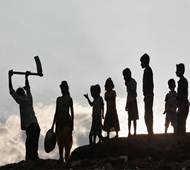
slavery copy copyAccording to the 2016 Global Slavery Index released by Australia-based human rights group Walk Free Foundation today, an estimated 45.8 million people, including women and children, are subject to some form of modern slavery in the world, compared to 35.8 million in 2014.

The report said India has the highest absolute numbers of people trapped in slavery with 18.35 million slaves among its 1.3 billion population while North Korea has the highest incidence (4.37 per cent of the population) and the weakest government response to deal with it.

In the last report in 2014, India had nearly 14.3 million people enslaved.
Incidences of slavery were found in all 167 countries in the index, with Asian countries occupy the top five for people trapped in slavery.

Behind India was China (3.39 million), Pakistan (2.13 million), Bangladesh (1.53 million) and Uzbekistan (1.23 million).

The index said that these five countries combined accounted for almost 58 per cent of the world's enslaved, or 26.6 million people.

The Index presents a ranking of 167 countries based on the proportion of the population that is estimated to be in modern slavery.

Modern slavery refers to situations of exploitation that a person cannot leave because of threats, violence, coercion, abuse of power or deception.

The research included over 42,000 interviews conducted in 53 languages across 25 countries, including 15 state-level surveys in India. These representative surveys covered 44 per cent of the global population.

The countries with the highest estimated prevalence of modern slavery by the proportion of their population are North Korea, Uzbekistan, Cambodia, Cambodia, India, and Qatar.

The countries with the lowest estimated prevalence of modern slavery by the proportion of their population are Luxembourg, Ireland, Norway, Denmark, Switzerland, Austria, Sweden and Belgium, the United States and Canada, and Australia and New Zealand.

The study also tracked the government actions and responses to the modern slavery and of the 161 assessed, 124 nations had criminalised human trafficking in line with the UN trafficking Protocol and 96 nations had developed national action plans to coordinate government response.

It noted that while India had more people enslaved than any other country, it had made significant progress in introducing measures to tackle the problem.

"It has criminalised trafficking, slavery, forced labour, child prostitution and forced marriage. The Indian government is currently tightening legislation against human trafficking, with tougher punishment for repeat offenders. It will offer victims protection and recovery support," it said.

It said that in addition to economic growth in India, ambitious programmes of legal and social reform are being undertaken right across the board, from regulation of labour relations to systems of social insurance for the most vulnerable.

Those governments taking the least action to combat modern slavery are North Korea, Iran, Eritrea, Equatorial Guinea, Hong Kong, Central African Republic, Papua New Guinea, Guinea, the Democratic Republic of the Congo and South Sudan.

The governments that have the strongest response to modern slavery are The Netherlands, the United States of America, the United Kingdom, Sweden, Australia, Portugal, Croatia, Spain, Belgium and Norway.

Seeking strong laws to abolish slavery, Andrew Forrest, Chairman and Founder of Walk Free Foundation, said eradicating slavery makes sense, morally, politically, logically and economically, and called on the governments of the world's leading economies to provide an example to others by enacting and implementing robust anti-slavery measures.

"We call on governments of the top 10 economies of the world to enact laws, at least as strong as the UK Modern Slavery Act 2015, with a budget and capability to ensure organisations are held to account for modern slavery in their supply chains, and to empower independent oversight."

Forrest said leaders of the world's major economies must bring the power of business to this issue, by requiring a focus on supply chain transparency.

"I believe in the critical role of leaders in government, business and civil society. Through our responsible use of power, strength of conviction, determination and collective will, we all can lead the world to end slavery," he said.

Forrest emphasised the key role that business needs to play in eradicating slavery.

"Businesses that don't actively look for forced labour within their supply chains are standing on a burning platform. Business leaders who refuse to look into the realities of their own supply chains are misguided and irresponsible," he said.

Comments

SK
 - 
Thursday, 2 Jun 2016

Since India is facing slavery, Naren has run away to Singapore to enjoy snake/ dog/cat/beef dishes......

Naren kotian
 - 
Tuesday, 31 May 2016

In that mostly 75% are from Muslim community as they enslave women as per their cult following .they have not changed since 6th century ...che papa ...ummah gang ge pitta netti geriruthe ..feku Anthe kumda ...for Muslims he might be feku ..but for nationalist Indians he is true hero who is transforming India .

Add new comment

  • Coastaldigest.com reserves the right to delete or block any comments.
  • Coastaldigset.com is not responsible for its readers’ comments.
  • Comments that are abusive, incendiary or irrelevant are strictly prohibited.
  • Please use a genuine email ID and provide your name to avoid reject.
News Network
January 22,2020

Bengaluru, Jan 22: Chief minister BS Yediyurappa has urged the business community to focus on industries that are farmers and job-oriented and promised that his government would provide all the assistance it can in setting up these industries.

“My government will go the extra mile to facilitate industries that help farmers and provide jobs for youths,” Yediyurappa said during a meeting with several investors and entrepreneurs on the first day of the World Economic Forum, which brings global industry players and government representatives face- to-face, in Davos, Switzerland, on Tuesday.

The chief minister met representatives of 2000 Watt Smart Cities Association, which is represented by sustainability professionals of Nuesch Development, a Swiss Company, and ReNew Power. Both made presentations of their projects to the state delegation.

Yediyurappa appeared impressed by the 2000 Watt’s food processing clusters (development of modern infrastructure and common facilities) projects in rural areas. While presenting their concept, company representatives said they are willing to invest in food clusters, which can provide a better remunerative price for farm produce.

“We will provide all assistance and scientific farming techniques to grow healthy food and market them with added value to the produce,” said Andreas Binkert, scientist and academician, 2000 Watts.

Madhav Bhagwat, CEO of Nuesch Development India, told the Karnataka delegation that the company specialises in carbon-neutral smart township development projects and it has already signed an MoU with the Pune Metropolitan Region Development Authority.

ReNew Power delegates expressed interest in setting up solar power plants in North Karnataka districts like Vijayapura, Kalaburagi, Koppal and Raichur. Samanth Sinha, CEO, ReNew Power, urged the Karnataka government to remove bureaucratic and legal bottlenecks in acquisition of land.

Industries minister Jagadish Shettar and chief secretary TM Vijay Bhaskar among others were present at the meeting.

Yediyurappa and members of the state’s delegation attended US president Donald Trump’s address at the meet. Union minister of commerce and industry Piyush Goel and Union minister of state for shipping Mansukh Mandaviya were also present in the audience.

Comments

Add new comment

  • Coastaldigest.com reserves the right to delete or block any comments.
  • Coastaldigset.com is not responsible for its readers’ comments.
  • Comments that are abusive, incendiary or irrelevant are strictly prohibited.
  • Please use a genuine email ID and provide your name to avoid reject.
coastaldigest.com web desk
June 9,2020

Kozhikode, Jun 9: Kerala Chief Minister Pinarayi Vijayan's daughter Veena T is all set to marry DYFI National President and CPM state committee member PA Muhammad Riyas on June 15. Interestingly, it's the second marriage for both. 

Veena, the elder daughter of Pinarayi Vijayan and Kamala Vijayan, is an IT entrepreneur based in Bengaluru.

According to sources, the marriage will be a simple function in Thiruvananthapuram where only close relatives will participate. The marriage registration has already been done. 

"It's only a private affair of two individuals," Riyas told media persons, reluctant to divulge more details. 

The 44-year-old Muhammad Riyas started his political career with the Students Federation of India (SFI) and climbed up the rungs through DYFI. He had unsuccessfully contested against UDF's M K Raghavan from Kozhikode parliament constituency in 2009. 

The son of retired IPS officer P M Abdul Khadar, Riyas is the familiar face of the left in primetime TV discussions, strongly articulating the CPM stance. 

A law graduate, he had begun at the grassroots level and gradually worked his way up the ladder. 

His marriage to Dr Sameeha Saithalavi, a former syndicate member of Calicut University, happened in 2002. The couple separated in 2015 and they have two sons aged 10 and 13. 

The 40-plus Veena is MD of the IT firm Exalogic Solutions since 2014. 

Prior to that, she was the CEO of RT Technosoft, a Thiruvananthapuram-based company owned by NRI industrialist Ravi Pillai. Before that, she had a six-year stint with Oracle. She has a son from her first marriage. 

"They both were divorced for more than five years. They knew each other and the marriage decision was taken by them only. It's completely a private affair," said a DYFI leader.

Comments

Add new comment

  • Coastaldigest.com reserves the right to delete or block any comments.
  • Coastaldigset.com is not responsible for its readers’ comments.
  • Comments that are abusive, incendiary or irrelevant are strictly prohibited.
  • Please use a genuine email ID and provide your name to avoid reject.
News Network
March 7,2020

Thrissur, Mar 7: A local temple in Kerala is at the centre of a social media storm after the picture of a ''Brahmins-only toilet'' outside its main campus went viral on online platforms, prompting the management to remove the signboard.

The picture of three toilets, with signboards showing "Men", "Women" and "Brahmins", at the Kuttumukku Mahadeva Temple in Thrissur, has gone viral with many social media users viewing it as an unethical practise that can portray the progressive state in a bad light.

However, temple officials said the toilets were located outside the main campus and the board was brought to their notice only now.

Kannan, an official of the temple committee, said the board was placed nearly two decades ago and nobody raised any complaint against it so far.

"That particular toilet was being used by priests and other temple employees. We didn't even notice that board... As soon as we came to know about it, we removed it and affixed a staff-only board," he told PTI.

Also a CPI-M functionary and ward councillor, Kannan said the shrine and it's management was against all kinds of unethical customs.

The temple official said they were planning to pursue legal measures against the man who posted the photo of the toilets on social media.

"We suspect that he did it deliberately to create issues during the time of the festival and to tarnish the shrine's reputation. Not only that, the photo he shared was an old one though he claimed that it was taken during the time of the festival, " he said.

Comments

Add new comment

  • Coastaldigest.com reserves the right to delete or block any comments.
  • Coastaldigset.com is not responsible for its readers’ comments.
  • Comments that are abusive, incendiary or irrelevant are strictly prohibited.
  • Please use a genuine email ID and provide your name to avoid reject.