


India tops global slavery index with 18.35 mn people enslaved

May 31, 2016

Melbourne, May 31: India has the dubious distinction of having the highest number of people in the world trapped in modern slavery with 18.35 million victims of forced labour, ranging from prostitution and begging, according to a new report, which estimated that nearly 46 million people are enslaved globally.
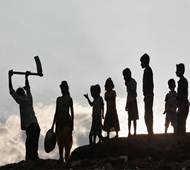
slavery copy copyAccording to the 2016 Global Slavery Index released by Australia-based human rights group Walk Free Foundation today, an estimated 45.8 million people, including women and children, are subject to some form of modern slavery in the world, compared to 35.8 million in 2014.

The report said India has the highest absolute numbers of people trapped in slavery with 18.35 million slaves among its 1.3 billion population while North Korea has the highest incidence (4.37 per cent of the population) and the weakest government response to deal with it.

In the last report in 2014, India had nearly 14.3 million people enslaved.
Incidences of slavery were found in all 167 countries in the index, with Asian countries occupy the top five for people trapped in slavery.

Behind India was China (3.39 million), Pakistan (2.13 million), Bangladesh (1.53 million) and Uzbekistan (1.23 million).

The index said that these five countries combined accounted for almost 58 per cent of the world's enslaved, or 26.6 million people.

The Index presents a ranking of 167 countries based on the proportion of the population that is estimated to be in modern slavery.

Modern slavery refers to situations of exploitation that a person cannot leave because of threats, violence, coercion, abuse of power or deception.

The research included over 42,000 interviews conducted in 53 languages across 25 countries, including 15 state-level surveys in India. These representative surveys covered 44 per cent of the global population.

The countries with the highest estimated prevalence of modern slavery by the proportion of their population are North Korea, Uzbekistan, Cambodia, Cambodia, India, and Qatar.

The countries with the lowest estimated prevalence of modern slavery by the proportion of their population are Luxembourg, Ireland, Norway, Denmark, Switzerland, Austria, Sweden and Belgium, the United States and Canada, and Australia and New Zealand.

The study also tracked the government actions and responses to the modern slavery and of the 161 assessed, 124 nations had criminalised human trafficking in line with the UN trafficking Protocol and 96 nations had developed national action plans to coordinate government response.

It noted that while India had more people enslaved than any other country, it had made significant progress in introducing measures to tackle the problem.

"It has criminalised trafficking, slavery, forced labour, child prostitution and forced marriage. The Indian government is currently tightening legislation against human trafficking, with tougher punishment for repeat offenders. It will offer victims protection and recovery support," it said.

It said that in addition to economic growth in India, ambitious programmes of legal and social reform are being undertaken right across the board, from regulation of labour relations to systems of social insurance for the most vulnerable.

Those governments taking the least action to combat modern slavery are North Korea, Iran, Eritrea, Equatorial Guinea, Hong Kong, Central African Republic, Papua New Guinea, Guinea, the Democratic Republic of the Congo and South Sudan.

The governments that have the strongest response to modern slavery are The Netherlands, the United States of America, the United Kingdom, Sweden, Australia, Portugal, Croatia, Spain, Belgium and Norway.

Seeking strong laws to abolish slavery, Andrew Forrest, Chairman and Founder of Walk Free Foundation, said eradicating slavery makes sense, morally, politically, logically and economically, and called on the governments of the world's leading economies to provide an example to others by enacting and implementing robust anti-slavery measures.

"We call on governments of the top 10 economies of the world to enact laws, at least as strong as the UK Modern Slavery Act 2015, with a budget and capability to ensure organisations are held to account for modern slavery in their supply chains, and to empower independent oversight."

Forrest said leaders of the world's major economies must bring the power of business to this issue, by requiring a focus on supply chain transparency.

"I believe in the critical role of leaders in government, business and civil society. Through our responsible use of power, strength of conviction, determination and collective will, we all can lead the world to end slavery," he said.

Forrest emphasised the key role that business needs to play in eradicating slavery.

"Businesses that don't actively look for forced labour within their supply chains are standing on a burning platform. Business leaders who refuse to look into the realities of their own supply chains are misguided and irresponsible," he said.

Comments

SK
 - 
Thursday, 2 Jun 2016

Since India is facing slavery, Naren has run away to Singapore to enjoy snake/ dog/cat/beef dishes......

Naren kotian
 - 
Tuesday, 31 May 2016

In that mostly 75% are from Muslim community as they enslave women as per their cult following .they have not changed since 6th century ...che papa ...ummah gang ge pitta netti geriruthe ..feku Anthe kumda ...for Muslims he might be feku ..but for nationalist Indians he is true hero who is transforming India .

Add new comment

  • Coastaldigest.com reserves the right to delete or block any comments.
  • Coastaldigset.com is not responsible for its readers’ comments.
  • Comments that are abusive, incendiary or irrelevant are strictly prohibited.
  • Please use a genuine email ID and provide your name to avoid reject.
News Network
August 4,2020

Bengaluru, Aug 4: Police barricades, yellow banners, walls with a fresh coat of paint and the sounds of bhajan mark parts of Ayodhya as the city awaits its big day Wednesday, when the first brick will be laid for the Ram temple.

Ayodhya is decked up for the bhoomi pujan that will be attended at the Ram Janmabhoomi by 175 people, who figure in a select guest list of seers and politicians topped by Prime Minister Narendra Modi.

Concerned over the spread of coronavirus, the authorities are encouraging others not to come to the temple town, asking them to mark the occasion by celebrating at their homes. The groundbreaking ceremony will be telecast live.

Roads leading to Ayodhya display hoardings with the picture of the proposed Ram temple and of Ram Lalla, the infant Ram, the deity now housed in a makeshift temple.

Around the town’s Hanumangarhi area – named after a well-known temple which Modi will visit on Wednesday – both police sirens and ‘bhajans’ in praise of Ram are heard.

Most of the shops in the locality wear a new look, with their fronts painted in bright yellow. A large number of policemen were deployed there on Tuesday. Some sat in the sweet shops, waiting for their next instructions.

Roads leading into the area are barricaded. Yards of yellow cloth and marigold garlands were being hung on poles.

Even on the day before the event, security checks on vehicles heading to Ayodhya begin from adjoining Barabanki district itself on the Lucknow-Ayodhya road. Policemen take down details, including mobile numbers of the travellers.

Senior Superintendent of Police Deepak Kumar said the focus of the force is on maintaining the Covid-19 protocol.

“So we are not going to allow any outsider to enter Ayodhya city,” he said. Prohibitory orders are also in force and not more than four people will be allowed to gather.

“The markets and shops will remain open but with strict adherence to the Covid protocol,” he said. Outsiders will be stopped from entering the city, but Ayodhya residents will be allowed in if they produce any identification document.

“We are also carrying out random checks on people living in Ayodhya to ensure that no outsiders are staying here,” he said.

The city’s temples and mosques will remain open, but no other religious event – except for the bhoomi pujan – will take place on Wednesday.

Pickets have been set up at sensitive points in the city.

Sub-inspector Ram Chandra Yadav and constables Avnish Kumar and Ankit Chaudhary man the Terhi Bazar Chauraha picket near the Ram Janmabhoomi site.

"We are here for the past some days, and were on duty on the Rakshabandhan day. Duty comes first and only after that come other things in life, like festivals," Yadav said.

Mayank Gupta, who runs a restaurant, was handing out food packets to policemen, his customers.

"For the last two months, I have been providing tiffin to them twice a day. There are around 100 policemen to whom I supply tiffin," Gupta said.

Comments

Add new comment

  • Coastaldigest.com reserves the right to delete or block any comments.
  • Coastaldigset.com is not responsible for its readers’ comments.
  • Comments that are abusive, incendiary or irrelevant are strictly prohibited.
  • Please use a genuine email ID and provide your name to avoid reject.
News Network
May 6,2020

Bengaluru, May 6: Resolving the disparity in payment of stipend to the Resident Doctors across Karnataka, Minister for Medical Education Dr K Sudhakar on Tuesday directed the Medical Education Department to consider the request made by the Resident Doctors Association (RDA) to increase the stipend.

Holding a video conference meeting with the department officials and Vice-Chancellor of the Rajiv Gandhi University of Health Sciences (RGUHS), the Minister instructed the officials to look into the request and submit a detailed proposal pertaining to the increase of stipend.

The Karnataka Resident Doctors Association had submitted a request seeking a hike in the stipend which is due since 2015.

Comments

Add new comment

  • Coastaldigest.com reserves the right to delete or block any comments.
  • Coastaldigset.com is not responsible for its readers’ comments.
  • Comments that are abusive, incendiary or irrelevant are strictly prohibited.
  • Please use a genuine email ID and provide your name to avoid reject.
News Network
July 23,2020

Bengaluru, Jul 23: The Siddi community in Karnataka got its first lawmaker as Governor Vajubhai Vala nominated five persons, including Shantharama Budna Siddi, to the Karnataka Legislative Council on Wednesday.

Shantharama Siddi had been working as a social worker and was a post holder at the Vanavasi Kalyan Prakalpa, a tribal welfare initiative of the Rashtriya Swayamsevak Sangh (RSS).

The Siddis, an ethnic group in India, are said to have descended from the people of the East African region. They are included in the list of Scheduled Tribes (ST) in Karnataka.

Apart from the Shantharama, the inclusion of CP Yogishwar, who had left Congress to join BJP in 2017 but failed to retain his seat in the 2018 Assembly polls, is also considered as a big decision.

Adagur H Vishwanath, another former JDS leader, who had quit his party and joined BJP but failed to retain his seat has also caught the attention of the people.

Further, Governor Vala has nominated Talwar Sabanna and Bharathi Shetty to the Upper House in the state.

Comments

Add new comment

  • Coastaldigest.com reserves the right to delete or block any comments.
  • Coastaldigset.com is not responsible for its readers’ comments.
  • Comments that are abusive, incendiary or irrelevant are strictly prohibited.
  • Please use a genuine email ID and provide your name to avoid reject.