


India tops global slavery index with 18.35 mn people enslaved

May 31, 2016

Melbourne, May 31: India has the dubious distinction of having the highest number of people in the world trapped in modern slavery with 18.35 million victims of forced labour, ranging from prostitution and begging, according to a new report, which estimated that nearly 46 million people are enslaved globally.
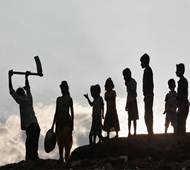
slavery copy copyAccording to the 2016 Global Slavery Index released by Australia-based human rights group Walk Free Foundation today, an estimated 45.8 million people, including women and children, are subject to some form of modern slavery in the world, compared to 35.8 million in 2014.

The report said India has the highest absolute numbers of people trapped in slavery with 18.35 million slaves among its 1.3 billion population while North Korea has the highest incidence (4.37 per cent of the population) and the weakest government response to deal with it.

In the last report in 2014, India had nearly 14.3 million people enslaved.
Incidences of slavery were found in all 167 countries in the index, with Asian countries occupy the top five for people trapped in slavery.

Behind India was China (3.39 million), Pakistan (2.13 million), Bangladesh (1.53 million) and Uzbekistan (1.23 million).

The index said that these five countries combined accounted for almost 58 per cent of the world's enslaved, or 26.6 million people.

The Index presents a ranking of 167 countries based on the proportion of the population that is estimated to be in modern slavery.

Modern slavery refers to situations of exploitation that a person cannot leave because of threats, violence, coercion, abuse of power or deception.

The research included over 42,000 interviews conducted in 53 languages across 25 countries, including 15 state-level surveys in India. These representative surveys covered 44 per cent of the global population.

The countries with the highest estimated prevalence of modern slavery by the proportion of their population are North Korea, Uzbekistan, Cambodia, Cambodia, India, and Qatar.

The countries with the lowest estimated prevalence of modern slavery by the proportion of their population are Luxembourg, Ireland, Norway, Denmark, Switzerland, Austria, Sweden and Belgium, the United States and Canada, and Australia and New Zealand.

The study also tracked the government actions and responses to the modern slavery and of the 161 assessed, 124 nations had criminalised human trafficking in line with the UN trafficking Protocol and 96 nations had developed national action plans to coordinate government response.

It noted that while India had more people enslaved than any other country, it had made significant progress in introducing measures to tackle the problem.

"It has criminalised trafficking, slavery, forced labour, child prostitution and forced marriage. The Indian government is currently tightening legislation against human trafficking, with tougher punishment for repeat offenders. It will offer victims protection and recovery support," it said.

It said that in addition to economic growth in India, ambitious programmes of legal and social reform are being undertaken right across the board, from regulation of labour relations to systems of social insurance for the most vulnerable.

Those governments taking the least action to combat modern slavery are North Korea, Iran, Eritrea, Equatorial Guinea, Hong Kong, Central African Republic, Papua New Guinea, Guinea, the Democratic Republic of the Congo and South Sudan.

The governments that have the strongest response to modern slavery are The Netherlands, the United States of America, the United Kingdom, Sweden, Australia, Portugal, Croatia, Spain, Belgium and Norway.

Seeking strong laws to abolish slavery, Andrew Forrest, Chairman and Founder of Walk Free Foundation, said eradicating slavery makes sense, morally, politically, logically and economically, and called on the governments of the world's leading economies to provide an example to others by enacting and implementing robust anti-slavery measures.

"We call on governments of the top 10 economies of the world to enact laws, at least as strong as the UK Modern Slavery Act 2015, with a budget and capability to ensure organisations are held to account for modern slavery in their supply chains, and to empower independent oversight."

Forrest said leaders of the world's major economies must bring the power of business to this issue, by requiring a focus on supply chain transparency.

"I believe in the critical role of leaders in government, business and civil society. Through our responsible use of power, strength of conviction, determination and collective will, we all can lead the world to end slavery," he said.

Forrest emphasised the key role that business needs to play in eradicating slavery.

"Businesses that don't actively look for forced labour within their supply chains are standing on a burning platform. Business leaders who refuse to look into the realities of their own supply chains are misguided and irresponsible," he said.

Comments

SK
 - 
Thursday, 2 Jun 2016

Since India is facing slavery, Naren has run away to Singapore to enjoy snake/ dog/cat/beef dishes......

Naren kotian
 - 
Tuesday, 31 May 2016

In that mostly 75% are from Muslim community as they enslave women as per their cult following .they have not changed since 6th century ...che papa ...ummah gang ge pitta netti geriruthe ..feku Anthe kumda ...for Muslims he might be feku ..but for nationalist Indians he is true hero who is transforming India .

Add new comment

  • Coastaldigest.com reserves the right to delete or block any comments.
  • Coastaldigset.com is not responsible for its readers’ comments.
  • Comments that are abusive, incendiary or irrelevant are strictly prohibited.
  • Please use a genuine email ID and provide your name to avoid reject.
News Network
April 27,2020

Bengaluru, Apr 27: Janata Dal-Secular leader and former Karnataka chief minister HD Kumaraswamy on Monday said that the government should work towards lowering the cost of living as the spending power of the consumer has weakened, and it should impose COVID cess on the ultra-rich.

"The economy won't bounce back within a very short period. It is important to lower the cost of living as the spending power of the consumer has depleted. The government must cut the petrol/diesel prices. The loss of revenue may be offset partially by imposing COVID cess on the ultra-rich," Kumaraswamy tweeted.

"According to RBI and international economic assessment agencies, the GDP growth rate of the country is expected to fall to a historic low. Such a dire situation calls for citizen-centric measures like full or partial waivers of EMIs, rents, school fees, and other levies," he added.

Kumaraswamy further said that the government must announce schemes to save the livelihoods of people, especially those in the unorganised sector.

"It is high time the government announced schemes to save livelihoods of people, especially those in the unorganised sector. The government must provide immediate relief to farmers, construction workers, cab and auto drivers, garment workers, etc," the former Karnataka CM tweeted.

The Confederation of Indian Industry (CII) had said on April 23 that India's economic growth is likely to hover between zero and 1.5 per cent in the current financial year as the extended COVID-19 lockdown slows down activity across most sectors.

India is under a nation-wide lockdown which was imposed on March 25 and later extended on April 14 to May 3 to stem the spread of coronavirus.

Comments

Add new comment

  • Coastaldigest.com reserves the right to delete or block any comments.
  • Coastaldigset.com is not responsible for its readers’ comments.
  • Comments that are abusive, incendiary or irrelevant are strictly prohibited.
  • Please use a genuine email ID and provide your name to avoid reject.
News Network
July 2,2020

Bengaluru, Jul 2: As many as 3,363 students from Covid-19 containment zones have appeared for SSLC examinations in different parts of Karnataka till yesterday. On the first day of exam, i.e., on June 25, only 998 students these zones had written the exam.

In the past few days the number of containment zones has increased across the state in general and Bengaluru in particular. In all, 32 students could not appear for the exam as they turned positive.

While on June 25, the number of students who were found unwell during the check up at exam centre was 201, it was 613 on Wednesday. Students who are sick and those from the containment zones take the exam in a different room.

The social science exam on Wednesday saw an attendance percentage of 97.96 (7.68 lakh). This was against 98.78% last year. There were 7.45 lakh fresh candidates, 20,000 private candidates and 593 from outside the state.

Five students in Yadgir district were given question papers based on the old syllabus for maths exam on June 27. Their answerscripts will be evaluated separately and action will be taken against the officials.

Malpractices assisted by schools by switching off CCTV cameras were reported in Ballari and Koppal. “We’ve completed all the core subjects. Now only languages are left. We’ll complete them too in a safe environment,” said S Suresh Kumar, primary and secondary education minister.

Comments

Add new comment

  • Coastaldigest.com reserves the right to delete or block any comments.
  • Coastaldigset.com is not responsible for its readers’ comments.
  • Comments that are abusive, incendiary or irrelevant are strictly prohibited.
  • Please use a genuine email ID and provide your name to avoid reject.
News Network
July 18,2020

Bengaluru, Jul 18: Vendors in Bengaluru are finding it hard to earn a livelihood as the state government has allowed the sale of products only for a few hours each day. The lockdown imposed by the Karnataka government on July 14 will continue till July 22.

Speaking to ANI, Vanajakshi, a local vendor said, "We took loans from banks and small financiers to run our business. But we are finding it tough to pay back as our livelihoods have been hit."
"Because of the lockdown, no one comes to buy and markets remain vacant. There was a time when the Gandhi Nagar market was filled with customers, but now it looks like a vacant playground," she added.

Mythri, an advocate, said, "Look at the conditions of vendors. It's precarious. They do not have any business at all. Even now they have been allowed to sell products till 12 noon, which is not sufficient. It's time for the government to step in and provide assistance. If the Central government can reduce corporate taxes, why can't it help them? At least it will help them pass off these difficult times. "

"They are earning through daily wages. The government imposed lockdown suddenly. Where will they go? The city market in Bengaluru is famous. At least 8,000 people come from slum areas. People here are poor. The lockdown was done suddenly and led to problems for these people," said Congress MLA Zamil Ahmed Khan.

Referring to a recent meeting with the chief minister BS Yediyurappa, he said, "During the meeting called by the CM, I suggested that food kits must be arranged for vendors. The CM said the government is providing rice and wheat but that's not enough."

Comments

Add new comment

  • Coastaldigest.com reserves the right to delete or block any comments.
  • Coastaldigset.com is not responsible for its readers’ comments.
  • Comments that are abusive, incendiary or irrelevant are strictly prohibited.
  • Please use a genuine email ID and provide your name to avoid reject.