


India tops global slavery index with 18.35 mn people enslaved

May 31, 2016

Melbourne, May 31: India has the dubious distinction of having the highest number of people in the world trapped in modern slavery with 18.35 million victims of forced labour, ranging from prostitution and begging, according to a new report, which estimated that nearly 46 million people are enslaved globally.
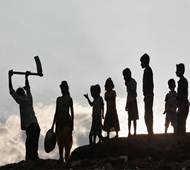
slavery copy copyAccording to the 2016 Global Slavery Index released by Australia-based human rights group Walk Free Foundation today, an estimated 45.8 million people, including women and children, are subject to some form of modern slavery in the world, compared to 35.8 million in 2014.

The report said India has the highest absolute numbers of people trapped in slavery with 18.35 million slaves among its 1.3 billion population while North Korea has the highest incidence (4.37 per cent of the population) and the weakest government response to deal with it.

In the last report in 2014, India had nearly 14.3 million people enslaved.
Incidences of slavery were found in all 167 countries in the index, with Asian countries occupy the top five for people trapped in slavery.

Behind India was China (3.39 million), Pakistan (2.13 million), Bangladesh (1.53 million) and Uzbekistan (1.23 million).

The index said that these five countries combined accounted for almost 58 per cent of the world's enslaved, or 26.6 million people.

The Index presents a ranking of 167 countries based on the proportion of the population that is estimated to be in modern slavery.

Modern slavery refers to situations of exploitation that a person cannot leave because of threats, violence, coercion, abuse of power or deception.

The research included over 42,000 interviews conducted in 53 languages across 25 countries, including 15 state-level surveys in India. These representative surveys covered 44 per cent of the global population.

The countries with the highest estimated prevalence of modern slavery by the proportion of their population are North Korea, Uzbekistan, Cambodia, Cambodia, India, and Qatar.

The countries with the lowest estimated prevalence of modern slavery by the proportion of their population are Luxembourg, Ireland, Norway, Denmark, Switzerland, Austria, Sweden and Belgium, the United States and Canada, and Australia and New Zealand.

The study also tracked the government actions and responses to the modern slavery and of the 161 assessed, 124 nations had criminalised human trafficking in line with the UN trafficking Protocol and 96 nations had developed national action plans to coordinate government response.

It noted that while India had more people enslaved than any other country, it had made significant progress in introducing measures to tackle the problem.

"It has criminalised trafficking, slavery, forced labour, child prostitution and forced marriage. The Indian government is currently tightening legislation against human trafficking, with tougher punishment for repeat offenders. It will offer victims protection and recovery support," it said.

It said that in addition to economic growth in India, ambitious programmes of legal and social reform are being undertaken right across the board, from regulation of labour relations to systems of social insurance for the most vulnerable.

Those governments taking the least action to combat modern slavery are North Korea, Iran, Eritrea, Equatorial Guinea, Hong Kong, Central African Republic, Papua New Guinea, Guinea, the Democratic Republic of the Congo and South Sudan.

The governments that have the strongest response to modern slavery are The Netherlands, the United States of America, the United Kingdom, Sweden, Australia, Portugal, Croatia, Spain, Belgium and Norway.

Seeking strong laws to abolish slavery, Andrew Forrest, Chairman and Founder of Walk Free Foundation, said eradicating slavery makes sense, morally, politically, logically and economically, and called on the governments of the world's leading economies to provide an example to others by enacting and implementing robust anti-slavery measures.

"We call on governments of the top 10 economies of the world to enact laws, at least as strong as the UK Modern Slavery Act 2015, with a budget and capability to ensure organisations are held to account for modern slavery in their supply chains, and to empower independent oversight."

Forrest said leaders of the world's major economies must bring the power of business to this issue, by requiring a focus on supply chain transparency.

"I believe in the critical role of leaders in government, business and civil society. Through our responsible use of power, strength of conviction, determination and collective will, we all can lead the world to end slavery," he said.

Forrest emphasised the key role that business needs to play in eradicating slavery.

"Businesses that don't actively look for forced labour within their supply chains are standing on a burning platform. Business leaders who refuse to look into the realities of their own supply chains are misguided and irresponsible," he said.

Comments

SK
 - 
Thursday, 2 Jun 2016

Since India is facing slavery, Naren has run away to Singapore to enjoy snake/ dog/cat/beef dishes......

Naren kotian
 - 
Tuesday, 31 May 2016

In that mostly 75% are from Muslim community as they enslave women as per their cult following .they have not changed since 6th century ...che papa ...ummah gang ge pitta netti geriruthe ..feku Anthe kumda ...for Muslims he might be feku ..but for nationalist Indians he is true hero who is transforming India .

Add new comment

  • Coastaldigest.com reserves the right to delete or block any comments.
  • Coastaldigset.com is not responsible for its readers’ comments.
  • Comments that are abusive, incendiary or irrelevant are strictly prohibited.
  • Please use a genuine email ID and provide your name to avoid reject.
News Network
January 28,2020

Bengaluru, Jan 28: Brace for hefty traffic penalties as the state government is all set to reverse a notification on revised fines which came into effect last September following pushback from road users and opposition parties.

The Karnataka government will implement traffic penalties as stipulated in the amended Motor Vehicles Act, 2019, in a phased manner following a diktat from the Centre. The government did not specify the timeline for it.

“At a recent meeting of transport ministers from various states, the Union government explained why it wanted to implement these huge fines. We found it convincing and will implement it in its original form,” said transport minister Laxman Savadi on Monday.

Savadi said India’s image globally has taken a beating due to the high number of road deaths and the Centre wants to change it at any cost. However, he said the entire set of hefty fines would not be reintroduced all at once.

BJP govt revised rates in Sept

The BJP government last September had revised fines on compoundable offences and those which are fined on the spot by traffic cops by 50%- 80%, barring drunken driving and racing.

As per the revised rates, helmetless riding attracted a penalty of Rs 500 against Rs 1,000 notified by the Centre. Driving without a licence attracted a fine of Rs 1,000 for

two- and three-wheelers and Rs 2,000 for light motor vehicles as against the earlier Rs 5,000 for all types of vehicles.

The central government recently told states and Union Territories they should enforce fines as per the amended Act and they cannot be rolled back. The road transport and highways ministry said fines cannot be reduced below the minimum amount fixed by law, unless the President gives his assent.

Comments

Add new comment

  • Coastaldigest.com reserves the right to delete or block any comments.
  • Coastaldigset.com is not responsible for its readers’ comments.
  • Comments that are abusive, incendiary or irrelevant are strictly prohibited.
  • Please use a genuine email ID and provide your name to avoid reject.
News Network
March 31,2020

Kasaragod, Mar 31: Two more Kasaragod natives lost their lives on Monday due to blockade of the interstate border by Karnataka police in the wake of outbreak of novel coronavirus.

They could not get emergency health care as the Karnataka police stopped the ambulance carrying them to a hospital in Mangaluru at the border.

Another critically-ill person, who was sent back by Manguluru hospital authorities on March 23 for being a Kasaragod native, also died on Monday.

This is the fifth such case in many days.

The deceased are Madhavan, 50, Ayesha, 55 and Aziz Haji, 61 respectively.

All three of them lived near the Karnataka border.

Madhavan, who hailed from Thummanattu in Manjeswaram, died enroute to Kanhangad hospital after being denied entry to cross over to Karnataka. He had an acute bronchial attack.

Udyavar native Ayesha, an asthma patient, was referred to the Mangaluru Hospital by the hospital authorities at Uppali. When the authorities stopped her at the border, she was taken to the Kanhangad hospital. However, she died before reaching the hospital.

Aziz Haji, from Nayabazar Cherugoli MA Cottage at Uppala, was allegedly refused entry into a Manguluru Hospital on March 23 on account of being a Kasaragod native. Haji was a dialysis patient at the hospital. “We were unable to contact his doctor at the time,” his relatives said. Haji, who was on the ventilator, lost his life Monday morning.

One more from Kerala dies as Karnataka police stop ambulance at border
Kunjathoor native Abdul Hameed and Bandwal native Fathima also lost their lives due to the closing of the interstate border.

The district authorities has appealed to the Government to intervene in the matter and influence Karnataka as to lift a ban in crossing over for ambulances carrying critical patients.

The people of Kasaragod are largely dependent on the medical facilities in Mangaluru for critical illness care.

The Kasaragod MP, Rajmohan Unnithan has said he would move the Supreme court against this.

Kerala Chief Minister Pinarayi Vijayan has already taken up the issue with the Centre.

Kerala HC takes up issue with Karnataka AAG

The Kerala High Court on Monday sought the views of the Advocate General of Karnataka on the issue of the government of the neighbouring state blocking its borders with Kerala.

Considering a Public Interest Litigation (PIL) filed by Kerala High Court Advocates Association, seeking a direction for opening the roads, a bench comprising Justices A K Jayasankaran Nambiar and Shaji P Chali requested the Advocate General of Karnataka to join the hearing at 11 am on Tuesday through video conferencing.

The Court orally observed that the blockades erecting embankments on the inter-state roads would affect the people's right to life.

The Karnataka government blocked the state highway with to prevent movement of vehicles carrying essential goods and people seeking emergency treatment at hospitals in the city of Mangalore bordering Kasaragod.

With 97 infected patients, Kasaragod has the largest number of COVID-19 cases in Kerala. 7,437 people are under observation in the district.

Comments

Add new comment

  • Coastaldigest.com reserves the right to delete or block any comments.
  • Coastaldigset.com is not responsible for its readers’ comments.
  • Comments that are abusive, incendiary or irrelevant are strictly prohibited.
  • Please use a genuine email ID and provide your name to avoid reject.
News Network
July 19,2020

Mysuru, Jul 19: Residents in the vicinity of the Chamundeshwari temple alleged VVIP racism against the administration for allowing BJP MP Shobha Karandlaje for a special visit there on Friday.

Even though the district collector had ordered the closure of temple visits due to the COVID pandemic, an exception was made for VVIPs.
The BJP leader claimed that she visited the temple on Thursday evening but the temple officials confirmed that she visited the temple on Friday at 7 am. It is her routine every year to visit the temple on the last Friday of Ashada Masa.

Locals, who tried get darshan of Chamundi Devi, were barred by the police leading to an altercation between locals and cops at the entrance to the temple.

Ashada Masa is considered an auspicious occasion and it is a belief among politicians that for the longevity of their political career, they need to visit Chamundeshwari temple every last Friday of Ashada Masa.

Comments

Add new comment

  • Coastaldigest.com reserves the right to delete or block any comments.
  • Coastaldigset.com is not responsible for its readers’ comments.
  • Comments that are abusive, incendiary or irrelevant are strictly prohibited.
  • Please use a genuine email ID and provide your name to avoid reject.