


India tops global slavery index with 18.35 mn people enslaved

May 31, 2016

Melbourne, May 31: India has the dubious distinction of having the highest number of people in the world trapped in modern slavery with 18.35 million victims of forced labour, ranging from prostitution and begging, according to a new report, which estimated that nearly 46 million people are enslaved globally.
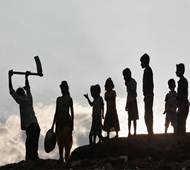
slavery copy copyAccording to the 2016 Global Slavery Index released by Australia-based human rights group Walk Free Foundation today, an estimated 45.8 million people, including women and children, are subject to some form of modern slavery in the world, compared to 35.8 million in 2014.

The report said India has the highest absolute numbers of people trapped in slavery with 18.35 million slaves among its 1.3 billion population while North Korea has the highest incidence (4.37 per cent of the population) and the weakest government response to deal with it.

In the last report in 2014, India had nearly 14.3 million people enslaved.
Incidences of slavery were found in all 167 countries in the index, with Asian countries occupy the top five for people trapped in slavery.

Behind India was China (3.39 million), Pakistan (2.13 million), Bangladesh (1.53 million) and Uzbekistan (1.23 million).

The index said that these five countries combined accounted for almost 58 per cent of the world's enslaved, or 26.6 million people.

The Index presents a ranking of 167 countries based on the proportion of the population that is estimated to be in modern slavery.

Modern slavery refers to situations of exploitation that a person cannot leave because of threats, violence, coercion, abuse of power or deception.

The research included over 42,000 interviews conducted in 53 languages across 25 countries, including 15 state-level surveys in India. These representative surveys covered 44 per cent of the global population.

The countries with the highest estimated prevalence of modern slavery by the proportion of their population are North Korea, Uzbekistan, Cambodia, Cambodia, India, and Qatar.

The countries with the lowest estimated prevalence of modern slavery by the proportion of their population are Luxembourg, Ireland, Norway, Denmark, Switzerland, Austria, Sweden and Belgium, the United States and Canada, and Australia and New Zealand.

The study also tracked the government actions and responses to the modern slavery and of the 161 assessed, 124 nations had criminalised human trafficking in line with the UN trafficking Protocol and 96 nations had developed national action plans to coordinate government response.

It noted that while India had more people enslaved than any other country, it had made significant progress in introducing measures to tackle the problem.

"It has criminalised trafficking, slavery, forced labour, child prostitution and forced marriage. The Indian government is currently tightening legislation against human trafficking, with tougher punishment for repeat offenders. It will offer victims protection and recovery support," it said.

It said that in addition to economic growth in India, ambitious programmes of legal and social reform are being undertaken right across the board, from regulation of labour relations to systems of social insurance for the most vulnerable.

Those governments taking the least action to combat modern slavery are North Korea, Iran, Eritrea, Equatorial Guinea, Hong Kong, Central African Republic, Papua New Guinea, Guinea, the Democratic Republic of the Congo and South Sudan.

The governments that have the strongest response to modern slavery are The Netherlands, the United States of America, the United Kingdom, Sweden, Australia, Portugal, Croatia, Spain, Belgium and Norway.

Seeking strong laws to abolish slavery, Andrew Forrest, Chairman and Founder of Walk Free Foundation, said eradicating slavery makes sense, morally, politically, logically and economically, and called on the governments of the world's leading economies to provide an example to others by enacting and implementing robust anti-slavery measures.

"We call on governments of the top 10 economies of the world to enact laws, at least as strong as the UK Modern Slavery Act 2015, with a budget and capability to ensure organisations are held to account for modern slavery in their supply chains, and to empower independent oversight."

Forrest said leaders of the world's major economies must bring the power of business to this issue, by requiring a focus on supply chain transparency.

"I believe in the critical role of leaders in government, business and civil society. Through our responsible use of power, strength of conviction, determination and collective will, we all can lead the world to end slavery," he said.

Forrest emphasised the key role that business needs to play in eradicating slavery.

"Businesses that don't actively look for forced labour within their supply chains are standing on a burning platform. Business leaders who refuse to look into the realities of their own supply chains are misguided and irresponsible," he said.

Comments

SK
 - 
Thursday, 2 Jun 2016

Since India is facing slavery, Naren has run away to Singapore to enjoy snake/ dog/cat/beef dishes......

Naren kotian
 - 
Tuesday, 31 May 2016

In that mostly 75% are from Muslim community as they enslave women as per their cult following .they have not changed since 6th century ...che papa ...ummah gang ge pitta netti geriruthe ..feku Anthe kumda ...for Muslims he might be feku ..but for nationalist Indians he is true hero who is transforming India .

Add new comment

  • Coastaldigest.com reserves the right to delete or block any comments.
  • Coastaldigset.com is not responsible for its readers’ comments.
  • Comments that are abusive, incendiary or irrelevant are strictly prohibited.
  • Please use a genuine email ID and provide your name to avoid reject.
News Network
May 12,2020

New Delhi, May 12: Minorities are "flourishing" in India and have been an equal partner in development without discrimination under the Modi government, Union Minister Mukhtar Abbas Naqvi said on Tuesday, dismissing allegations of Islamophobia as an attempt to defame the country.

The "Narendra Modi phobia club” has been unable to digest the inclusive growth under the prime minister and is engaged in a "nefarious campaign" in India and abroad through fake propaganda alleging "intolerance, communalism and discrimination" against minorities in India, Naqvi said.

In a blog titled "Islamophobia -- Bogey of Bogus Bashing Brigade", the minority affairs minister argued that the "Modi phobia club" is playing the “Islamophobia card" to harm the pluralistic fabric of India, but will not succeed.

Naqvi's remarks come days after a wave of angry reactions on Twitter by citizens and rights activists from various Arab countries following allegations that Muslims are being blamed for spreading COVID-19 in parts of India.

Also, the 57-member prominent international Mulim grouping, the Organisation of Islamic Cooperation, recently accused India of "Islamophobia".

India has dismissed all such allegations.

"Minorities in India are flourishing equally with all the citizens with a sense of equality, security and prosperity. Misinformation against such a gracious and tolerant country and its effective leadership is nothing but the height of ignorance and mental bankruptcy," Naqvi said.

He claimed that no riot took place in last 5 years of the Modi government and it was after "nefarious preaching" by those who were irked by this that the Delhi riots happened.

Naqvi said the women who sat on protests at Shaheen Bagh cannot be termed "anti-nationals" but they had been "misguided by the bogus bashing brigade”.

This brigade pushed these women on a path which had an “entry gate” but no “exit gate”, the minister said.

This was a “calculated conspiracy” by the brigade that wants to defame and disgrace Modi and India, Naqvi said.

He also argued that for the "first time since Independence", India has forged close and strong ties with nearly all Islamic nations and countries such as Saudi Arabia, the UAE, Afghanistan, Russia, Palestine, Mauritius and the Maldives have conferred Modi with their highest civilian awards.

"The United Nations has also conferred Narendra Modi with the prestigious 'Champions of the Earth Award'. Prime Minister Narendra Modi's global acceptance and popularity doesn't need any certificate," Naqvi said.

The Modi government never planned development on the basis of Hindus, Muslims, Sikhs, Christians or on region and caste, and its priority has been the poor and deprived, Naqvi said, adding that still some people with a “prejudiced mindset” are trying to defame India by raising the bogey of Islamophobia.

There is not a single incident of discrimination against any section of the society, including minorities under the Modi government, the minister asserted.

All sections, including minorities, are strongly moving forward on the path of “development with dignity” under the Modi government, he said.

When the challenges due to the coronavirus were in initial stages across the world in early January and several countries, including Pakistan, had not taken care of their people abroad, it was the Modi government that brought back thousands of Indians stranded in Wuhan (China), Iran, Iraq, Saudi Arabia and other countries, Naqvi said, adding that a majority of these people were Muslims.

In the recent Vande Bharat Mission also, the Indian government is bringing back thousands of Indians from countries such as the Maldives, the UAE, Saudi Arabia, Iran, Qatar and other countries which include a large number of Muslims, he pointed out.

"Strong eternal commitment of my country will defeat and demolish the fake and fabricated Islamophobia card of the 'India bashing brigade'," Naqvi said in his blog.

Comments

Add new comment

  • Coastaldigest.com reserves the right to delete or block any comments.
  • Coastaldigset.com is not responsible for its readers’ comments.
  • Comments that are abusive, incendiary or irrelevant are strictly prohibited.
  • Please use a genuine email ID and provide your name to avoid reject.
coastaldigest.com news network
August 4,2020

Bengaluru, Aug 4: Karnataka on Tuesday reported its biggest single-day spike of 6,259 Covid-19 cases and 110 fresh deaths, taking the total infection count to 1,45,830 and the toll to 2,704, the health department said.

The day also saw a record 6,777 patients getting discharged after recovery, outnumbering the fresh cases. Out of 6,259 fresh cases, a total of 2,035 cases were from Bengaluru Urban district. The previous biggest single-day record was on July 30 when the state added 6,128 cases.

A bulletin from the department said cumulatively 1,45,830 Covid-19 positive cases have been confirmed in the state and it included 2,704 deaths and 69,272 discharges. Out of the 73,846 active cases, as many as 73,212 patients were stable in isolation at designated hospitals while 634 in the intensive care units.

Among the fresh deaths, Bengaluru Urban accounted for 30 followed by Dakshina Kannada (13) and Mysuru (9).

Most of the people who succumbed either had a history of Severe Acute Respiratory Infection (SARI) or Influenza-like illness (ILI), the bulletin said. Besides Bengaluru Urban, the other districts which reported higher fresh cases on Tuesday are Mysuru 662, Kalaburagi 285, Ballari 284, Belagavi 263, Dakshina Kannada 225, Davangere 191, Dharwad and Hassan 188. Bengaluru Urban district continued to top the list of positive cases with a total of 63,033 infections, followed by Ballari 7,638 and Dakshina Kannada 6,388.

Among discharges too Bengaluru Urban tops the districts with 27,877 discharges, followed by Ballari 3,724 and Kalaburagi 3,470. A total of 14,89,016 samples had been tested so far, out of which 42,458 on Tuesday with 29,488 being rapid antigen tests.

Comments

Add new comment

  • Coastaldigest.com reserves the right to delete or block any comments.
  • Coastaldigset.com is not responsible for its readers’ comments.
  • Comments that are abusive, incendiary or irrelevant are strictly prohibited.
  • Please use a genuine email ID and provide your name to avoid reject.
News Network
April 29,2020

Bengaluru, Apr 29: Union Minister Ravi Shankar Prasad on Tuesday clarified that Department of Telecommunications has extended the relaxed terms and conditions for VPN till July 31.

"Wish to clarify that it is not extension of WFH. In response to IT Industry's request to facilitate WFH for OSPs, Department of Telecommunications, India had relaxed terms and conditions for VPN till April 30 After discussions with IT Ministers this relaxation in terms and conditions is extended till July 31," Prasad Tweeted quoting Deputy Chief Minister of Karnataka Dr Ashwath Narayan.

Earlier, the Karnataka government issued a press statement saying that the central government has given permission to IT professionals to work from home till July 31 in the view of COVID-19 pandemic.

Comments

Add new comment

  • Coastaldigest.com reserves the right to delete or block any comments.
  • Coastaldigset.com is not responsible for its readers’ comments.
  • Comments that are abusive, incendiary or irrelevant are strictly prohibited.
  • Please use a genuine email ID and provide your name to avoid reject.