


India tops global slavery index with 18.35 mn people enslaved

May 31, 2016

Melbourne, May 31: India has the dubious distinction of having the highest number of people in the world trapped in modern slavery with 18.35 million victims of forced labour, ranging from prostitution and begging, according to a new report, which estimated that nearly 46 million people are enslaved globally.
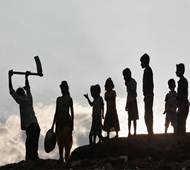
slavery copy copyAccording to the 2016 Global Slavery Index released by Australia-based human rights group Walk Free Foundation today, an estimated 45.8 million people, including women and children, are subject to some form of modern slavery in the world, compared to 35.8 million in 2014.

The report said India has the highest absolute numbers of people trapped in slavery with 18.35 million slaves among its 1.3 billion population while North Korea has the highest incidence (4.37 per cent of the population) and the weakest government response to deal with it.

In the last report in 2014, India had nearly 14.3 million people enslaved.
Incidences of slavery were found in all 167 countries in the index, with Asian countries occupy the top five for people trapped in slavery.

Behind India was China (3.39 million), Pakistan (2.13 million), Bangladesh (1.53 million) and Uzbekistan (1.23 million).

The index said that these five countries combined accounted for almost 58 per cent of the world's enslaved, or 26.6 million people.

The Index presents a ranking of 167 countries based on the proportion of the population that is estimated to be in modern slavery.

Modern slavery refers to situations of exploitation that a person cannot leave because of threats, violence, coercion, abuse of power or deception.

The research included over 42,000 interviews conducted in 53 languages across 25 countries, including 15 state-level surveys in India. These representative surveys covered 44 per cent of the global population.

The countries with the highest estimated prevalence of modern slavery by the proportion of their population are North Korea, Uzbekistan, Cambodia, Cambodia, India, and Qatar.

The countries with the lowest estimated prevalence of modern slavery by the proportion of their population are Luxembourg, Ireland, Norway, Denmark, Switzerland, Austria, Sweden and Belgium, the United States and Canada, and Australia and New Zealand.

The study also tracked the government actions and responses to the modern slavery and of the 161 assessed, 124 nations had criminalised human trafficking in line with the UN trafficking Protocol and 96 nations had developed national action plans to coordinate government response.

It noted that while India had more people enslaved than any other country, it had made significant progress in introducing measures to tackle the problem.

"It has criminalised trafficking, slavery, forced labour, child prostitution and forced marriage. The Indian government is currently tightening legislation against human trafficking, with tougher punishment for repeat offenders. It will offer victims protection and recovery support," it said.

It said that in addition to economic growth in India, ambitious programmes of legal and social reform are being undertaken right across the board, from regulation of labour relations to systems of social insurance for the most vulnerable.

Those governments taking the least action to combat modern slavery are North Korea, Iran, Eritrea, Equatorial Guinea, Hong Kong, Central African Republic, Papua New Guinea, Guinea, the Democratic Republic of the Congo and South Sudan.

The governments that have the strongest response to modern slavery are The Netherlands, the United States of America, the United Kingdom, Sweden, Australia, Portugal, Croatia, Spain, Belgium and Norway.

Seeking strong laws to abolish slavery, Andrew Forrest, Chairman and Founder of Walk Free Foundation, said eradicating slavery makes sense, morally, politically, logically and economically, and called on the governments of the world's leading economies to provide an example to others by enacting and implementing robust anti-slavery measures.

"We call on governments of the top 10 economies of the world to enact laws, at least as strong as the UK Modern Slavery Act 2015, with a budget and capability to ensure organisations are held to account for modern slavery in their supply chains, and to empower independent oversight."

Forrest said leaders of the world's major economies must bring the power of business to this issue, by requiring a focus on supply chain transparency.

"I believe in the critical role of leaders in government, business and civil society. Through our responsible use of power, strength of conviction, determination and collective will, we all can lead the world to end slavery," he said.

Forrest emphasised the key role that business needs to play in eradicating slavery.

"Businesses that don't actively look for forced labour within their supply chains are standing on a burning platform. Business leaders who refuse to look into the realities of their own supply chains are misguided and irresponsible," he said.

Comments

SK
 - 
Thursday, 2 Jun 2016

Since India is facing slavery, Naren has run away to Singapore to enjoy snake/ dog/cat/beef dishes......

Naren kotian
 - 
Tuesday, 31 May 2016

In that mostly 75% are from Muslim community as they enslave women as per their cult following .they have not changed since 6th century ...che papa ...ummah gang ge pitta netti geriruthe ..feku Anthe kumda ...for Muslims he might be feku ..but for nationalist Indians he is true hero who is transforming India .

Add new comment

  • Coastaldigest.com reserves the right to delete or block any comments.
  • Coastaldigset.com is not responsible for its readers’ comments.
  • Comments that are abusive, incendiary or irrelevant are strictly prohibited.
  • Please use a genuine email ID and provide your name to avoid reject.
News Network
June 15,2020

Bengaluru, Jun 15: After a three-month delay, seven-time MLA and former state minister DK Shivakumar, who has been appointed as the Karnataka Pradesh Congress Committee (KPCC) president, will take charge on July 2 at a simple function at the new party office here.

Mr Shivakumar was appointed as KPCC president on March 11.

Party sources said on Monday that Shivakumar plans to take charge of the party through a “pratijna dina” (pledge day) ceremony that would be telecast live to 7,800 locations across the state and over 10 lakh party workers are expected to attend it virtually.

Comments

Add new comment

  • Coastaldigest.com reserves the right to delete or block any comments.
  • Coastaldigset.com is not responsible for its readers’ comments.
  • Comments that are abusive, incendiary or irrelevant are strictly prohibited.
  • Please use a genuine email ID and provide your name to avoid reject.
News Network
February 5,2020

Bengaluru, Feb 5: Despite installing a BJP government in Karnataka through disguised operation Kamala, the Prime Minister Narendra Modi-led union government has continued its step motherly attitude towards this south Indian state.

Under the new formula adopted to share central taxes among states Karnataka will be the worst-affected. Though the 15th Finance Commission has recommended a special grant of Rs 5,495 crore for the state for 2020-21, the Centre appears reluctant to pay up and instead has asked for the proposal to be reviewed.

During the Union budget, the report of the 14th Finance Commission headed by NK Singh for 2020-21 was tabled in Lok Sabha. It shows besides Karnataka, Telangana, Mizoram and Kerala saw their central tax share decrease, while Uttar Pradesh, Bihar and Maharashtra were top gainers.

Karnataka's share has decreased from 4.7% provided by the previous finance commission, to 3.6%. Acknowledging there is a steep decline in Karnataka's share from 2019-20, the finance commission has recommended a special grant of Rs 5,495 crore for the state.

Its share in 2019-20 was Rs 36,675 crore, but under the new formula, Karnataka will get only Rs 31,180 crore in 2020-21 from the divisible pool of Rs 8.5 lakh crore - a decline of 22.5%.

Also, the decrease for Karnataka comes on the back of a shortfall in 2019-20. While the state was entitled to Rs 39,806 crore from the divisible pool, it got only Rs 36,675 crore as the Centre suffered a tax revenue shortfall of Rs 1.5 lakh crore.

What is more disheartening though is the Centre's refusal to pay the special grant. Instead, the Union finance ministry has asked the finance commission to reconsider the recommendation. This has prompted the state to take up the issue with the Centre.

"The decline in central taxes devolution comes at a time when the state is going through a tough financial situation. Steps are being taken to ensure Karnataka gets justice," said chief secretary TM Vijay Bhaskar.

Officials said besides corrective measures for 2020-21, the focus will be on ensuring a fair share in subsequent years. However, Karnataka has little chance of getting its dues as the Centre is known to be prudent when distributing tax proceeds among states.

"The Centre has certain views on devolution. We have done our duty by submitting the interim report. It's up to the states to convince the Centre," said Ravi Kota, joint secretary of 15th Finance Commission.

Under the new formula, the commission changed the weightage for some of the six criteria it considers - population, area, forest cover, income distance, demographic performance and tax effort.

Comments

Add new comment

  • Coastaldigest.com reserves the right to delete or block any comments.
  • Coastaldigset.com is not responsible for its readers’ comments.
  • Comments that are abusive, incendiary or irrelevant are strictly prohibited.
  • Please use a genuine email ID and provide your name to avoid reject.
News Network
March 28,2020

Bengaluru, Mar 28: The Karnataka government on Saturday said that the state run Indira Canteens would provide food packets free of cost to the poor and needy in the wake of the lockdown, the government said here on Saturday.

The canteens would operate in three schedules -from 7:30 AM to 10 AM, 12:30 PM to 3 PM and 7:30 PM to 9 PM, the government said in a public announcement

During the scheduled hours, street side vendors, labourers and poor would be provided food free of cost.

After the cabinet meeting on Friday, Chief Minister B S Yediyurappa had said food packets would be provided to the poor and needy with the help of some organisations through the Canteens and had sought the help of everyone in this regard.

The State-sponsored, subsidised 'Indira Canteens' as of now serves breakfast at Rs five and lunch and dinner at Rs 10.

The government asked people availing the facility to maintain cleanliness at the canteen and staff who serve food to compulsorily use masks and hand gloves.

It also said soaps and sanitizers should be made available at the canteens.

The government also asked people to maintain a minimum distance of one metre while standing in queue and take all precautionary measures.

Earlier, a day after announcing that food would be provided free of cost through the canteens for daily wagers, Yediyurappa on March 24 had said it has been decided that the canteens will not be opened, after realizing that it was leading to crowding, which drew criticism.

Comments

Add new comment

  • Coastaldigest.com reserves the right to delete or block any comments.
  • Coastaldigset.com is not responsible for its readers’ comments.
  • Comments that are abusive, incendiary or irrelevant are strictly prohibited.
  • Please use a genuine email ID and provide your name to avoid reject.