


India tops global slavery index with 18.35 mn people enslaved

May 31, 2016

Melbourne, May 31: India has the dubious distinction of having the highest number of people in the world trapped in modern slavery with 18.35 million victims of forced labour, ranging from prostitution and begging, according to a new report, which estimated that nearly 46 million people are enslaved globally.
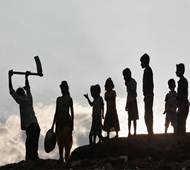
slavery copy copyAccording to the 2016 Global Slavery Index released by Australia-based human rights group Walk Free Foundation today, an estimated 45.8 million people, including women and children, are subject to some form of modern slavery in the world, compared to 35.8 million in 2014.

The report said India has the highest absolute numbers of people trapped in slavery with 18.35 million slaves among its 1.3 billion population while North Korea has the highest incidence (4.37 per cent of the population) and the weakest government response to deal with it.

In the last report in 2014, India had nearly 14.3 million people enslaved.
Incidences of slavery were found in all 167 countries in the index, with Asian countries occupy the top five for people trapped in slavery.

Behind India was China (3.39 million), Pakistan (2.13 million), Bangladesh (1.53 million) and Uzbekistan (1.23 million).

The index said that these five countries combined accounted for almost 58 per cent of the world's enslaved, or 26.6 million people.

The Index presents a ranking of 167 countries based on the proportion of the population that is estimated to be in modern slavery.

Modern slavery refers to situations of exploitation that a person cannot leave because of threats, violence, coercion, abuse of power or deception.

The research included over 42,000 interviews conducted in 53 languages across 25 countries, including 15 state-level surveys in India. These representative surveys covered 44 per cent of the global population.

The countries with the highest estimated prevalence of modern slavery by the proportion of their population are North Korea, Uzbekistan, Cambodia, Cambodia, India, and Qatar.

The countries with the lowest estimated prevalence of modern slavery by the proportion of their population are Luxembourg, Ireland, Norway, Denmark, Switzerland, Austria, Sweden and Belgium, the United States and Canada, and Australia and New Zealand.

The study also tracked the government actions and responses to the modern slavery and of the 161 assessed, 124 nations had criminalised human trafficking in line with the UN trafficking Protocol and 96 nations had developed national action plans to coordinate government response.

It noted that while India had more people enslaved than any other country, it had made significant progress in introducing measures to tackle the problem.

"It has criminalised trafficking, slavery, forced labour, child prostitution and forced marriage. The Indian government is currently tightening legislation against human trafficking, with tougher punishment for repeat offenders. It will offer victims protection and recovery support," it said.

It said that in addition to economic growth in India, ambitious programmes of legal and social reform are being undertaken right across the board, from regulation of labour relations to systems of social insurance for the most vulnerable.

Those governments taking the least action to combat modern slavery are North Korea, Iran, Eritrea, Equatorial Guinea, Hong Kong, Central African Republic, Papua New Guinea, Guinea, the Democratic Republic of the Congo and South Sudan.

The governments that have the strongest response to modern slavery are The Netherlands, the United States of America, the United Kingdom, Sweden, Australia, Portugal, Croatia, Spain, Belgium and Norway.

Seeking strong laws to abolish slavery, Andrew Forrest, Chairman and Founder of Walk Free Foundation, said eradicating slavery makes sense, morally, politically, logically and economically, and called on the governments of the world's leading economies to provide an example to others by enacting and implementing robust anti-slavery measures.

"We call on governments of the top 10 economies of the world to enact laws, at least as strong as the UK Modern Slavery Act 2015, with a budget and capability to ensure organisations are held to account for modern slavery in their supply chains, and to empower independent oversight."

Forrest said leaders of the world's major economies must bring the power of business to this issue, by requiring a focus on supply chain transparency.

"I believe in the critical role of leaders in government, business and civil society. Through our responsible use of power, strength of conviction, determination and collective will, we all can lead the world to end slavery," he said.

Forrest emphasised the key role that business needs to play in eradicating slavery.

"Businesses that don't actively look for forced labour within their supply chains are standing on a burning platform. Business leaders who refuse to look into the realities of their own supply chains are misguided and irresponsible," he said.

Comments

SK
 - 
Thursday, 2 Jun 2016

Since India is facing slavery, Naren has run away to Singapore to enjoy snake/ dog/cat/beef dishes......

Naren kotian
 - 
Tuesday, 31 May 2016

In that mostly 75% are from Muslim community as they enslave women as per their cult following .they have not changed since 6th century ...che papa ...ummah gang ge pitta netti geriruthe ..feku Anthe kumda ...for Muslims he might be feku ..but for nationalist Indians he is true hero who is transforming India .

Add new comment

  • Coastaldigest.com reserves the right to delete or block any comments.
  • Coastaldigset.com is not responsible for its readers’ comments.
  • Comments that are abusive, incendiary or irrelevant are strictly prohibited.
  • Please use a genuine email ID and provide your name to avoid reject.
coastaldigest.com news network
July 4,2020

Mangaluru, Jul 4: Normal life was thrown out of gear as heavy rain under the influence of South East Monsoon started lashing coastal districts of Karnataka including Dakshina Kannada on Saturday.

The heavy rain is likely to continue till July 7, according to the meteorological experts. 

The water level in Netravati river is increasing and district administration has warned the people living in the low lying areas and has asked them to move to safer places.

Owing to lack of storm water drains, water logging of the roads inconvenienced the motorists at KS Rao Road, Pumpwell, Bejai, and other areas. 

The Met department sounded warning for fishermen not to venture into the sea observing that strong winds with speed reaching 50-60 kmph are likely to prevail over Southwest and West Central Arabian Sea till July 5.

Comments

Add new comment

  • Coastaldigest.com reserves the right to delete or block any comments.
  • Coastaldigset.com is not responsible for its readers’ comments.
  • Comments that are abusive, incendiary or irrelevant are strictly prohibited.
  • Please use a genuine email ID and provide your name to avoid reject.
News Network
January 2,2020

Bengaluru, Jan 2: The Congress leadership in Delhi is expected to start the process of selecting a new party chief for Karnataka next week. There are strong indications the race has narrowed to DK Shivakumar and MB Patil.

Party insiders said the leadership almost finalised Shivakumar’s name as the president of Karnataka Pradesh Congress Committee (KPCC), but the decision was put on hold after requests by some senior members.

“It’s not that we are against Shivakumar. We think the party should have a Lingayat at the helm since community strongman and chief minister BS Yediyurappa is at the fag end of his long political career. There’s an opportunity here for a Congressman to occupy that space,” said a senior Congress politician, who didn’t want to be named.

That’s where the candidacy of Patil, a Lingayat, scores high.

The party, however, doesn’t want to compromise on quality and wants an efficient KPCC president who can unite two rival factions within the party, one led by Siddaramaiah and another by former union minister KH Muniyappa.

The need to pick a new state president arose after Dinesh Gundurao resigned from the post last month, taking moral responsibility for Congress’s poor showing in the byelections. Siddaramaiah also stood down as Congress party legislature leader.

The insiders said the new KPCC chief could be announced after January 16. The party might also appoint two working presidents and a new legislature party leader, who will automatically become the opposition’s voice in the assembly.

For the latter position, the name of senior Dalit politician and former deputy chief minister G Parameshwara is doing the rounds. But the party, the sources said, could still ask Siddaramaiah to reconsider his decision and stay on.

Many Congress members had raised questions over his stewardship after the bypoll disappointment. They said on his watch, the party had also fared badly in the assembly and Lok Sabha elections, demanding that he be held accountable.

Siddaramaiah is expected to visit Delhi next week to discuss the leadership issue with party boss Sonia Gandhi. Some other senior Congress members, including BK Hariprasad, are also likely to meet her.

Comments

Add new comment

  • Coastaldigest.com reserves the right to delete or block any comments.
  • Coastaldigset.com is not responsible for its readers’ comments.
  • Comments that are abusive, incendiary or irrelevant are strictly prohibited.
  • Please use a genuine email ID and provide your name to avoid reject.
coastaldigest.com news network
July 18,2020

Udupi, Jul 18: Noted multi-lingual scholar Dr Uliyar Padmanabha Upadhyaya passed away last night at a private hospital in Manipal. The 88-year-old was survived by a son and a daughter.

His wife Susheela Uadhyaya, who was also a multi-lingual scholar, had passed away in January 2014 at the age of 77. The duo had compiled the six-volume Tulu Lexicon. Its first volume was published in 1988 and the last volume in 1997.

Son of Sitaram Upadhyaya, who was a scholar in the court of the Raja of Travancore, Dr Padmanabha was born on April 10, 1932 at Uliyar in Majur Village near Kaup in Udupi district. 

The Upadhyaya couple had conducted serious research work in linguistics and folk culture and produced a number of books-some of them jointly, some individually and some in collaboration with others. 

Dr Padmanabha had acquired three Master of Arts degrees in Sanskrit, Kannada and Linguistics from Madras, Kerala and Pune Universities, Vidwan in Hindi and PhD in Linguistics from the Pune University for his thesis titled “A Comparative Study of Kannada Dialects”.

He was a visiting Professor at the Universities of London and Paris. He knew Hindi, Kannada, Tulu, Malayalam, Tamil, English, French and Olof, the language of Senegal in Africa.

His works include Nanjanagudu Kannada (Vokkaliga Dialect), Coorg Kannada, Kuruba - A Dravidian Language, Kannada - A Phonetic Language, Malayalam Language and Literature (with Ms. Susheela), Effect of Bilingualism on Bidar Kannada, Coimbatore Tamil, Kannada as Spoken by Different Population Groups in Mysore City, Dravidian and Negro African: Ethno Linguistic Study (with Ms. Susheela), Conversational Kannada, Coastal Karnataka and Bhuta Worship: Aspects of a Ritualistic Theatre (with Ms. Susheela).

Also Read: Eminent linguist Dr Susheela P Upadhyaya no more

Comments

Add new comment

  • Coastaldigest.com reserves the right to delete or block any comments.
  • Coastaldigset.com is not responsible for its readers’ comments.
  • Comments that are abusive, incendiary or irrelevant are strictly prohibited.
  • Please use a genuine email ID and provide your name to avoid reject.