


India tops global slavery index with 18.35 mn people enslaved

May 31, 2016

Melbourne, May 31: India has the dubious distinction of having the highest number of people in the world trapped in modern slavery with 18.35 million victims of forced labour, ranging from prostitution and begging, according to a new report, which estimated that nearly 46 million people are enslaved globally.
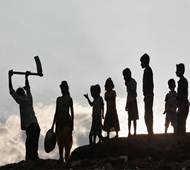
slavery copy copyAccording to the 2016 Global Slavery Index released by Australia-based human rights group Walk Free Foundation today, an estimated 45.8 million people, including women and children, are subject to some form of modern slavery in the world, compared to 35.8 million in 2014.

The report said India has the highest absolute numbers of people trapped in slavery with 18.35 million slaves among its 1.3 billion population while North Korea has the highest incidence (4.37 per cent of the population) and the weakest government response to deal with it.

In the last report in 2014, India had nearly 14.3 million people enslaved.
Incidences of slavery were found in all 167 countries in the index, with Asian countries occupy the top five for people trapped in slavery.

Behind India was China (3.39 million), Pakistan (2.13 million), Bangladesh (1.53 million) and Uzbekistan (1.23 million).

The index said that these five countries combined accounted for almost 58 per cent of the world's enslaved, or 26.6 million people.

The Index presents a ranking of 167 countries based on the proportion of the population that is estimated to be in modern slavery.

Modern slavery refers to situations of exploitation that a person cannot leave because of threats, violence, coercion, abuse of power or deception.

The research included over 42,000 interviews conducted in 53 languages across 25 countries, including 15 state-level surveys in India. These representative surveys covered 44 per cent of the global population.

The countries with the highest estimated prevalence of modern slavery by the proportion of their population are North Korea, Uzbekistan, Cambodia, Cambodia, India, and Qatar.

The countries with the lowest estimated prevalence of modern slavery by the proportion of their population are Luxembourg, Ireland, Norway, Denmark, Switzerland, Austria, Sweden and Belgium, the United States and Canada, and Australia and New Zealand.

The study also tracked the government actions and responses to the modern slavery and of the 161 assessed, 124 nations had criminalised human trafficking in line with the UN trafficking Protocol and 96 nations had developed national action plans to coordinate government response.

It noted that while India had more people enslaved than any other country, it had made significant progress in introducing measures to tackle the problem.

"It has criminalised trafficking, slavery, forced labour, child prostitution and forced marriage. The Indian government is currently tightening legislation against human trafficking, with tougher punishment for repeat offenders. It will offer victims protection and recovery support," it said.

It said that in addition to economic growth in India, ambitious programmes of legal and social reform are being undertaken right across the board, from regulation of labour relations to systems of social insurance for the most vulnerable.

Those governments taking the least action to combat modern slavery are North Korea, Iran, Eritrea, Equatorial Guinea, Hong Kong, Central African Republic, Papua New Guinea, Guinea, the Democratic Republic of the Congo and South Sudan.

The governments that have the strongest response to modern slavery are The Netherlands, the United States of America, the United Kingdom, Sweden, Australia, Portugal, Croatia, Spain, Belgium and Norway.

Seeking strong laws to abolish slavery, Andrew Forrest, Chairman and Founder of Walk Free Foundation, said eradicating slavery makes sense, morally, politically, logically and economically, and called on the governments of the world's leading economies to provide an example to others by enacting and implementing robust anti-slavery measures.

"We call on governments of the top 10 economies of the world to enact laws, at least as strong as the UK Modern Slavery Act 2015, with a budget and capability to ensure organisations are held to account for modern slavery in their supply chains, and to empower independent oversight."

Forrest said leaders of the world's major economies must bring the power of business to this issue, by requiring a focus on supply chain transparency.

"I believe in the critical role of leaders in government, business and civil society. Through our responsible use of power, strength of conviction, determination and collective will, we all can lead the world to end slavery," he said.

Forrest emphasised the key role that business needs to play in eradicating slavery.

"Businesses that don't actively look for forced labour within their supply chains are standing on a burning platform. Business leaders who refuse to look into the realities of their own supply chains are misguided and irresponsible," he said.

Comments

SK
 - 
Thursday, 2 Jun 2016

Since India is facing slavery, Naren has run away to Singapore to enjoy snake/ dog/cat/beef dishes......

Naren kotian
 - 
Tuesday, 31 May 2016

In that mostly 75% are from Muslim community as they enslave women as per their cult following .they have not changed since 6th century ...che papa ...ummah gang ge pitta netti geriruthe ..feku Anthe kumda ...for Muslims he might be feku ..but for nationalist Indians he is true hero who is transforming India .

Add new comment

  • Coastaldigest.com reserves the right to delete or block any comments.
  • Coastaldigset.com is not responsible for its readers’ comments.
  • Comments that are abusive, incendiary or irrelevant are strictly prohibited.
  • Please use a genuine email ID and provide your name to avoid reject.
News Network
March 28,2020

Bengaluru, Mar 28: The Karnataka government on Saturday said that the state run Indira Canteens would provide food packets free of cost to the poor and needy in the wake of the lockdown, the government said here on Saturday.

The canteens would operate in three schedules -from 7:30 AM to 10 AM, 12:30 PM to 3 PM and 7:30 PM to 9 PM, the government said in a public announcement

During the scheduled hours, street side vendors, labourers and poor would be provided food free of cost.

After the cabinet meeting on Friday, Chief Minister B S Yediyurappa had said food packets would be provided to the poor and needy with the help of some organisations through the Canteens and had sought the help of everyone in this regard.

The State-sponsored, subsidised 'Indira Canteens' as of now serves breakfast at Rs five and lunch and dinner at Rs 10.

The government asked people availing the facility to maintain cleanliness at the canteen and staff who serve food to compulsorily use masks and hand gloves.

It also said soaps and sanitizers should be made available at the canteens.

The government also asked people to maintain a minimum distance of one metre while standing in queue and take all precautionary measures.

Earlier, a day after announcing that food would be provided free of cost through the canteens for daily wagers, Yediyurappa on March 24 had said it has been decided that the canteens will not be opened, after realizing that it was leading to crowding, which drew criticism.

Comments

Add new comment

  • Coastaldigest.com reserves the right to delete or block any comments.
  • Coastaldigset.com is not responsible for its readers’ comments.
  • Comments that are abusive, incendiary or irrelevant are strictly prohibited.
  • Please use a genuine email ID and provide your name to avoid reject.
News Network
January 11,2020

Bengaluru, Jan 11: The Chief Justice of India Justice Sharad Arvind Bobde on Saturday inaugurated the phase-1 of the new building of the Karnataka Judicial Academy on Crescent Road in Bengaluru.

The new building has three floors, besides, the ground floor and two basement floors.

While Chief Minister B S Yediyurappa inaugurated the 319-seater multi-purpose auditorium, at which Chief Justice of the High Court of Karnataka Justice Abhay Shreeniwas Oka felicitated Justice Bobde.

Justice Ravi Malimath, President of the Karnataka Judicial Academy and Judge of the High Court of Karnataka, in his welcome address said that the academy has so far trained as many as 4000 judicial officers and striving for excellence in the field of judiciary.

The building, built in the first phase, has parking in the lower and the upper basement, which can accommodate 44 cars and 124 two-wheelers, the ground floor consists of a 319-seater multi-purpose air-conditioned auditorium, a lecture hall with 84 seats, two lecture halls with 40 seats each and a VIP lounge. The First Floor has a lecture hall with 84 seats, two lecture halls with 40 seats each, a VIP lounge, two discussion rooms and an administrative office for the staff of the academy.

The second phase, to be built has a parking facility for 36 four-wheelers and 22 two-wheelers in the lower basement and 32 four-wheelers and 30 two-wheelers in the upper basement.

The total cost of the project, including Phase-1 and Phase-2, to be executed by the Public Works Department in the sprawling 2.2 acres plot of the Karnataka Judicial Academy is around Rs 96.02 Crore.

Comments

Add new comment

  • Coastaldigest.com reserves the right to delete or block any comments.
  • Coastaldigset.com is not responsible for its readers’ comments.
  • Comments that are abusive, incendiary or irrelevant are strictly prohibited.
  • Please use a genuine email ID and provide your name to avoid reject.
coastaldigest.com web desk
July 25,2020

Bengaluru, July 25: A 105-year-old person from Bengaluru’s Basaveshwar Nagar, who was under treatment for covid-19 at a hospital for past five days, breathed his last today. He was a former government account who retired in 1973. He was the oldest known covid-19 patient in the state so far.

Many members of the patient's family are said to be infected and are hospitalised at various facilities. The funeral will be overseen by two uninfected family members.

The patient 74411 died on Saturday morning at around 9 a.m., said Dr Prasanna, Managing Director of Pristine Hospital And Research Centre where the former was admitted.

“The patient was initially doing well when he admitted on July 20. He did not have significant lung changes when he was admitted. However, after three days, his blood pressure started to drop so he was put on oxygen in the ICU. Yesterday morning, with continued deterioration, he was placed on non-invasive ventilator support,” Dr Prasanna said.

“Finally, by last night, his oxygen saturation levels began to plummet abruptly and we had to intubate him for ventilator support. His condition continued to deteriorate, however. The cause of death was respiratory failure and the onset of sepsis,” he added.

Although earmarked for supplies of Remdesivir by the government, the hospital did not receive the drugs. An appeal to Dr K Sudhakar, Minister of Medical Education by the hospital staff resulted in an assurance that the medication would arrive. “However, in the end, we had to source the medication ourselves on Friday,” medical staff said.

Dr Thrilok Chandra, Head, Critical Care Support Unit (CCSU), which oversees the care of critical or vulnerable-aged Covid-19 patients, had said that Patient 74411 had been diagnosed early. “He was identified when the disease was still in the early stages in his body. He only had symptoms of Influenza-Like Illness (ILI), so the symptoms were not severe,” Dr Chandra had said.

“It’s very sad. We were rooting for him to pull through. He had no comorbidities at all. He had been bed-ridden from last year, but he was healthy. His only potential comorbidity was his advanced age,” Dr Prasanna said.

According to government data, 34% of Covid-19 fatalities in India are aged between 60 and 74 years of age. Fourteen per cent are aged above 74.

Comments

Add new comment

  • Coastaldigest.com reserves the right to delete or block any comments.
  • Coastaldigset.com is not responsible for its readers’ comments.
  • Comments that are abusive, incendiary or irrelevant are strictly prohibited.
  • Please use a genuine email ID and provide your name to avoid reject.