


India tops global slavery index with 18.35 mn people enslaved

May 31, 2016

Melbourne, May 31: India has the dubious distinction of having the highest number of people in the world trapped in modern slavery with 18.35 million victims of forced labour, ranging from prostitution and begging, according to a new report, which estimated that nearly 46 million people are enslaved globally.
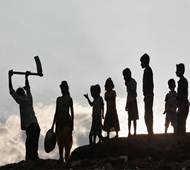
slavery copy copyAccording to the 2016 Global Slavery Index released by Australia-based human rights group Walk Free Foundation today, an estimated 45.8 million people, including women and children, are subject to some form of modern slavery in the world, compared to 35.8 million in 2014.

The report said India has the highest absolute numbers of people trapped in slavery with 18.35 million slaves among its 1.3 billion population while North Korea has the highest incidence (4.37 per cent of the population) and the weakest government response to deal with it.

In the last report in 2014, India had nearly 14.3 million people enslaved.
Incidences of slavery were found in all 167 countries in the index, with Asian countries occupy the top five for people trapped in slavery.

Behind India was China (3.39 million), Pakistan (2.13 million), Bangladesh (1.53 million) and Uzbekistan (1.23 million).

The index said that these five countries combined accounted for almost 58 per cent of the world's enslaved, or 26.6 million people.

The Index presents a ranking of 167 countries based on the proportion of the population that is estimated to be in modern slavery.

Modern slavery refers to situations of exploitation that a person cannot leave because of threats, violence, coercion, abuse of power or deception.

The research included over 42,000 interviews conducted in 53 languages across 25 countries, including 15 state-level surveys in India. These representative surveys covered 44 per cent of the global population.

The countries with the highest estimated prevalence of modern slavery by the proportion of their population are North Korea, Uzbekistan, Cambodia, Cambodia, India, and Qatar.

The countries with the lowest estimated prevalence of modern slavery by the proportion of their population are Luxembourg, Ireland, Norway, Denmark, Switzerland, Austria, Sweden and Belgium, the United States and Canada, and Australia and New Zealand.

The study also tracked the government actions and responses to the modern slavery and of the 161 assessed, 124 nations had criminalised human trafficking in line with the UN trafficking Protocol and 96 nations had developed national action plans to coordinate government response.

It noted that while India had more people enslaved than any other country, it had made significant progress in introducing measures to tackle the problem.

"It has criminalised trafficking, slavery, forced labour, child prostitution and forced marriage. The Indian government is currently tightening legislation against human trafficking, with tougher punishment for repeat offenders. It will offer victims protection and recovery support," it said.

It said that in addition to economic growth in India, ambitious programmes of legal and social reform are being undertaken right across the board, from regulation of labour relations to systems of social insurance for the most vulnerable.

Those governments taking the least action to combat modern slavery are North Korea, Iran, Eritrea, Equatorial Guinea, Hong Kong, Central African Republic, Papua New Guinea, Guinea, the Democratic Republic of the Congo and South Sudan.

The governments that have the strongest response to modern slavery are The Netherlands, the United States of America, the United Kingdom, Sweden, Australia, Portugal, Croatia, Spain, Belgium and Norway.

Seeking strong laws to abolish slavery, Andrew Forrest, Chairman and Founder of Walk Free Foundation, said eradicating slavery makes sense, morally, politically, logically and economically, and called on the governments of the world's leading economies to provide an example to others by enacting and implementing robust anti-slavery measures.

"We call on governments of the top 10 economies of the world to enact laws, at least as strong as the UK Modern Slavery Act 2015, with a budget and capability to ensure organisations are held to account for modern slavery in their supply chains, and to empower independent oversight."

Forrest said leaders of the world's major economies must bring the power of business to this issue, by requiring a focus on supply chain transparency.

"I believe in the critical role of leaders in government, business and civil society. Through our responsible use of power, strength of conviction, determination and collective will, we all can lead the world to end slavery," he said.

Forrest emphasised the key role that business needs to play in eradicating slavery.

"Businesses that don't actively look for forced labour within their supply chains are standing on a burning platform. Business leaders who refuse to look into the realities of their own supply chains are misguided and irresponsible," he said.

Comments

SK
 - 
Thursday, 2 Jun 2016

Since India is facing slavery, Naren has run away to Singapore to enjoy snake/ dog/cat/beef dishes......

Naren kotian
 - 
Tuesday, 31 May 2016

In that mostly 75% are from Muslim community as they enslave women as per their cult following .they have not changed since 6th century ...che papa ...ummah gang ge pitta netti geriruthe ..feku Anthe kumda ...for Muslims he might be feku ..but for nationalist Indians he is true hero who is transforming India .

Add new comment

  • Coastaldigest.com reserves the right to delete or block any comments.
  • Coastaldigset.com is not responsible for its readers’ comments.
  • Comments that are abusive, incendiary or irrelevant are strictly prohibited.
  • Please use a genuine email ID and provide your name to avoid reject.
News Network
March 27,2020

Mysuru, Mar 27: A 35-year old man from Mysuru, Karnataka was tested positive for coronavirus infection on Thursday, taking the state-wide count to 52 altogether.

This new case could be an indication that Covid-19 has entered into the third stage of community transmission in Karnataka, as the infected person neither has any travel history nor have been in contact with Covid-affected persons.

The patient works in the quality assurance section of a pharmaceutical company in Nanjangud in Mysuru district, and has been in continuous contact with medical care professionals.

Mysuru DC Mr Abhiram G Shankar informs that detailed investigation is under process.

He is currently undergoing treatment at an isolation ward in a designated hospital in Mysuru. So far his seven primary contacts have been traced and they are under home quarantine, Mr Abhiram Shankar said.

A 35 year old Mysurean, and another 46 year old Keralite, both who had come from Dubai, were the first and second cases tested positive for Covid-19 in Mysuru. They are also currently kept under isolation.

Mysuru district administration has identified 898 international passengers in Mysuru district including 152 in the taluks. Among them, while 149 persons have completed home quarantine period by now, the rest are still in isolation.

Comments

Add new comment

  • Coastaldigest.com reserves the right to delete or block any comments.
  • Coastaldigset.com is not responsible for its readers’ comments.
  • Comments that are abusive, incendiary or irrelevant are strictly prohibited.
  • Please use a genuine email ID and provide your name to avoid reject.
News Network
April 12,2020

New Delhi, Apr 12: Ramping up efforts to "stamp out" coronavirus cases in the state, Kerala Finance Minister Thomas Isaac has said that not only lockdown but intense testing of people and tracing of their contacts are also equally important in the fight against the outbreak.

Kerala, which was the first state in the country to report a coronavirus infection in late January, has also prepared a time table for coming out of the lockdown and there would be district-specific strategies to tackle the situation while the number of cases are on the decline.

In efforts to curb spreading of coronavirus infections, the country is under a 21-day lockdown till April 14 and many states have sought an extension amid rising number of cases. Kerala has proposed extending the lockdown and gradual phasing out after proper assessment.

"Lockdown should go on till we stamp out entire infections. Now, it is not enough to have lockdown. Equally important is that we should have intense testing, tracing and isolating (of people with coronavirus infections)," he said in a telephonic interview.

The government is closely monitoring the situation and there would be region-specific or district-specific strategies in place to tackle the outbreak, he said.

Against the backdrop of the lockdown that has also disrupted economic activities, Isaac said an exit strategy is being prepared and restrictions are being relaxed in certain segments, including agriculture.

Coronavirus India update: State-wise total number of confirmed cases, deaths on April 12

"The number of patients is coming down (in the state). We hope that in the coming days, the decline will be much more faster," he said during the interview late Friday.

On Saturday, the Kerala government said there were a total of 373 confirmed cases of coronavirus infections and 228 patients were under treatment in various hospitals in the state.

Keeping the trend in the last few days, the number of people under observation has come down to 1,23,490. So far, 14,613 samples from people with symptoms were sent for testing and the results of 12,818 samples have come negative, the government said in a statement on Saturday.

Indicating that there would be a calibrated exit from the lockdown, Isaac said the withdrawal would depend on three main factors, including the count of cases and the percentage of people who are under observation.

While emphasising that people must also be fed during the lockdown period, Isaac also said a time table is being prepared by the state to come out of the lockdown.

Even as strict measures are being implemented to deal with the current situation, the state is also preparing for a possible third wave of coronavirus cases.

Three students, who had returned from the Chinese city of Wuhan, were tested positive. They were also the first such cases, to be reported in January-February period, and have recovered. Wuhan was the epicentre of coronavirus infections before it spread to other countries.

Later, there was a second wave of infections in Kerala.

According to the minister, the possibility of a third wave has also been considered for the exit strategy.

"A lot of Malayalees are expected to come back from outside the state. We will welcome them... before that, we want to stamp out all Covid cases in Kerala. Flatten the curve completely so that when these people from outside, they will be quarantined, they will be tested and only then they will be able to integrate with the rest of the community," he said.

The Kerala government's measures, including extensive testing and efforts to trace people who came in contact with coronavirus-infected persons, have helped in curbing spreading of infections.

The state's public healthcare system has also been appreciated in various quarters.

"People are health conscious. There is a demand for quality healthcare services and the response to this demand has been strengthening of the public healthcare system. We have a robust public healthcare system," the minister emphasised.

On April 9, Isaac tweeted about low level of coronavirus spreading in the state.

"International norm for Covid spread is 2.6 per 1 Covid patient. Total number of primary Covid infected who arrived in Kerala from abroad is 254. The secondary spread has been limited to 91. The international mortality rate is 5.75. With just 2 deaths, rate in Kerala is 0.58," he had tweeted.

Death toll due to the coronavirus increased to 273 and the number of cases to 8,356 in the country on Sunday.

Comments

Add new comment

  • Coastaldigest.com reserves the right to delete or block any comments.
  • Coastaldigset.com is not responsible for its readers’ comments.
  • Comments that are abusive, incendiary or irrelevant are strictly prohibited.
  • Please use a genuine email ID and provide your name to avoid reject.
News Network
January 24,2020

Mangaluru, Jan 24: Aditya Rao, who was arrested for planting Improvised explosive device (IED) at Mangaluru airport on January 20, was brought to the airport on Friday for recreation of the crime scene as part of the investigation process.

Yesterday, one more case was registered against Rao in connection with a hoax call to the terminal manager of the airport on January 20, police said.

"One more case has been registered against Aditya Rao at Bajpe Police station for a hoax call to the terminal manager of Mangaluru International Airport on January 20," said PS Harsha, Mangalore Commissioner of Police on Thursday.

Earlier, Harsha informed that Rao, who surrendered before the Bengaluru Police, is now in the custody of Mangaluru Police.

"Our investigation team arrested Aditya Rao in Bengaluru in connection with the planting of an explosive device at Mangaluru airport. We produced the accused before Bengaluru's first JMFC court and the court issued a transit warrant," Harsha said.

"We have brought him to Mangaluru from Bengaluru and now the accused is in our custody. Our investigation team will interrogate him. We will investigate all aspects. He will be produced before Mangaluru 6th JMFC Court," he added.

Rao hails from Udupi and has engineering and MBA degrees.

According to the police, the IED was recovered from a bag at the Mangaluru airport. It was later defused in an open field by the personnel of the bomb disposal squad.

Comments

Add new comment

  • Coastaldigest.com reserves the right to delete or block any comments.
  • Coastaldigset.com is not responsible for its readers’ comments.
  • Comments that are abusive, incendiary or irrelevant are strictly prohibited.
  • Please use a genuine email ID and provide your name to avoid reject.