


India tops global slavery index with 18.35 mn people enslaved

May 31, 2016

Melbourne, May 31: India has the dubious distinction of having the highest number of people in the world trapped in modern slavery with 18.35 million victims of forced labour, ranging from prostitution and begging, according to a new report, which estimated that nearly 46 million people are enslaved globally.
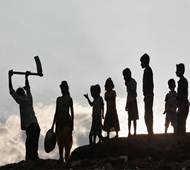
slavery copy copyAccording to the 2016 Global Slavery Index released by Australia-based human rights group Walk Free Foundation today, an estimated 45.8 million people, including women and children, are subject to some form of modern slavery in the world, compared to 35.8 million in 2014.

The report said India has the highest absolute numbers of people trapped in slavery with 18.35 million slaves among its 1.3 billion population while North Korea has the highest incidence (4.37 per cent of the population) and the weakest government response to deal with it.

In the last report in 2014, India had nearly 14.3 million people enslaved.
Incidences of slavery were found in all 167 countries in the index, with Asian countries occupy the top five for people trapped in slavery.

Behind India was China (3.39 million), Pakistan (2.13 million), Bangladesh (1.53 million) and Uzbekistan (1.23 million).

The index said that these five countries combined accounted for almost 58 per cent of the world's enslaved, or 26.6 million people.

The Index presents a ranking of 167 countries based on the proportion of the population that is estimated to be in modern slavery.

Modern slavery refers to situations of exploitation that a person cannot leave because of threats, violence, coercion, abuse of power or deception.

The research included over 42,000 interviews conducted in 53 languages across 25 countries, including 15 state-level surveys in India. These representative surveys covered 44 per cent of the global population.

The countries with the highest estimated prevalence of modern slavery by the proportion of their population are North Korea, Uzbekistan, Cambodia, Cambodia, India, and Qatar.

The countries with the lowest estimated prevalence of modern slavery by the proportion of their population are Luxembourg, Ireland, Norway, Denmark, Switzerland, Austria, Sweden and Belgium, the United States and Canada, and Australia and New Zealand.

The study also tracked the government actions and responses to the modern slavery and of the 161 assessed, 124 nations had criminalised human trafficking in line with the UN trafficking Protocol and 96 nations had developed national action plans to coordinate government response.

It noted that while India had more people enslaved than any other country, it had made significant progress in introducing measures to tackle the problem.

"It has criminalised trafficking, slavery, forced labour, child prostitution and forced marriage. The Indian government is currently tightening legislation against human trafficking, with tougher punishment for repeat offenders. It will offer victims protection and recovery support," it said.

It said that in addition to economic growth in India, ambitious programmes of legal and social reform are being undertaken right across the board, from regulation of labour relations to systems of social insurance for the most vulnerable.

Those governments taking the least action to combat modern slavery are North Korea, Iran, Eritrea, Equatorial Guinea, Hong Kong, Central African Republic, Papua New Guinea, Guinea, the Democratic Republic of the Congo and South Sudan.

The governments that have the strongest response to modern slavery are The Netherlands, the United States of America, the United Kingdom, Sweden, Australia, Portugal, Croatia, Spain, Belgium and Norway.

Seeking strong laws to abolish slavery, Andrew Forrest, Chairman and Founder of Walk Free Foundation, said eradicating slavery makes sense, morally, politically, logically and economically, and called on the governments of the world's leading economies to provide an example to others by enacting and implementing robust anti-slavery measures.

"We call on governments of the top 10 economies of the world to enact laws, at least as strong as the UK Modern Slavery Act 2015, with a budget and capability to ensure organisations are held to account for modern slavery in their supply chains, and to empower independent oversight."

Forrest said leaders of the world's major economies must bring the power of business to this issue, by requiring a focus on supply chain transparency.

"I believe in the critical role of leaders in government, business and civil society. Through our responsible use of power, strength of conviction, determination and collective will, we all can lead the world to end slavery," he said.

Forrest emphasised the key role that business needs to play in eradicating slavery.

"Businesses that don't actively look for forced labour within their supply chains are standing on a burning platform. Business leaders who refuse to look into the realities of their own supply chains are misguided and irresponsible," he said.

Comments

SK
 - 
Thursday, 2 Jun 2016

Since India is facing slavery, Naren has run away to Singapore to enjoy snake/ dog/cat/beef dishes......

Naren kotian
 - 
Tuesday, 31 May 2016

In that mostly 75% are from Muslim community as they enslave women as per their cult following .they have not changed since 6th century ...che papa ...ummah gang ge pitta netti geriruthe ..feku Anthe kumda ...for Muslims he might be feku ..but for nationalist Indians he is true hero who is transforming India .

Add new comment

  • Coastaldigest.com reserves the right to delete or block any comments.
  • Coastaldigset.com is not responsible for its readers’ comments.
  • Comments that are abusive, incendiary or irrelevant are strictly prohibited.
  • Please use a genuine email ID and provide your name to avoid reject.
coastaldigest.com news network
April 17,2020

The unexpected lockdown to prevent spread of covid–19 has caused a serious damage to the lives of Indian expatriates irrespective of laborers and entrepreneurs in Kingdom of Saudi Arabia. Different stories of expatriates' ordeals are emerging from the region. 

Abdul Razaq, hailing from Udupi in Karnataka has been running small scale business at Jeddah, Saudi Arabia, based on oil refinery projects of the government. He was undergoing medical treatment for his cancer which is in fist stage. He explaines his ordeals caused by lockdown and stopping the flight facility. 

“I was regularly visiting home country for the treatment of cancer. Now I cannot go as international flight service has been stopped. I expect that government will hear problems of expatriates and will arrange facilities to take us back to home”, he said.

Mubeen from Bengaluru was working on temporary basis  for a company in Jubail. He had lost his jobs like some of his colleagues due to the lockdown.

“As everything was alright, I had brought my parents recently to Saudi Arabia on a visit visa. Things changed drastically with covid-19 attack. Continuous lockdown caused burden over the company and they removed temporary employees like me to control possible losses” he said.

“Now owner of the flat has been harassing me for the rent. I do not have money either to pay rent or to cover daily family expenses. I do not know what to do further”, he added. 

Iqbal from Mangaluru left for Saudi Arabia to help his family. He got a job in a juce centre in Dammam recently. Corona lockdown made his life difficult. He is eager to return his home country. 

“I came to Saudi Arbia because of financial difficulties as I had not found any job with good salary there. I thought I can earn well by going to Saudi Arabia. However, here too the salary was not so good. Now juice center is closed due to lockdown and sponsor is giving very small amount of money as salary through which we cannot afford our expenses and our families back in home,” he said.

“Here It is not easy get help of fellow Indians since most of them have their own ordeals. I would like to return home country; there however we can manage to get help of friends and relatives. I am looking forward the help of Indian government to start air facility for stranded NRIs,” he said. 

Mohsin from Mysuru is a taxi driver in Dammam, Saudi Arabia. He was earning on commission basis. Now Saudi government banned movement of taxis in the region, which pushed him and his fellow taxi drivers into trouble.

“We were earning commissions daily on the basis of trips. Now we cannot move outside with taxi since it may cause us to pay the fine of SR.10000. How can I manage my expenses and family members in home?”, he asked.

There are cases of pregnant women who have to return India for delivery. Those who brought family here on visit visa will not have insurance. Delivery charges and any kind of medical facilities without insurance in Saudi Arabia is very expensive. Expatriate Indians with such problems are awaiting government's help.

“I had brought my wife on one year visit visa. Now she is pregnant and I have to send her back to home for delivery. If lockdown continues, it is difficult to send back and we have to spend big amounts for delivery without insurance. It is a big burden to me as I work for small salary in a company”, said Yunus from Hyderabad, who is living in Jeddah, Saudi Arabia.

Lockdown is haunting even entrepreneurs in Saudi Arabia. Most of expatriates in the industrial hub of Jubail are doing business based on Saudi Government’s oil refinery projects. Saudi Arabia temporarily stopped most of the projects as part of public health safety measures to maintain social distance. 

“We are doing business based on oil refinery projects. Now projects are stopped. We brought around 1100 people on work permit visa on temporary basis. And also, we have around 1200 permanent workers. It is a big burden to provide them with food, accommodation and salary. It may cause a big loss for our company”, said owner of expatriates company, Sheikh Mohammed.

Saudi Arabia had reported first corona virus affected case in March 2, 2020. At the end of March, it was 1600 and now it already corssed 6000. Saudi Health ministry has cautioned the number of affected people may rise 10000 to 200,000 and directed for more precautionary measures. In such case, the Indian expatriates may have to face crisis in the region. 

Indian expatriate organizations are demanding for immediate intervention of Indian government to ensure better quarantine facility and treatment of NRIs in Saudi Arabia as the cases are increasing rapidly. The condition of laborers in some of the camps are such that seven to eight people should share a single bed room. 

“Normally if there is a flat, it will consist three to four bed rooms. In single bedroom companies will provide three four bunk beds and six to eight people should share the room. In such cases, if a person affected with virus it will spread quickly to others. Thus, Indian government should ensure quarantine facility for NRIs”, says Wasim Rabbani, president of Indian Social Forum, Eastern Region, Saudi Arabia. 

President of Karnataka Non Residential Indians, A forum for the NRI organizations of Karnataka, Zakaria Muzain says Indian Government should immediately interfere to bring back those stranded NRIs who wish to return home. Government should intervene to pressure Indian embassy to take the issues of troubled expatriates. 

“Government should make special flight arrangement for such NRIs in trouble. It should also arrange quarantine facility for those who return to India. Already there are many Non-Governmental charity organization which have come forward to give their facilities for NRIs”, he said. 

NRIs from all categories are looking forward for the help of Indian government. It is important to Indian government to take quick action as the problem is increasing in Saudi Arabia.

Comments

Althaf
 - 
Monday, 20 Apr 2020

Help from modi government is a nightmare 

Add new comment

  • Coastaldigest.com reserves the right to delete or block any comments.
  • Coastaldigset.com is not responsible for its readers’ comments.
  • Comments that are abusive, incendiary or irrelevant are strictly prohibited.
  • Please use a genuine email ID and provide your name to avoid reject.
coastaldigest.com web desk
June 8,2020

New Delhi, Jun 8: Two civil defence employees have been arrested by the Rajasthan Police today in Jaipur based on Military Intelligence (MI) inputs that they had been passing on sensitive information to Pakistan's spy agency ISI.

The arrested are: Vikas Kumar (29), a civil defence employee at an army ammunition depot near Shri Ganganagar (Rajasthan) and Chiman Lal (22), a civil contractual employee of the army's Mahajan Field Firing Range (MFFR), Bikaner. 

Both were working as espionage agents on behalf of Pakistan's intelligence agency and were giving out details of Ammunition and MFFR, vital military installations in India's Western front. 

The MI Lucknow's operation named Desert Chase assumes great importance as the Shri Ganganagar Ammunition Depot and Bikaner MMFR are strategically important military installations on the western front along the Pakistan border.

The work on the "operation" began in August 2019, when the MI Lucknow, through its sleuths, learnt about an espionage agent near Sri Ganganagar who was passing military information to his handlers in Pakistan. The individual was identified as Vikas Kumar - the civil defence employee at an army ammunition depot near Sri Ganganagar.

The MI Lucknow shared the case with UP ATS in the month of January 2020. Vikas's activities were monitored and analysed by a joint team of MI Lucknow and UP ATS. The operation was code-named 'Desert Chase'.

Based on these, it was learnt that Vikas is acquiring photos of a "water distribution register" at a water point/pump house in MFFR through a contractual civil employee named Chiman Lal. The development of the case was halted due to the start of the lockdown period all across the country.

Finally, the case shared with Rajasthan Police Intelligence in the first week of May 2020. A joint team was formed between Rajasthan Police-Intelligence and MI Lucknow.

Fresh leads were found as new payments were detected along with a trail of sensitive information being passed on to Pakistan by two accused.  

Vikas Kumar confessed to having passed the following information to Pakistan:

•    Details received from Chiman Lal about Army units and their strength coming to MFFR.
•    Details of ammunition coming to his ammunition depot including their type, quantity, mode of transportation, date of arrival on a routine basis (almost every time it came to his notice).
•    Details of ammunition (to include their type, quantity and mode/date of transportation) further distributed/transferred to local army establishments/units (including two local brigades) and elsewhere from his ammunition depot.
•    ORBAT (Order of battle; composition related details) of two local army brigades and all changes in them as they came to his notice.
•    Name, rank and personality traits of some Senior Military Officers in the two army brigades nearby, his ammunition depot and others who visited the military station.
•    Photos of arms, ammunition, tanks other military vehicles (with their tactical numbers) at MFFR whenever he could visit it after April 2019.

Vikas also confessed to having received at least Rs 75,000 in total from his Pakistani handler for the information he has shared during this entire period. He used to receive them mostly on bank accounts of his and his brother, Hemant Kumar. The latter was found to have no links to the espionage case otherwise. Out of this sum, he had paid approximately Rs 9,000 in total to Chiman Lal for his assistance in lots of Rs 1000- Rs 2000 since their first meet.

Comments

Add new comment

  • Coastaldigest.com reserves the right to delete or block any comments.
  • Coastaldigset.com is not responsible for its readers’ comments.
  • Comments that are abusive, incendiary or irrelevant are strictly prohibited.
  • Please use a genuine email ID and provide your name to avoid reject.
News Network
June 2,2020

Tumkur, Jun 2: Karnataka Agriculture Minister BC Patil on Monday said that state will not be affected due to locust swarm as it has moved to other states.

"There will be no effect as locust insects diverted to other states after they came from Pakistan. We were also worried and were prepared to face it, luckily we will not be affected by insects," he said.

Locust is a type of grasshoppers and moves in large numbers and devastates crops. Several parts of Rajasthan including Ganganagar have reported locust attacks.

There is a prediction of another attack in June this year.

Comments

Add new comment

  • Coastaldigest.com reserves the right to delete or block any comments.
  • Coastaldigset.com is not responsible for its readers’ comments.
  • Comments that are abusive, incendiary or irrelevant are strictly prohibited.
  • Please use a genuine email ID and provide your name to avoid reject.