


India tops global slavery index with 18.35 mn people enslaved

May 31, 2016

Melbourne, May 31: India has the dubious distinction of having the highest number of people in the world trapped in modern slavery with 18.35 million victims of forced labour, ranging from prostitution and begging, according to a new report, which estimated that nearly 46 million people are enslaved globally.
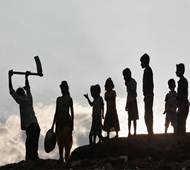
slavery copy copyAccording to the 2016 Global Slavery Index released by Australia-based human rights group Walk Free Foundation today, an estimated 45.8 million people, including women and children, are subject to some form of modern slavery in the world, compared to 35.8 million in 2014.

The report said India has the highest absolute numbers of people trapped in slavery with 18.35 million slaves among its 1.3 billion population while North Korea has the highest incidence (4.37 per cent of the population) and the weakest government response to deal with it.

In the last report in 2014, India had nearly 14.3 million people enslaved.
Incidences of slavery were found in all 167 countries in the index, with Asian countries occupy the top five for people trapped in slavery.

Behind India was China (3.39 million), Pakistan (2.13 million), Bangladesh (1.53 million) and Uzbekistan (1.23 million).

The index said that these five countries combined accounted for almost 58 per cent of the world's enslaved, or 26.6 million people.

The Index presents a ranking of 167 countries based on the proportion of the population that is estimated to be in modern slavery.

Modern slavery refers to situations of exploitation that a person cannot leave because of threats, violence, coercion, abuse of power or deception.

The research included over 42,000 interviews conducted in 53 languages across 25 countries, including 15 state-level surveys in India. These representative surveys covered 44 per cent of the global population.

The countries with the highest estimated prevalence of modern slavery by the proportion of their population are North Korea, Uzbekistan, Cambodia, Cambodia, India, and Qatar.

The countries with the lowest estimated prevalence of modern slavery by the proportion of their population are Luxembourg, Ireland, Norway, Denmark, Switzerland, Austria, Sweden and Belgium, the United States and Canada, and Australia and New Zealand.

The study also tracked the government actions and responses to the modern slavery and of the 161 assessed, 124 nations had criminalised human trafficking in line with the UN trafficking Protocol and 96 nations had developed national action plans to coordinate government response.

It noted that while India had more people enslaved than any other country, it had made significant progress in introducing measures to tackle the problem.

"It has criminalised trafficking, slavery, forced labour, child prostitution and forced marriage. The Indian government is currently tightening legislation against human trafficking, with tougher punishment for repeat offenders. It will offer victims protection and recovery support," it said.

It said that in addition to economic growth in India, ambitious programmes of legal and social reform are being undertaken right across the board, from regulation of labour relations to systems of social insurance for the most vulnerable.

Those governments taking the least action to combat modern slavery are North Korea, Iran, Eritrea, Equatorial Guinea, Hong Kong, Central African Republic, Papua New Guinea, Guinea, the Democratic Republic of the Congo and South Sudan.

The governments that have the strongest response to modern slavery are The Netherlands, the United States of America, the United Kingdom, Sweden, Australia, Portugal, Croatia, Spain, Belgium and Norway.

Seeking strong laws to abolish slavery, Andrew Forrest, Chairman and Founder of Walk Free Foundation, said eradicating slavery makes sense, morally, politically, logically and economically, and called on the governments of the world's leading economies to provide an example to others by enacting and implementing robust anti-slavery measures.

"We call on governments of the top 10 economies of the world to enact laws, at least as strong as the UK Modern Slavery Act 2015, with a budget and capability to ensure organisations are held to account for modern slavery in their supply chains, and to empower independent oversight."

Forrest said leaders of the world's major economies must bring the power of business to this issue, by requiring a focus on supply chain transparency.

"I believe in the critical role of leaders in government, business and civil society. Through our responsible use of power, strength of conviction, determination and collective will, we all can lead the world to end slavery," he said.

Forrest emphasised the key role that business needs to play in eradicating slavery.

"Businesses that don't actively look for forced labour within their supply chains are standing on a burning platform. Business leaders who refuse to look into the realities of their own supply chains are misguided and irresponsible," he said.

Comments

SK
 - 
Thursday, 2 Jun 2016

Since India is facing slavery, Naren has run away to Singapore to enjoy snake/ dog/cat/beef dishes......

Naren kotian
 - 
Tuesday, 31 May 2016

In that mostly 75% are from Muslim community as they enslave women as per their cult following .they have not changed since 6th century ...che papa ...ummah gang ge pitta netti geriruthe ..feku Anthe kumda ...for Muslims he might be feku ..but for nationalist Indians he is true hero who is transforming India .

Add new comment

  • Coastaldigest.com reserves the right to delete or block any comments.
  • Coastaldigset.com is not responsible for its readers’ comments.
  • Comments that are abusive, incendiary or irrelevant are strictly prohibited.
  • Please use a genuine email ID and provide your name to avoid reject.
News Network
July 9,2020

Bengaluru, Jul 9: Alarmed over surging COVID-19 cases, the Karnataka government has decided to divide this tech city into containment zones to curb the spread of the pandemic, a state minister said on Thursday.

"The city will be divided into red, orange and yellow zones in commensurate with the number of Covid cases in them for containing the virus spread on war footing," Law and Parliamentary Affairs Minister J.C. Madhuswamy told reporters here.

Cabinet ministers representing assembly segments in the city will be in-charge of the zones to ensure the cases are curbed with strict enforcement of lockdown guidelines, especially wearing mask and maintaining social distancing by the people in the confinement areas.

"Chief Minister B.S. Yediyurappa has convened a meeting of ministers, MLAs, MPs and corporators of all the 198 civic wards across the city on Friday to discuss and draw an action plan to contain the pandemic," said Madhuswamy.

With 1,148 positive cases, the city''s Covid tally rose to 12,509 and active to 10,103, while 2,228 were discharged, including 418 on Wednesday, while 177 succumbed to the infection since March 9, with 23 in the last 24 hours.

"The Chief Minister ordered deploying more ambulances in the containment areas where cases have been spiking daily to rush Covid patients to the nearest hospital for immediate treatment," said Madhuswamy.

The city civic corporation -- Bruhat Bengaluru Mahanagara Palike (BBMP) --has increased the containment zones to 3,181 due to more cases spiking, with southern and western suburbs accounting for most infections.

"The containment zones are concentrated more in the city''s southern and western suburbs. Active cases doubled over the last 8 days and shot up to a whopping 12,509 from 4,555 on June 30," an official said.

Refuting graft charges by opposition Congress leader Siddaramaiah in the purchase of medical equipment for treatment of Covid patients, Madhuswamy said the state government had not spent more than Rs 600 crore so far.

"We are running a government. Not a private office. We will give account. He (Siddaramaiah) is welcome to check the accounts and verify the documents," asserted the minister.

In a related development, the cabinet also approved an ordinance to increase the state contingency fund to Rs 500 crore from Rs 80 crore for the Covid-19 induced economic relief measures announced by the chief minister in June.

Comments

Add new comment

  • Coastaldigest.com reserves the right to delete or block any comments.
  • Coastaldigset.com is not responsible for its readers’ comments.
  • Comments that are abusive, incendiary or irrelevant are strictly prohibited.
  • Please use a genuine email ID and provide your name to avoid reject.
News Network
May 14,2020

Bengaluru, May 14: Three youths died of "asphyxiation" when they fell into a pit in the abandoned Kolar gold field mines, where they had gone to allegedly steal iron material early on Thursday, police said.

On Wednesday night, the trio had entered the gold mine in Kolar district, about 100 km from Bengaluru, and fell in the pit after losing balance.

After inhaling the poisonous gas in the pit, they were asphyxiated to death, they said.

"It was a seven hour exercise after which we could bring out two bodies. Work is on to retrieve the third," a police officer told .

Police reached the spot after they were alerted by the accomplices of the deceased.

Comments

Add new comment

  • Coastaldigest.com reserves the right to delete or block any comments.
  • Coastaldigset.com is not responsible for its readers’ comments.
  • Comments that are abusive, incendiary or irrelevant are strictly prohibited.
  • Please use a genuine email ID and provide your name to avoid reject.
coastaldigest.com web desk
July 27,2020

New Delhi, Jul 27: A month after banning 59 Chinese applications, the government of Indian has now reportedly banned 47 more apps of Chinese origin in the country. According to sources, the 47 banned Chinese apps were operating as clones of the earlier banned apps. 

The list of the 47 Chinese applications banned by the Indian government will be released soon.

India has also prepared a list of over 250 Chinese apps, including apps linked to Alibaba, that it will examine for any user privacy or national security violations, government sources said. The list also includes Tencent-backed gaming app PUBG.

Some top gaming Chinese applications are also expected to be banned in the new list that is being drawn up, sources said. The Chinese applications, that are being reviewed, have allegedly been sharing data with the Chinese agencies.

Today's decision follows after a high-profile ban of 59 Chinese apps including TikTok, as border tensions continued in Ladakh after a violent, fatal face-off between the Indian and Chinese armies. The government said these apps were engaged in activities that were prejudicial to the sovereignty, integrity and defence of India.

A government press release announcing the ban stated: "The Ministry of Information Technology, invoking it's power under section 69A of the Information Technology Act read with the relevant provisions of the Information Technology (Procedure and Safeguards for Blocking of Access of Information by Public) Rules 2009 and in view of the emergent nature of threats has decided to block 59 apps since in view of information available they are engaged in activities which is prejudicial to sovereignty and integrity of India, defence of India, security of state and public order".

A day later, Google said it has removed all the banned applications from the Play Store. Following the ban, TikTok refuted the claims that suggest it will pursue legal action against the Indian government for banning the app in India.

Reacting to the 59 apps banned by India, the Chinese Foreign Ministry said the country is "strongly concerned regarding the decision of the Indian government".

“China is strongly concerned, verifying the situation,” Chinese Foreign Ministry spokesperson Zhao Lijian was quoted as saying by news agency ANI.

"We want to stress that the Chinese government always asks Chinese businesses to abide by international and local laws-regulations. The Indian government has a responsibility to uphold the legal rights of international investors including Chinese ones," Zhao Lijian said.

Comments

Add new comment

  • Coastaldigest.com reserves the right to delete or block any comments.
  • Coastaldigset.com is not responsible for its readers’ comments.
  • Comments that are abusive, incendiary or irrelevant are strictly prohibited.
  • Please use a genuine email ID and provide your name to avoid reject.