


India tops global slavery index with 18.35 mn people enslaved

May 31, 2016

Melbourne, May 31: India has the dubious distinction of having the highest number of people in the world trapped in modern slavery with 18.35 million victims of forced labour, ranging from prostitution and begging, according to a new report, which estimated that nearly 46 million people are enslaved globally.
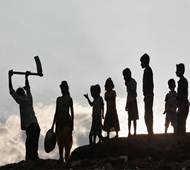
slavery copy copyAccording to the 2016 Global Slavery Index released by Australia-based human rights group Walk Free Foundation today, an estimated 45.8 million people, including women and children, are subject to some form of modern slavery in the world, compared to 35.8 million in 2014.

The report said India has the highest absolute numbers of people trapped in slavery with 18.35 million slaves among its 1.3 billion population while North Korea has the highest incidence (4.37 per cent of the population) and the weakest government response to deal with it.

In the last report in 2014, India had nearly 14.3 million people enslaved.
Incidences of slavery were found in all 167 countries in the index, with Asian countries occupy the top five for people trapped in slavery.

Behind India was China (3.39 million), Pakistan (2.13 million), Bangladesh (1.53 million) and Uzbekistan (1.23 million).

The index said that these five countries combined accounted for almost 58 per cent of the world's enslaved, or 26.6 million people.

The Index presents a ranking of 167 countries based on the proportion of the population that is estimated to be in modern slavery.

Modern slavery refers to situations of exploitation that a person cannot leave because of threats, violence, coercion, abuse of power or deception.

The research included over 42,000 interviews conducted in 53 languages across 25 countries, including 15 state-level surveys in India. These representative surveys covered 44 per cent of the global population.

The countries with the highest estimated prevalence of modern slavery by the proportion of their population are North Korea, Uzbekistan, Cambodia, Cambodia, India, and Qatar.

The countries with the lowest estimated prevalence of modern slavery by the proportion of their population are Luxembourg, Ireland, Norway, Denmark, Switzerland, Austria, Sweden and Belgium, the United States and Canada, and Australia and New Zealand.

The study also tracked the government actions and responses to the modern slavery and of the 161 assessed, 124 nations had criminalised human trafficking in line with the UN trafficking Protocol and 96 nations had developed national action plans to coordinate government response.

It noted that while India had more people enslaved than any other country, it had made significant progress in introducing measures to tackle the problem.

"It has criminalised trafficking, slavery, forced labour, child prostitution and forced marriage. The Indian government is currently tightening legislation against human trafficking, with tougher punishment for repeat offenders. It will offer victims protection and recovery support," it said.

It said that in addition to economic growth in India, ambitious programmes of legal and social reform are being undertaken right across the board, from regulation of labour relations to systems of social insurance for the most vulnerable.

Those governments taking the least action to combat modern slavery are North Korea, Iran, Eritrea, Equatorial Guinea, Hong Kong, Central African Republic, Papua New Guinea, Guinea, the Democratic Republic of the Congo and South Sudan.

The governments that have the strongest response to modern slavery are The Netherlands, the United States of America, the United Kingdom, Sweden, Australia, Portugal, Croatia, Spain, Belgium and Norway.

Seeking strong laws to abolish slavery, Andrew Forrest, Chairman and Founder of Walk Free Foundation, said eradicating slavery makes sense, morally, politically, logically and economically, and called on the governments of the world's leading economies to provide an example to others by enacting and implementing robust anti-slavery measures.

"We call on governments of the top 10 economies of the world to enact laws, at least as strong as the UK Modern Slavery Act 2015, with a budget and capability to ensure organisations are held to account for modern slavery in their supply chains, and to empower independent oversight."

Forrest said leaders of the world's major economies must bring the power of business to this issue, by requiring a focus on supply chain transparency.

"I believe in the critical role of leaders in government, business and civil society. Through our responsible use of power, strength of conviction, determination and collective will, we all can lead the world to end slavery," he said.

Forrest emphasised the key role that business needs to play in eradicating slavery.

"Businesses that don't actively look for forced labour within their supply chains are standing on a burning platform. Business leaders who refuse to look into the realities of their own supply chains are misguided and irresponsible," he said.

Comments

SK
 - 
Thursday, 2 Jun 2016

Since India is facing slavery, Naren has run away to Singapore to enjoy snake/ dog/cat/beef dishes......

Naren kotian
 - 
Tuesday, 31 May 2016

In that mostly 75% are from Muslim community as they enslave women as per their cult following .they have not changed since 6th century ...che papa ...ummah gang ge pitta netti geriruthe ..feku Anthe kumda ...for Muslims he might be feku ..but for nationalist Indians he is true hero who is transforming India .

Add new comment

  • Coastaldigest.com reserves the right to delete or block any comments.
  • Coastaldigset.com is not responsible for its readers’ comments.
  • Comments that are abusive, incendiary or irrelevant are strictly prohibited.
  • Please use a genuine email ID and provide your name to avoid reject.
News Network
June 26,2020

Bengaluru, Jun 26: Karnataka's Commercial Taxes Department has sealed off an undeclared warehouse with imported goods worth Rs 4 crore in Bengaluru and found 60 GST registrations linked to a Chinese national from Wuhan.

The tax department officials found 25,446 China-made electronic and fast-moving consumer goods worth Rs 4 crore stored in the warehouse which was not declared to the tax authorities.

Commissioner of Commercial Taxes MS Srikar said in a statement that the officers noticed that one person from Wuhan City, China, got the premises in Bengaluru on lease.

They also found that about 60 registrations (both central and state jurisdictions) under the GST Act, in the name of a number of persons for online trading of imported China-made goods, had a single address which was vacant.

Most of the registrations were found irregular in the filing of returns and payment of tax. Majority of the firms either filed nil returns or were non-filers. The registration data showed that one business was registered in 2017-18, 43 in 2018-19, 14 in 2019-20 and two in 2020-21. Most of the 60 firms were private limited companies and 24 persons were interchangeably directors in 58 firms.

At the time of raid, neither the lessee, the Chinese national, nor any of the other 59 registered taxable persons were available at the business premises and no one came forward to participate in the proceedings in spite of providing sufficient time.

It is learnt that the Chinese national is operating the business from Wuhan City since January 2020 with the assistance of some of his agents/employees in Bengaluru.

It has also been learnt that multiple registrations are being taken for a better rating on e-commerce platforms, Srikar said.

The raids were led by Nitesh K Patil, Additional Commissioner, Enforcement, South Zone.
The Commercial Taxes Department is closely watching the genuineness of newly registered persons and conducting post-registration verification visits.

Any registration taken with mala fide intention of evading taxes will be dealt with seriously, the Commissioner said. 

Comments

Add new comment

  • Coastaldigest.com reserves the right to delete or block any comments.
  • Coastaldigset.com is not responsible for its readers’ comments.
  • Comments that are abusive, incendiary or irrelevant are strictly prohibited.
  • Please use a genuine email ID and provide your name to avoid reject.
News Network
April 28,2020

Bengaluru, Apr 28: Karnataka has found that the rapid antibody test kits for COVID-19 that the Centre supplied to the state have only 47% sensitivity. The state will be returning the kits to the Indian Council of Medical Research (ICMR).

Karnataka had received 11,400 rapid antibody test kits from the ICMR a few days back, out of which it had sent around 200 of them to NIMHANS for validation.

After the ICMR, on Monday, sent a circular to all states to return the test kits to the suppliers, Dr CN Manjunath, Director, Jayadeva Institute of Cardiovascular Sciences and Research, and nodal officer for lab testing in the state's COVID-19 task force, said, "We have cancelled the orders we placed to Guangzhou Wondfo Biotech and Zhuhai Livzon Diagnostics for one lakh rapid antibody test kits. Since the ICMR supplied us with 11,400 kits out of the 6.5 lakh kits it procured, we will be returning the kits to them."

Manjunath told said that the validation at NIMHANS revealed the kits to have only 47% sensitivity. Sensitivity is the ability of a test to identify the true-positives in a population, i.e., the actual number of people who've been infected with the disease. With the rapid antibody testing kits being shelved, the state's plan to randomly test high risk groups has taken a backseat. 

So far, the state has tested 43,791 samples. 

Karnataka now has 22 testing facilities -- 14 government and seven private labs. Many private labs have not tested any samples so far because of the lack of test kits (the state has made it clear that it will not provide test kits to private labs). So, getting an ICMR approval for testing has become a moot point.p

Agreeing to the setback the state's plans of ramping up testing has taken, Manjunath said, "It is true that RT-PCR test kits are in shortage. Even Pune's Mylabs had a shortage in supplying test kits. But we are relying on institutes like Kidwai, Narayana Health and Biocon's Syngene that have received approval for testing. They're big institutes and we hope that they will test a large number of samples."

On reports that the Centre has RT-PCR test kits that will last for only a week, he said, "We have test kits that will last for eight to 10 days. We have ordered for more. We are hoping to receive them before the current kits run out."

Comments

Add new comment

  • Coastaldigest.com reserves the right to delete or block any comments.
  • Coastaldigset.com is not responsible for its readers’ comments.
  • Comments that are abusive, incendiary or irrelevant are strictly prohibited.
  • Please use a genuine email ID and provide your name to avoid reject.
coastaldigest.com web desk
July 24,2020

Indore, Jul 24: A woman who sells fruits on a cart and who lashed out at municipal officials here has done PhD in Materials Science. Her siblings too are well educated and sell fruits as they did not find jobs.

Dr Raisa Ansari, who lives at Bakery Street in Pardeshipura with her family said she wanted to be a scientist but did not get a job anywhere.

Speaking to media persons, Raisa said, "I have done PhD in Materials Science and wanted to be a scientist but did not get job anywhere. I sell fruit here but the municipal officials are bothering us. We are being forced to move from here to there like cattle. Our religion may be the reason why we are not getting jobs but we are proud to be Indian. I am still looking for a job."

Dr Raisa's mother Ayesha Ansari said she herself is not educated, but has four children of whom three girls and one boy studied a lot but no one got job.

Speaking to media persons Ayesha said, "I have four children and they are well educated. I have not studied but all my children are educated but did not get job so all of them sell fruits."

"When the matter came to marriage, one of the daughters got married. Raisa and Shahjahan Bi wanted an educated boy, but they were not able to find a suitable match because of their complexion and sometimes they rejected the proposal because of dowry, so both are single. Two of my grandchildren are studying biology. They will become doctors," said Ayesha.

Meanwhile, people in the neighbourhood lauded the family's abilities. They said theirs was an educated family had to sell fruits as they did not get jobs.

Comments

Add new comment

  • Coastaldigest.com reserves the right to delete or block any comments.
  • Coastaldigset.com is not responsible for its readers’ comments.
  • Comments that are abusive, incendiary or irrelevant are strictly prohibited.
  • Please use a genuine email ID and provide your name to avoid reject.