


India tops global slavery index with 18.35 mn people enslaved

May 31, 2016

Melbourne, May 31: India has the dubious distinction of having the highest number of people in the world trapped in modern slavery with 18.35 million victims of forced labour, ranging from prostitution and begging, according to a new report, which estimated that nearly 46 million people are enslaved globally.
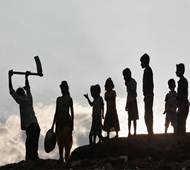
slavery copy copyAccording to the 2016 Global Slavery Index released by Australia-based human rights group Walk Free Foundation today, an estimated 45.8 million people, including women and children, are subject to some form of modern slavery in the world, compared to 35.8 million in 2014.

The report said India has the highest absolute numbers of people trapped in slavery with 18.35 million slaves among its 1.3 billion population while North Korea has the highest incidence (4.37 per cent of the population) and the weakest government response to deal with it.

In the last report in 2014, India had nearly 14.3 million people enslaved.
Incidences of slavery were found in all 167 countries in the index, with Asian countries occupy the top five for people trapped in slavery.

Behind India was China (3.39 million), Pakistan (2.13 million), Bangladesh (1.53 million) and Uzbekistan (1.23 million).

The index said that these five countries combined accounted for almost 58 per cent of the world's enslaved, or 26.6 million people.

The Index presents a ranking of 167 countries based on the proportion of the population that is estimated to be in modern slavery.

Modern slavery refers to situations of exploitation that a person cannot leave because of threats, violence, coercion, abuse of power or deception.

The research included over 42,000 interviews conducted in 53 languages across 25 countries, including 15 state-level surveys in India. These representative surveys covered 44 per cent of the global population.

The countries with the highest estimated prevalence of modern slavery by the proportion of their population are North Korea, Uzbekistan, Cambodia, Cambodia, India, and Qatar.

The countries with the lowest estimated prevalence of modern slavery by the proportion of their population are Luxembourg, Ireland, Norway, Denmark, Switzerland, Austria, Sweden and Belgium, the United States and Canada, and Australia and New Zealand.

The study also tracked the government actions and responses to the modern slavery and of the 161 assessed, 124 nations had criminalised human trafficking in line with the UN trafficking Protocol and 96 nations had developed national action plans to coordinate government response.

It noted that while India had more people enslaved than any other country, it had made significant progress in introducing measures to tackle the problem.

"It has criminalised trafficking, slavery, forced labour, child prostitution and forced marriage. The Indian government is currently tightening legislation against human trafficking, with tougher punishment for repeat offenders. It will offer victims protection and recovery support," it said.

It said that in addition to economic growth in India, ambitious programmes of legal and social reform are being undertaken right across the board, from regulation of labour relations to systems of social insurance for the most vulnerable.

Those governments taking the least action to combat modern slavery are North Korea, Iran, Eritrea, Equatorial Guinea, Hong Kong, Central African Republic, Papua New Guinea, Guinea, the Democratic Republic of the Congo and South Sudan.

The governments that have the strongest response to modern slavery are The Netherlands, the United States of America, the United Kingdom, Sweden, Australia, Portugal, Croatia, Spain, Belgium and Norway.

Seeking strong laws to abolish slavery, Andrew Forrest, Chairman and Founder of Walk Free Foundation, said eradicating slavery makes sense, morally, politically, logically and economically, and called on the governments of the world's leading economies to provide an example to others by enacting and implementing robust anti-slavery measures.

"We call on governments of the top 10 economies of the world to enact laws, at least as strong as the UK Modern Slavery Act 2015, with a budget and capability to ensure organisations are held to account for modern slavery in their supply chains, and to empower independent oversight."

Forrest said leaders of the world's major economies must bring the power of business to this issue, by requiring a focus on supply chain transparency.

"I believe in the critical role of leaders in government, business and civil society. Through our responsible use of power, strength of conviction, determination and collective will, we all can lead the world to end slavery," he said.

Forrest emphasised the key role that business needs to play in eradicating slavery.

"Businesses that don't actively look for forced labour within their supply chains are standing on a burning platform. Business leaders who refuse to look into the realities of their own supply chains are misguided and irresponsible," he said.

Comments

SK
 - 
Thursday, 2 Jun 2016

Since India is facing slavery, Naren has run away to Singapore to enjoy snake/ dog/cat/beef dishes......

Naren kotian
 - 
Tuesday, 31 May 2016

In that mostly 75% are from Muslim community as they enslave women as per their cult following .they have not changed since 6th century ...che papa ...ummah gang ge pitta netti geriruthe ..feku Anthe kumda ...for Muslims he might be feku ..but for nationalist Indians he is true hero who is transforming India .

Add new comment

  • Coastaldigest.com reserves the right to delete or block any comments.
  • Coastaldigset.com is not responsible for its readers’ comments.
  • Comments that are abusive, incendiary or irrelevant are strictly prohibited.
  • Please use a genuine email ID and provide your name to avoid reject.
News Network
April 28,2020

Bengaluru, Apr 28: A CRPF jawan has been arrested in Karnataka for allegedly defying the COVID-19 lockdown norms with the paramilitary force taking strong exception to his 'ill treatment', following which an inquiry has been ordered by the state police.

State DGP Praveen Sood has ordered inquiry into the incident, which has triggered a row after a video of it went viral.

In the clip, some police constables are purportedly seen hitting CRPF soldier Sachin Sawant with sticks in Belagavi.

According to the information shared on social media, Sawant was washing his bike when a police team reached the spot and started beating him up for not wearing a mask during the lockdown.

Taking a serious view of the 'ill-treatment' meted out to its Cobra Commando, the CRPF has written a letter to the Karnataka police demanding an investigation into the matter.

In a letter to the DGP of Karnataka, the additional Director general of police of CRPF Sanjay Arora said Sawant was cleaning his bike when a skirmish happened between him and the police over not wearing the mask.

Arora wrote, "Sawant was manhandled and ill-treated, before his family members and paraded to the police station barefoot, where he was kept in chains and handcuff.

From the scrutiny of a viral video on social media, it is apparent that the conduct of police personnel was not citizen centric."

The CRPF ADGP also said the 'unpleasant' situation could have been avoided if the Karnataka police had taken CRPF hierarchy into confidence before making the arrest.

In response, Sood ordered an inquiry into the matter.

He tweeted that IGP Belagavi has been asked to conduct a probe into the incident involving CRPF constable. Action will be taken against guilty after receipt of report, he said.

According to sources, Home Minister Basavaraj Bommai has directed the state police chief to conduct a detailed inquiry into the incident.

Denouncing the arrest, Karnataka Irrigation Minister Ramesh Jarkiholi has sought the release of the CRPF jawan.

"It was wrong on the part of the constables to ill treat CRPF jawan and an inquiry be conducted against the erring policemen," said jarkiholi in a press release.

However, Superintendent of Police of Belagavi district, Laxman Nimbargi defended the arrest of Sawant.

Comments

Add new comment

  • Coastaldigest.com reserves the right to delete or block any comments.
  • Coastaldigset.com is not responsible for its readers’ comments.
  • Comments that are abusive, incendiary or irrelevant are strictly prohibited.
  • Please use a genuine email ID and provide your name to avoid reject.
News Network
April 17,2020

Bengaluru, Apr 17: The Karnataka government on Friday asked Information Technology, biotechnology and allied companies not to go for closure or layoffs citing lack of work orders due to COVID-19 lockdown and instead consider measures like cutting salaries among other things.

It said IT/BT companies in the state can resume operations with 50 per cent from their office space after April 20.

Deputy chief minister C N Ashwath Narayan, who is also in charge of IT & BT department, held video consultation with the captains of the industry in light of the disruption caused due to the lockdown, and discussed on the way forward - both for effective implementation of the lockdown as well as the future course to deal with the unique circumstances.

"Immediately we are going to permit 50 per cent, but it doesn't mean that they will be able to mobilise 50 per cent immediately. It will take few weeks for them to do so. Gradually percentage will increase and it will start getting back to normalcy," Ashwath Narayan told reporters.

Stating that there were discussions regarding layoffs, he said, companies should not go for layoffs, instead of that gradation or deduction in the salary should be taken up, so that it doesn't affect the functioning of companies also that are facing less orders.

"On handling such financial crisis they (industry) wanted government consideration with mutual cooperation and understanding the concerns," he added.

Pointing out that concerns were also expressed regarding measures or protocol that needs to be followed if any positive cases are reported in any of the office spaces, Ashwath Narayan said, certain guidelines will be issued in consultation with the Health Department.

"Once the relaxation is given this may become the usual phenomena, as cases will be reported here and there... so in that scenario how we need to work and handle the situation is important, so we will be working on protocols how to handle the situation. So far we have planned for residential areas and not for work spaces," he said.

The deputy chief minister said the IT and BT industry leaders are extremely happy with regard to the support system or backup given by the government of Karnataka, particularly IT/BT department.

Even during this crisis period in the entire world, Karnataka and Bengaluru were able to get a good reputation and become reliable partner, as IT/BT service providers in both the city and the state were able to provide excellent quality services to their clients without any interruption, he said.

If you compare with any state or country, we have done extremely well, and hope that this would get more business, he added.

Biocon chief Kiran Mazumdar Shaw, Infosys co-founder Kris Gopalakrishnan, who is also the Chairman of Vision Group IT, were among others present at the video conferencing.

Noting that concerns expressed by the industry regarding passes for employees to commute to office, Ashwath Narayan said, the government would make necessary arrangements in this regard, considering measures that need to be taken after April 20.

Regarding providing transport facility, they can seek for services from public transport Bangalore Metropolitan Transport Corporation (BMTC) on a contract basis, he said, adding that "We will be ready to facilitate BMTC."

The minister said the industry leaders wanted internet services to continue with the same quality and without any interruption.

Comments

Add new comment

  • Coastaldigest.com reserves the right to delete or block any comments.
  • Coastaldigset.com is not responsible for its readers’ comments.
  • Comments that are abusive, incendiary or irrelevant are strictly prohibited.
  • Please use a genuine email ID and provide your name to avoid reject.
News Network
May 29,2020

New Delhi, May 29: Opining that there is no harm in importing ideas from abroad Swadeshi Jagran Manch, an affiliate of Rashtriya Swayamsevak Sangh, has suggested that India should take a cue from Pakistan and turn the “locust threat” into “chicken feed.

In an interview, Ashwani Mahajan, national co-convener of Swadeshi Jagran Manch (SJM) said: “I saw an article which shows that Pakistan has turned the locust threat into an opportunity by converting it into chicken feed”

“If there is a good idea originating from anywhere, we should be open to exploring such ideas. We should adopt good ideas. There is no harm in that,” he added.

He also shared the article on Twitter and wrote: “Pakistan turns locust threat into chicken feed. Need to understand the idea and replicate it in India.”

The article stated “an innovative pilot project in Pakistan’s Okara district offers a sustainable solution in which farmers earn money by trapping locusts that are turned into high-protein chicken feed by animal feed mills”.

“It was the brainchild of Muhammad Khurshid, a civil servant in the Ministry of National Food Security and Research, and Johar Ali, a bio-technologist from the Pakistan Agricultural Research Council,” according to the article.

Both Pakistan and India have been hit by locust attacks. These are desert locusts, which is one of the 12 species of short-horned grasshoppers. Swarms can comprise billions and travel up to 130 km in a day.

India has been battling the locust attacks with moderate success since December. However, the onset of monsoon could bring more trouble.

Comments

Add new comment

  • Coastaldigest.com reserves the right to delete or block any comments.
  • Coastaldigset.com is not responsible for its readers’ comments.
  • Comments that are abusive, incendiary or irrelevant are strictly prohibited.
  • Please use a genuine email ID and provide your name to avoid reject.