


India tops global slavery index with 18.35 mn people enslaved

May 31, 2016

Melbourne, May 31: India has the dubious distinction of having the highest number of people in the world trapped in modern slavery with 18.35 million victims of forced labour, ranging from prostitution and begging, according to a new report, which estimated that nearly 46 million people are enslaved globally.
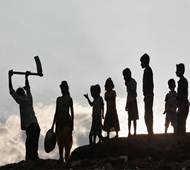
slavery copy copyAccording to the 2016 Global Slavery Index released by Australia-based human rights group Walk Free Foundation today, an estimated 45.8 million people, including women and children, are subject to some form of modern slavery in the world, compared to 35.8 million in 2014.

The report said India has the highest absolute numbers of people trapped in slavery with 18.35 million slaves among its 1.3 billion population while North Korea has the highest incidence (4.37 per cent of the population) and the weakest government response to deal with it.

In the last report in 2014, India had nearly 14.3 million people enslaved.
Incidences of slavery were found in all 167 countries in the index, with Asian countries occupy the top five for people trapped in slavery.

Behind India was China (3.39 million), Pakistan (2.13 million), Bangladesh (1.53 million) and Uzbekistan (1.23 million).

The index said that these five countries combined accounted for almost 58 per cent of the world's enslaved, or 26.6 million people.

The Index presents a ranking of 167 countries based on the proportion of the population that is estimated to be in modern slavery.

Modern slavery refers to situations of exploitation that a person cannot leave because of threats, violence, coercion, abuse of power or deception.

The research included over 42,000 interviews conducted in 53 languages across 25 countries, including 15 state-level surveys in India. These representative surveys covered 44 per cent of the global population.

The countries with the highest estimated prevalence of modern slavery by the proportion of their population are North Korea, Uzbekistan, Cambodia, Cambodia, India, and Qatar.

The countries with the lowest estimated prevalence of modern slavery by the proportion of their population are Luxembourg, Ireland, Norway, Denmark, Switzerland, Austria, Sweden and Belgium, the United States and Canada, and Australia and New Zealand.

The study also tracked the government actions and responses to the modern slavery and of the 161 assessed, 124 nations had criminalised human trafficking in line with the UN trafficking Protocol and 96 nations had developed national action plans to coordinate government response.

It noted that while India had more people enslaved than any other country, it had made significant progress in introducing measures to tackle the problem.

"It has criminalised trafficking, slavery, forced labour, child prostitution and forced marriage. The Indian government is currently tightening legislation against human trafficking, with tougher punishment for repeat offenders. It will offer victims protection and recovery support," it said.

It said that in addition to economic growth in India, ambitious programmes of legal and social reform are being undertaken right across the board, from regulation of labour relations to systems of social insurance for the most vulnerable.

Those governments taking the least action to combat modern slavery are North Korea, Iran, Eritrea, Equatorial Guinea, Hong Kong, Central African Republic, Papua New Guinea, Guinea, the Democratic Republic of the Congo and South Sudan.

The governments that have the strongest response to modern slavery are The Netherlands, the United States of America, the United Kingdom, Sweden, Australia, Portugal, Croatia, Spain, Belgium and Norway.

Seeking strong laws to abolish slavery, Andrew Forrest, Chairman and Founder of Walk Free Foundation, said eradicating slavery makes sense, morally, politically, logically and economically, and called on the governments of the world's leading economies to provide an example to others by enacting and implementing robust anti-slavery measures.

"We call on governments of the top 10 economies of the world to enact laws, at least as strong as the UK Modern Slavery Act 2015, with a budget and capability to ensure organisations are held to account for modern slavery in their supply chains, and to empower independent oversight."

Forrest said leaders of the world's major economies must bring the power of business to this issue, by requiring a focus on supply chain transparency.

"I believe in the critical role of leaders in government, business and civil society. Through our responsible use of power, strength of conviction, determination and collective will, we all can lead the world to end slavery," he said.

Forrest emphasised the key role that business needs to play in eradicating slavery.

"Businesses that don't actively look for forced labour within their supply chains are standing on a burning platform. Business leaders who refuse to look into the realities of their own supply chains are misguided and irresponsible," he said.

Comments

SK
 - 
Thursday, 2 Jun 2016

Since India is facing slavery, Naren has run away to Singapore to enjoy snake/ dog/cat/beef dishes......

Naren kotian
 - 
Tuesday, 31 May 2016

In that mostly 75% are from Muslim community as they enslave women as per their cult following .they have not changed since 6th century ...che papa ...ummah gang ge pitta netti geriruthe ..feku Anthe kumda ...for Muslims he might be feku ..but for nationalist Indians he is true hero who is transforming India .

Add new comment

  • Coastaldigest.com reserves the right to delete or block any comments.
  • Coastaldigset.com is not responsible for its readers’ comments.
  • Comments that are abusive, incendiary or irrelevant are strictly prohibited.
  • Please use a genuine email ID and provide your name to avoid reject.
News Network
April 29,2020

Bengaluru, Apr 29: Indian women have always been the epitome of beauty, strength, and intelligence. Today, the success of Indian women across various walks of life has proven that they have earned this reputation.

One such dedicated social worker is Dr Sunitha Manjunath, the Founder of 'Sumanaa Foundation' of Sanjay Nagar in Bengaluru.

Sumanaa Foundation, based out of Sanjay Nagar in Bengaluru has been on the forefront to support people in distress due to COVID-19. 

The foundation under the leadership of its founder Dr Sunitha Manjunath procured a total of 20000 kgs of farm-fresh produce in four phases from farmers who are unable to sell it due to the COVID Lockdown and have distributed it across 6000 families across Bengaluru city.

"We have procured these vegetables after identifying farmers who are unable to sell their produce due to the challenges of lockdown.

This initiative not only supports the farmers by helping them get the right price for their produce, but also gives us an opportunity to get vegetables at a reasonable price by escaping all middlemen and commissions. We have identified 6000 poor families mainly around Bengaluru city who have not been able to earn their daily wages and given them coupons.

The foundation members identify genuine cases and give them coupons which can be redeemed in exchange of an essential vegetables kit," said Dr Sunitha Manjunath, the founder of Sumanaa Foundation.

These vegetables have been procured from Chikkaballapura, Doddaballapura, and surrounding villages and included vegetables like onions, tomatoes, capsicum, green chillies, beans, carrots, brinjal, potatoes, beetroots etc. These farmers got a fair price for their produce and were overjoyed to know that their harvest is being distributed free of cost to needy and deserving families.

Sumanaa Foundation has been actively supporting the city administration in fighting COVID-19 pandemic. In the recent weeks the foundation has distributed sanitisers and masks to BBMP Pourakarmikas.

The foundation also cooked food for over 400 people each day. This food was handed over to the city administration, which further distributed this to the police department and other staff working across government departments during these testing times.

Dr Sunitha, an engineer by qualification, had enjoyed a high-flying corporate career with BOSCH. She was offered a global role, which she turned down to setup her NGO, 'Sumanaa Foundation' and to serve the needy in and around her locality. Over the past seven years, the NGO with 70 members has done a wide range of activities to support the poor and needy in Bengaluru.

The core team of Sumanaa Foundation works under the leadership of its president Dr Sunitha Manjunath and includes young and energetic individuals like Manjunath K, Prakash K, Vidya Prakash, Sindu Gowda, Byregowda, Nishita Arjun, Arjun Varadaraj and Manoj Kumar
'Meal of Humanity' is a notable initiative of Dr Sunitha Manjunath and her team. Under this program, over 300 poor people are served mid-day meals every day. 

This is currently a self-sustained program with no external funding. Dr Sunitha Manjunath, her family members, and friends contribute their hard-earned money to bring smiles to hundreds of migrant workers and daily wage laborers.

'Wall of Humanity' is another unique concept implemented by Sumanaa Foundation. People can leave used or unnecessary daily use products like clothes, toys, groceries, etc at a designated area. This can be picked by anyone in need of these items. This self-helping model has touched the lives of hundreds of people in and around the area of Sanjay Nagar.

Regular blood donation camps, eye checkups, scholarship for students, tailoring machine distribution, environmental initiatives, Swacch Bharath programs, wall painting across the roadside are just a few among the hundreds of activities undertaken by Sumanaa Foundation regularly under the leadership of Dr Sunitha Manjunath and her team of friends.

"A life without an aim is worthless and so is a death without achievement. The aim of my life is to touch the lives of the hundreds of people who are not as privileged as you and me. I'd like to thank my husband Manjunath, my In-Laws and my friends from Sumanaa Foundation who work tirelessly alongside me across all our initiatives," said an elated Dr Sunitha Manjuanth on receiving the 'ET Power Icons' award for Excellence in Social Service and Public Initiatives.

Dr Sunitha Manjunath has also been awarded the prestigious 'Kempegowda Award' and many more such awards for her contribution to the society.

Comments

Add new comment

  • Coastaldigest.com reserves the right to delete or block any comments.
  • Coastaldigset.com is not responsible for its readers’ comments.
  • Comments that are abusive, incendiary or irrelevant are strictly prohibited.
  • Please use a genuine email ID and provide your name to avoid reject.
Agencies
July 3,2020

New Delhi, Jul 3: The aviation regulator DGCA said on Friday it was extending the suspension of scheduled international passenger flights in the country till July 31 but added that some international scheduled services on selected routes may be permitted on a case to case basis.

Scheduled international passenger flights were suspended in India on March 23 due to the coronavirus pandemic.

Modifying its June 26 circular that stated that scheduled international passenger flights will remain suspended till July 15, 2020, the regulator stated on Friday it has decided to extend the deadline to July 31, 2020.

However, international scheduled flights may be allowed on selected routes by the competent authority on a case to case basis,” said the circular by the Directorate General of Civil Aviation (DGCA).

Air India and other private domestic airlines have been operating unscheduled international repatriation flights under the Vande Bharat Mission, which was started on May 6 by the Central government.

India resumed scheduled domestic passenger flights on May 25, after a gap of two months.

Comments

Add new comment

  • Coastaldigest.com reserves the right to delete or block any comments.
  • Coastaldigset.com is not responsible for its readers’ comments.
  • Comments that are abusive, incendiary or irrelevant are strictly prohibited.
  • Please use a genuine email ID and provide your name to avoid reject.
News Network
March 30,2020

Mangaluru, Mar 30: In continuing cases of tipplers in the southern states ending their lives due to non-availability of liquor during the lockdown, two men committed suicide in Karnataka's Dakshina Kannada district.

The two suicides were reported in Kadaba taluk on Saturday, police said.

Tomy Thomas (50), a rubber tapping labourer in an estate at Kutrupadi village of the taluk, was found hanging at his rented house on Saturday. Thomas, a native of Kottayam in Kerala, had joined at the estate here a month ago.

Local people said he was desperately moving around in the last few days asking about places where he can get liquor. He had also not reported to work in these days. The body has been kept at the mortuary of a hospital at Deralakatte.

In another incident, a 70-year old man, belonging to Kodimbala village in the taluk, allegedly hanged himself from the branch of a tree near his house at Nakur.

The deceased has been identified as Thomas, who had left his family here 30 years ago and had been working in Kerala. He had returned here only a few years back.

Sources said Thomas, an alcohol addict, was having health problems related to withdrawal. He has been living on pavements at Kadaba without going home.

Kadaba police has registered cases in connection with the two incidents.

Incidents of tipplers committing suicide have been reported in Kerala and Telangana in the past few days. Two men ended their lives in Kerala today while a 50-year old daily wage worker jumped to death from a building in Hyderabad on Friday.

Comments

Add new comment

  • Coastaldigest.com reserves the right to delete or block any comments.
  • Coastaldigset.com is not responsible for its readers’ comments.
  • Comments that are abusive, incendiary or irrelevant are strictly prohibited.
  • Please use a genuine email ID and provide your name to avoid reject.