


India tops global slavery index with 18.35 mn people enslaved

May 31, 2016

Melbourne, May 31: India has the dubious distinction of having the highest number of people in the world trapped in modern slavery with 18.35 million victims of forced labour, ranging from prostitution and begging, according to a new report, which estimated that nearly 46 million people are enslaved globally.
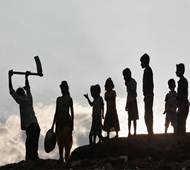
slavery copy copyAccording to the 2016 Global Slavery Index released by Australia-based human rights group Walk Free Foundation today, an estimated 45.8 million people, including women and children, are subject to some form of modern slavery in the world, compared to 35.8 million in 2014.

The report said India has the highest absolute numbers of people trapped in slavery with 18.35 million slaves among its 1.3 billion population while North Korea has the highest incidence (4.37 per cent of the population) and the weakest government response to deal with it.

In the last report in 2014, India had nearly 14.3 million people enslaved.
Incidences of slavery were found in all 167 countries in the index, with Asian countries occupy the top five for people trapped in slavery.

Behind India was China (3.39 million), Pakistan (2.13 million), Bangladesh (1.53 million) and Uzbekistan (1.23 million).

The index said that these five countries combined accounted for almost 58 per cent of the world's enslaved, or 26.6 million people.

The Index presents a ranking of 167 countries based on the proportion of the population that is estimated to be in modern slavery.

Modern slavery refers to situations of exploitation that a person cannot leave because of threats, violence, coercion, abuse of power or deception.

The research included over 42,000 interviews conducted in 53 languages across 25 countries, including 15 state-level surveys in India. These representative surveys covered 44 per cent of the global population.

The countries with the highest estimated prevalence of modern slavery by the proportion of their population are North Korea, Uzbekistan, Cambodia, Cambodia, India, and Qatar.

The countries with the lowest estimated prevalence of modern slavery by the proportion of their population are Luxembourg, Ireland, Norway, Denmark, Switzerland, Austria, Sweden and Belgium, the United States and Canada, and Australia and New Zealand.

The study also tracked the government actions and responses to the modern slavery and of the 161 assessed, 124 nations had criminalised human trafficking in line with the UN trafficking Protocol and 96 nations had developed national action plans to coordinate government response.

It noted that while India had more people enslaved than any other country, it had made significant progress in introducing measures to tackle the problem.

"It has criminalised trafficking, slavery, forced labour, child prostitution and forced marriage. The Indian government is currently tightening legislation against human trafficking, with tougher punishment for repeat offenders. It will offer victims protection and recovery support," it said.

It said that in addition to economic growth in India, ambitious programmes of legal and social reform are being undertaken right across the board, from regulation of labour relations to systems of social insurance for the most vulnerable.

Those governments taking the least action to combat modern slavery are North Korea, Iran, Eritrea, Equatorial Guinea, Hong Kong, Central African Republic, Papua New Guinea, Guinea, the Democratic Republic of the Congo and South Sudan.

The governments that have the strongest response to modern slavery are The Netherlands, the United States of America, the United Kingdom, Sweden, Australia, Portugal, Croatia, Spain, Belgium and Norway.

Seeking strong laws to abolish slavery, Andrew Forrest, Chairman and Founder of Walk Free Foundation, said eradicating slavery makes sense, morally, politically, logically and economically, and called on the governments of the world's leading economies to provide an example to others by enacting and implementing robust anti-slavery measures.

"We call on governments of the top 10 economies of the world to enact laws, at least as strong as the UK Modern Slavery Act 2015, with a budget and capability to ensure organisations are held to account for modern slavery in their supply chains, and to empower independent oversight."

Forrest said leaders of the world's major economies must bring the power of business to this issue, by requiring a focus on supply chain transparency.

"I believe in the critical role of leaders in government, business and civil society. Through our responsible use of power, strength of conviction, determination and collective will, we all can lead the world to end slavery," he said.

Forrest emphasised the key role that business needs to play in eradicating slavery.

"Businesses that don't actively look for forced labour within their supply chains are standing on a burning platform. Business leaders who refuse to look into the realities of their own supply chains are misguided and irresponsible," he said.

Comments

SK
 - 
Thursday, 2 Jun 2016

Since India is facing slavery, Naren has run away to Singapore to enjoy snake/ dog/cat/beef dishes......

Naren kotian
 - 
Tuesday, 31 May 2016

In that mostly 75% are from Muslim community as they enslave women as per their cult following .they have not changed since 6th century ...che papa ...ummah gang ge pitta netti geriruthe ..feku Anthe kumda ...for Muslims he might be feku ..but for nationalist Indians he is true hero who is transforming India .

Add new comment

  • Coastaldigest.com reserves the right to delete or block any comments.
  • Coastaldigset.com is not responsible for its readers’ comments.
  • Comments that are abusive, incendiary or irrelevant are strictly prohibited.
  • Please use a genuine email ID and provide your name to avoid reject.
News Network
July 29,2020

Bengaluru, Jul 29: Karnataka Congress President DK Shivakumar on Tuesday criticised BJP-led Karnataka government for limiting or omitting various topics including chapters on 18th century Mysore ruler Tipu Sultan and his father Hyder Ali.

Speaking to media here at Karnataka Pradesh Congress Committee (KPCC) office, Shivakumar said Congress will not allow BJP government in Karnataka to "divert history".

"Tipu Sultan does not belong to one caste or a class. He is part of the history of this country. BJP government has removed chapters related to him for its political advantage. It is their decision whether they celebrate Tipu Sultan Jayanti or not, but he is part of our history. 

The President of this country Ramnath Kovind came to the Vidhan Sabha and praised Tipu's patriotism during a joint session," Shivakumar said.

"The BJP government has come to power today. Our history should not change. We will not let these people to covert or dilute history. This is the stand of the Congress party. Our experts will study the pros and cons of this decision," he added.

Shivakumar further said many countries around the world have praised the Constitution, Indian history and expressed their willingness to "adapt it".

"But the BJP is trying to curtail this. We need to educate our children. Our team will also study this and we will not let this happen," he said.
The Karnataka government, in a bid to reduce the syllabus for state board schools by 30 per cent, has limited or omitted various topics including chapters on Mysuru rulers Hyder Ali and Tipu Sultan from the class 7 social science textbook.

The reduction in syllabus comes as schools are closed to prevent the spread of coronavirus in the state, and classes have been moved online.
The Department of Public Instruction of the Karnataka government also limited or removed various other topics from the syllabus of class 6 to 10 as they were repeated or can be alternatively taught.

Earlier, the Central Board of Secondary Education (CBSE) had revised the syllabus for the classes IX to XII for the academic session 2020-21 in a "one-time measure" owing to the COVID-19 pandemic.

Comments

Add new comment

  • Coastaldigest.com reserves the right to delete or block any comments.
  • Coastaldigset.com is not responsible for its readers’ comments.
  • Comments that are abusive, incendiary or irrelevant are strictly prohibited.
  • Please use a genuine email ID and provide your name to avoid reject.
News Network
May 29,2020

Bengaluru, May 29: Seven out of ten (72 per cent) workers in Karnataka reported having lost their employment during the COVID-19-induced lockdown, according to findings of a survey by Azim Premji University, in collaboration with ten civil society organisations.

The university said in a statement it conducted "a detailed" phone survey of 5,000 workers across 12 states in the country, to gauge the impact of the COVID-19 lockdown on employment, livelihoods, and access to government relief schemes.

The survey covered self-employed, casual, and regular wage and salaried workers and it released the findings for Karnataka on Thursday.

Seventy-six per cent of urban workers and 66 per cent of rural workers lost their employment, the survey findings said.

For non-agricultural self-employed workers and wage workers, who were still employed, average weekly earnings fell by two-third.

More than four in ten salaried workers (44 per cent) saw either a reduction in their salary or received no salary during the lockdown.

Six out of ten households reported that they did not have enough money to buy even a weeks worth of essential items, according to the survey.

Eight out ten households reported a reduction in food intake, while less than three in ten vulnerable households (27 per cent) in urban Karnataka received any form of cash transfer from the government, it said.

In summary, the disruption in the Karnatakas economy and labour markets is enormous. Livelihoods have been devastated at unprecedented levels during the lockdown.

The recovery from this could be slow and very painful, the statement said.

As a response to the findings of this survey, the team which has conducted the survey suggested a universalisation of the PDS to expand its reach and implementation of expanded rations for at least the next six months.

It suggested cash transfers equal to at least Rs.7000 per month for two months, and proactive steps like expansion of MGNREGA, introduction of urban employment guarantee, and investment in universal basic services, among others.

Comments

Add new comment

  • Coastaldigest.com reserves the right to delete or block any comments.
  • Coastaldigset.com is not responsible for its readers’ comments.
  • Comments that are abusive, incendiary or irrelevant are strictly prohibited.
  • Please use a genuine email ID and provide your name to avoid reject.
Agencies
June 12,2020

Bengaluru, Jun 12: The Central government has identified Karnataka's Udupi and Yadgir among the "emerging districts of concern" for COVID-19 in the country. Confirming the development, a top official of the state health department said, "they (centre) had reviewed these two districts a few days back...there was a sudden spurt of cases due to Maharashtra returnees turning positive." Sources said union cabinet secretary Rajiv Gauba, during a recent video conference with state chief secretaries and health secretaries, had shared his thoughts on the issue.

According to the information shared, districts with more than 400 cases, half of which was reported post-May 18 lockdown relaxation, have been identified as "emerging districts of concern." They are concentrated in the seven states/union territories of Maharashtra, Rajasthan, Tamil Nadu, West Bengal, Karnataka, Jammu and Kashmir and Haryana. "Udupi and Yadgir from Karnataka, along with Gurugram in Haryana and Kolhapur in Maharashtra have 90 per cent of the cases recorded after May 18," they said.

As on June 11 evening, Udupi had a total of 969 positive cases, out of which 619 are active, while 735 positive cases have been reported in Yadgir, out of which 626 are active. The two districts had reported a total of only 11 cases each as on May 18. While Udupi till last evening had seen 349 discharges, it was 108 in Yadgir.

Both districts have reported one COVID related fatality so far. As of June 11 evening, cumulatively 6,245 COVID-19 positive cases were confirmed in the state, which included 72 deaths and 2,976 discharges.

Comments

Add new comment

  • Coastaldigest.com reserves the right to delete or block any comments.
  • Coastaldigset.com is not responsible for its readers’ comments.
  • Comments that are abusive, incendiary or irrelevant are strictly prohibited.
  • Please use a genuine email ID and provide your name to avoid reject.