


India tops global slavery index with 18.35 mn people enslaved

May 31, 2016

Melbourne, May 31: India has the dubious distinction of having the highest number of people in the world trapped in modern slavery with 18.35 million victims of forced labour, ranging from prostitution and begging, according to a new report, which estimated that nearly 46 million people are enslaved globally.
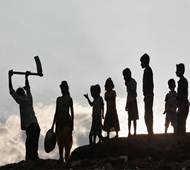
slavery copy copyAccording to the 2016 Global Slavery Index released by Australia-based human rights group Walk Free Foundation today, an estimated 45.8 million people, including women and children, are subject to some form of modern slavery in the world, compared to 35.8 million in 2014.

The report said India has the highest absolute numbers of people trapped in slavery with 18.35 million slaves among its 1.3 billion population while North Korea has the highest incidence (4.37 per cent of the population) and the weakest government response to deal with it.

In the last report in 2014, India had nearly 14.3 million people enslaved.
Incidences of slavery were found in all 167 countries in the index, with Asian countries occupy the top five for people trapped in slavery.

Behind India was China (3.39 million), Pakistan (2.13 million), Bangladesh (1.53 million) and Uzbekistan (1.23 million).

The index said that these five countries combined accounted for almost 58 per cent of the world's enslaved, or 26.6 million people.

The Index presents a ranking of 167 countries based on the proportion of the population that is estimated to be in modern slavery.

Modern slavery refers to situations of exploitation that a person cannot leave because of threats, violence, coercion, abuse of power or deception.

The research included over 42,000 interviews conducted in 53 languages across 25 countries, including 15 state-level surveys in India. These representative surveys covered 44 per cent of the global population.

The countries with the highest estimated prevalence of modern slavery by the proportion of their population are North Korea, Uzbekistan, Cambodia, Cambodia, India, and Qatar.

The countries with the lowest estimated prevalence of modern slavery by the proportion of their population are Luxembourg, Ireland, Norway, Denmark, Switzerland, Austria, Sweden and Belgium, the United States and Canada, and Australia and New Zealand.

The study also tracked the government actions and responses to the modern slavery and of the 161 assessed, 124 nations had criminalised human trafficking in line with the UN trafficking Protocol and 96 nations had developed national action plans to coordinate government response.

It noted that while India had more people enslaved than any other country, it had made significant progress in introducing measures to tackle the problem.

"It has criminalised trafficking, slavery, forced labour, child prostitution and forced marriage. The Indian government is currently tightening legislation against human trafficking, with tougher punishment for repeat offenders. It will offer victims protection and recovery support," it said.

It said that in addition to economic growth in India, ambitious programmes of legal and social reform are being undertaken right across the board, from regulation of labour relations to systems of social insurance for the most vulnerable.

Those governments taking the least action to combat modern slavery are North Korea, Iran, Eritrea, Equatorial Guinea, Hong Kong, Central African Republic, Papua New Guinea, Guinea, the Democratic Republic of the Congo and South Sudan.

The governments that have the strongest response to modern slavery are The Netherlands, the United States of America, the United Kingdom, Sweden, Australia, Portugal, Croatia, Spain, Belgium and Norway.

Seeking strong laws to abolish slavery, Andrew Forrest, Chairman and Founder of Walk Free Foundation, said eradicating slavery makes sense, morally, politically, logically and economically, and called on the governments of the world's leading economies to provide an example to others by enacting and implementing robust anti-slavery measures.

"We call on governments of the top 10 economies of the world to enact laws, at least as strong as the UK Modern Slavery Act 2015, with a budget and capability to ensure organisations are held to account for modern slavery in their supply chains, and to empower independent oversight."

Forrest said leaders of the world's major economies must bring the power of business to this issue, by requiring a focus on supply chain transparency.

"I believe in the critical role of leaders in government, business and civil society. Through our responsible use of power, strength of conviction, determination and collective will, we all can lead the world to end slavery," he said.

Forrest emphasised the key role that business needs to play in eradicating slavery.

"Businesses that don't actively look for forced labour within their supply chains are standing on a burning platform. Business leaders who refuse to look into the realities of their own supply chains are misguided and irresponsible," he said.

Comments

SK
 - 
Thursday, 2 Jun 2016

Since India is facing slavery, Naren has run away to Singapore to enjoy snake/ dog/cat/beef dishes......

Naren kotian
 - 
Tuesday, 31 May 2016

In that mostly 75% are from Muslim community as they enslave women as per their cult following .they have not changed since 6th century ...che papa ...ummah gang ge pitta netti geriruthe ..feku Anthe kumda ...for Muslims he might be feku ..but for nationalist Indians he is true hero who is transforming India .

Add new comment

  • Coastaldigest.com reserves the right to delete or block any comments.
  • Coastaldigset.com is not responsible for its readers’ comments.
  • Comments that are abusive, incendiary or irrelevant are strictly prohibited.
  • Please use a genuine email ID and provide your name to avoid reject.
coastaldigest.com news network
February 7,2020

Newsroom, Feb 7: Prime Minister Narendra Modi’s recent statement that there is no detention camp in India is no more a lie. That doesn’t mean that there are no detention camps in the country, but the name of the camps have changed. 

In December, at a mega rally at Ramlila Maidan, meant to launch the BJP's campaign for the assembly elections in Delhi, Mr Modi had stated: “The rumour of detention centres being spread by the Congress and urban Naxals is totally false. This is being done with a bad intention to destroy the country, it’s filled with evil motives; this is a lie, lie, lie.” He had further claimed: “Neither are any of the country’s Muslims being sent to detention centres nor is there any detention centre in India”

In reality there are at least six detention camps in jails in Assam to house foreigners found staying in India illegally. A month prior to PM’s statement, Union minister of the state for home affairs Nityanand Rai had revealed that the six camps in Assam housed 1,043 foreigners — 1,025 Bangladeshis and 18 Myanmarese. Apart from these, at least ten new detention centres are coming up.

Outside Assam too, the Maharashtra government, under the then chief minister Devendra Fadnavis, had identified land for the state’s first detention centre for illegal immigrants.

Besides, in a case relating to illegal immigrants in Karnataka High Court in November this year, the Centre had told the court that it had written to all state governments in 2014 and sent a follow-up letter in 2018 to have detention centres to house foreign nationals illegally staying in India.

Karnataka’s first detention centre, apparently meant to lodge illegal immigrants and migrants overstaying in the country, is already open in Sondekoppa village on the outskirts of Bengaluru. The facility with several rooms, a kitchen and toilets has been kept ready on the directions of the government. 

Meanwhile, Union Minister of state for home Nityanand Rai has told the Lok Sabha that the name "detention centre" has now been changed to "holding centre".

Comments

Add new comment

  • Coastaldigest.com reserves the right to delete or block any comments.
  • Coastaldigset.com is not responsible for its readers’ comments.
  • Comments that are abusive, incendiary or irrelevant are strictly prohibited.
  • Please use a genuine email ID and provide your name to avoid reject.
coastaldigest.com news network
May 12,2020

Manama: Kannada Sangha Bahrain President Mr. Pradeep Shetty and Vice President of Bahrain's prestigious KHK HEROES Foundation Mohammed Mansoor on Monday, May 11, met The Second Secretary (Consular & CW) of the Embassy of India, Bahrain Mr. P. K. Chowdhury in the Indian Embassy. 

The situation, problems and relief of Indians and Kannadigas residing in Bahrain during the COVID 19 Pandemic was discussed in detail. The distribution of food (dry ration) kits, as well as those seeking repatriation, was also discussed in the meeting.

When asked about the repatriation of distressed Kannadigas, the Second Secretary said that though the number of Kannadigas who wish to return home is not much compared to the rest of the states, still Embassy is compiling all the information and will do the needful soon. 

Mr. Shetty and Mr. Mansoor told the Second Secretary that those who are in problem can contact them and they are ready to do their best.

Comments

Add new comment

  • Coastaldigest.com reserves the right to delete or block any comments.
  • Coastaldigset.com is not responsible for its readers’ comments.
  • Comments that are abusive, incendiary or irrelevant are strictly prohibited.
  • Please use a genuine email ID and provide your name to avoid reject.
News Network
May 25,2020

Bengaluru, May 25: After facing flak from the opposition for skipping quarantine rules to contain COVID-19 spread, Union Minister Sadananda Gowda on Monday said there are certain exemption clauses for those who hold certain responsible posts, adding that he cannot go under quarantine as he has to ensure medical supply in every part of the country.

"Guidelines are applicable to all citizens, but there are certain exemption clauses, for those who hold certain responsible posts," Gowda told media on being asked about allegations by opposition parties that he did not go to required institutional quarantine after domestic air travel from Delhi to Bengaluru.

"I am a Minister and I am heading Pharmaceutical Ministry. If the supply of medicines and other things is not proper then what doctors can do for patients, is it not a failure of government? It' is my responsibility to ensure the supply of medicines to each corner of the country," he said.

Earlier in the day, the BJP MP, who arrived at Bengaluru airport from Delhi and straight away got into his car and drove to his residence. He skipped the institutional quarantine measures as set by the Central government.

Karnataka Director General of Police Praveen Sood said: "Incoming domestic flight passengers from Maharashtra, Rajasthan, Delhi, Gujarat, Tamil Nadu, Delhi and Madhya Pradesh will undergo 7-day institutional Quarantine followed by home quarantine."

Comments

Kannadiga
 - 
Monday, 25 May 2020

This is called has nagpur soldiers. He might think this virus has given excuse to all bjpean's or why he jumped out from the airport quarantine regulation. If the virus infected to any others what will.he do. What will his media will telecast. Same like Delhi they will target some other community. 


All must be away from him and his associates.

Here it is the duty of each individuals to keep distance and stay safe.

Not like our qualified leaders and ministers


Add new comment

  • Coastaldigest.com reserves the right to delete or block any comments.
  • Coastaldigset.com is not responsible for its readers’ comments.
  • Comments that are abusive, incendiary or irrelevant are strictly prohibited.
  • Please use a genuine email ID and provide your name to avoid reject.