


India tops global slavery index with 18.35 mn people enslaved

May 31, 2016

Melbourne, May 31: India has the dubious distinction of having the highest number of people in the world trapped in modern slavery with 18.35 million victims of forced labour, ranging from prostitution and begging, according to a new report, which estimated that nearly 46 million people are enslaved globally.
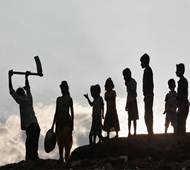
slavery copy copyAccording to the 2016 Global Slavery Index released by Australia-based human rights group Walk Free Foundation today, an estimated 45.8 million people, including women and children, are subject to some form of modern slavery in the world, compared to 35.8 million in 2014.

The report said India has the highest absolute numbers of people trapped in slavery with 18.35 million slaves among its 1.3 billion population while North Korea has the highest incidence (4.37 per cent of the population) and the weakest government response to deal with it.

In the last report in 2014, India had nearly 14.3 million people enslaved.
Incidences of slavery were found in all 167 countries in the index, with Asian countries occupy the top five for people trapped in slavery.

Behind India was China (3.39 million), Pakistan (2.13 million), Bangladesh (1.53 million) and Uzbekistan (1.23 million).

The index said that these five countries combined accounted for almost 58 per cent of the world's enslaved, or 26.6 million people.

The Index presents a ranking of 167 countries based on the proportion of the population that is estimated to be in modern slavery.

Modern slavery refers to situations of exploitation that a person cannot leave because of threats, violence, coercion, abuse of power or deception.

The research included over 42,000 interviews conducted in 53 languages across 25 countries, including 15 state-level surveys in India. These representative surveys covered 44 per cent of the global population.

The countries with the highest estimated prevalence of modern slavery by the proportion of their population are North Korea, Uzbekistan, Cambodia, Cambodia, India, and Qatar.

The countries with the lowest estimated prevalence of modern slavery by the proportion of their population are Luxembourg, Ireland, Norway, Denmark, Switzerland, Austria, Sweden and Belgium, the United States and Canada, and Australia and New Zealand.

The study also tracked the government actions and responses to the modern slavery and of the 161 assessed, 124 nations had criminalised human trafficking in line with the UN trafficking Protocol and 96 nations had developed national action plans to coordinate government response.

It noted that while India had more people enslaved than any other country, it had made significant progress in introducing measures to tackle the problem.

"It has criminalised trafficking, slavery, forced labour, child prostitution and forced marriage. The Indian government is currently tightening legislation against human trafficking, with tougher punishment for repeat offenders. It will offer victims protection and recovery support," it said.

It said that in addition to economic growth in India, ambitious programmes of legal and social reform are being undertaken right across the board, from regulation of labour relations to systems of social insurance for the most vulnerable.

Those governments taking the least action to combat modern slavery are North Korea, Iran, Eritrea, Equatorial Guinea, Hong Kong, Central African Republic, Papua New Guinea, Guinea, the Democratic Republic of the Congo and South Sudan.

The governments that have the strongest response to modern slavery are The Netherlands, the United States of America, the United Kingdom, Sweden, Australia, Portugal, Croatia, Spain, Belgium and Norway.

Seeking strong laws to abolish slavery, Andrew Forrest, Chairman and Founder of Walk Free Foundation, said eradicating slavery makes sense, morally, politically, logically and economically, and called on the governments of the world's leading economies to provide an example to others by enacting and implementing robust anti-slavery measures.

"We call on governments of the top 10 economies of the world to enact laws, at least as strong as the UK Modern Slavery Act 2015, with a budget and capability to ensure organisations are held to account for modern slavery in their supply chains, and to empower independent oversight."

Forrest said leaders of the world's major economies must bring the power of business to this issue, by requiring a focus on supply chain transparency.

"I believe in the critical role of leaders in government, business and civil society. Through our responsible use of power, strength of conviction, determination and collective will, we all can lead the world to end slavery," he said.

Forrest emphasised the key role that business needs to play in eradicating slavery.

"Businesses that don't actively look for forced labour within their supply chains are standing on a burning platform. Business leaders who refuse to look into the realities of their own supply chains are misguided and irresponsible," he said.

Comments

SK
 - 
Thursday, 2 Jun 2016

Since India is facing slavery, Naren has run away to Singapore to enjoy snake/ dog/cat/beef dishes......

Naren kotian
 - 
Tuesday, 31 May 2016

In that mostly 75% are from Muslim community as they enslave women as per their cult following .they have not changed since 6th century ...che papa ...ummah gang ge pitta netti geriruthe ..feku Anthe kumda ...for Muslims he might be feku ..but for nationalist Indians he is true hero who is transforming India .

Add new comment

  • Coastaldigest.com reserves the right to delete or block any comments.
  • Coastaldigset.com is not responsible for its readers’ comments.
  • Comments that are abusive, incendiary or irrelevant are strictly prohibited.
  • Please use a genuine email ID and provide your name to avoid reject.
News Network
May 9,2020

New Delhi, May 9: The Finance Ministry on Friday announced relief to those who have been facing difficulty with their residency status in India under section 6 of the Income-tax Act due to lockdown and suspension of international flights owing to COIVD-19 outbreak, as they have had to prolong their stay in India.

According to a Central Board of Direct Taxes (CBDT) release, Finance Minister Nirmala Sitharaman today allowed discounting of prolonged stay period in India for the purpose of determining residency status after considering various representations received from people who had to prolong their stay in India due to lockdown and suspension of international flights.

They expressed concern that they will be required to file tax returns as Indian residents and not as NRIs after 120 days of stay.

The Finance Ministry stated that the lockdown continues during the financial year 2020-21 and it is not yet clear when international flight operations would resume, a circular excluding the period of stay of these individuals up to the date of resumption of international flight operations shall be issued for determination of the residential status for the financial year 2020-21.

A circular also said that in order to avoid genuine hardship in such cases, the CBDT has decided that for the purposes of determining the residential status under section 6 of the Act during the previous year 2019-20 in respect of an individual who has come to India on a visit before March 22, 2020 and:

(a) has been unable to leave India on or before March 31, 2020, his period of stay in India from March 22, 2020 to March 31, 2020 shall not be taken into account; or

(b) has been quarantined in India on account of novel coronavirus (Covid-19) on or after March 1, 2020 and has departed on an evacuation flight on or before March 31, 2020 or has been unable to leave India on or before March 31, 2020, his period of stay from the beginning of his quarantine to his date of departure or March 31, 2020, as the case may be, shall not be taken into account; or

(c) has departed on an evacuation flight on or before March 31, 2020, his period of stay in India from March 22, 2020 to his date of departure shall not be taken into account."

The release said there are number of individuals who had come on a visit to India during the previous year 2019-20 for a particular duration and intended to leave India before the end of the previous year for maintaining their status as non-resident or not ordinary resident in India.

"However, due to declaration of the lockdown and suspension of international flights owing to outbreak of COVID-19, they are required to prolong their stay in India. The status of an individual whether he is resident in India or a non-resident or not ordinarily resident, is dependent, inter-alia, on the period for which the person is in India during a year," it said.

Comments

Add new comment

  • Coastaldigest.com reserves the right to delete or block any comments.
  • Coastaldigset.com is not responsible for its readers’ comments.
  • Comments that are abusive, incendiary or irrelevant are strictly prohibited.
  • Please use a genuine email ID and provide your name to avoid reject.
News Network
April 23,2020

Mangaluru, Apr 23: Playing the role of a good samaritan, the owner of a commercial complex and houses has waived off a month’s rent at Panemangalore in Bantwal.

B H Complex owner Mohammed Hassan has waived the rent of 21 shops and 12 houses in the complex. Due to Lockdown, people are without jobs and are struggling to eke out a living and Mr Hassan's good gesture helps them.

Hailing from Barimaru, Mr Hassan, who was working in foreign country, has come down and settled here. He had constructed houses and commercial complex and was living on the rent he was receiving.

Comments

Add new comment

  • Coastaldigest.com reserves the right to delete or block any comments.
  • Coastaldigset.com is not responsible for its readers’ comments.
  • Comments that are abusive, incendiary or irrelevant are strictly prohibited.
  • Please use a genuine email ID and provide your name to avoid reject.
Agencies
March 14,2020

Bengaluru, Mar 14: Bus-stands and railway stations in this IT city wore a deserted look on Saturday and malls, cinemas, pubs and night clubs remained shut as part of the lockdown announced by the state government following the country's first coronavirus fatality reported from Karnataka on March 12.

Six people in Karnataka have contracted the virus including the 76-year-old man who died due to this disease from Kalaburagi in the state.

A day after chief minister B S Yediyurappa announced the shutdown for a week, the usual rush at the Central bus-stand was missing.

"Since yesterday there is slackness. Today again we are witnessing the same," a Bangalore Metropolitan Transport Corporation official told PTI.

The Karnataka State Road Transport Corporation, which runs inter-city and inter-state buses, too has seen a decline in its revenue.

"For the past five to six days we are seeing a drop of Rs 32 lakh to Rs 35 lakh in our daily revenue of Rs eight crore," Bengaluru divisional controller B T Prabhakar Reddy said.

On March 13, Yediyurappa issued instructions to stop all kinds of exhibitions, summer camps, conferences, fairs, marriage, sports and engagement events and birthday parties state-wide for a week from Saturday.

Business at pubs and aars have taken a hit due to the virus threat.

"Our businesses have suffered somewhere between 40 per cent and 70 per cent.

It is very difficult to cope with the situation," said Manu Chandra, Bengaluru chapter head of National Restaurant Association of India.

In Chitradurga district, the annual Rathayatra was cancelled whereas in Bengaluru, a temple displayed a board that it will not distribute any 'teertha' (holy water) or 'prasad' (offering) to devotees in view of the coronavirus scare.

Comments

Add new comment

  • Coastaldigest.com reserves the right to delete or block any comments.
  • Coastaldigset.com is not responsible for its readers’ comments.
  • Comments that are abusive, incendiary or irrelevant are strictly prohibited.
  • Please use a genuine email ID and provide your name to avoid reject.