


India tops global slavery index with 18.35 mn people enslaved

May 31, 2016

Melbourne, May 31: India has the dubious distinction of having the highest number of people in the world trapped in modern slavery with 18.35 million victims of forced labour, ranging from prostitution and begging, according to a new report, which estimated that nearly 46 million people are enslaved globally.
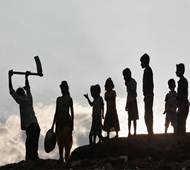
slavery copy copyAccording to the 2016 Global Slavery Index released by Australia-based human rights group Walk Free Foundation today, an estimated 45.8 million people, including women and children, are subject to some form of modern slavery in the world, compared to 35.8 million in 2014.

The report said India has the highest absolute numbers of people trapped in slavery with 18.35 million slaves among its 1.3 billion population while North Korea has the highest incidence (4.37 per cent of the population) and the weakest government response to deal with it.

In the last report in 2014, India had nearly 14.3 million people enslaved.
Incidences of slavery were found in all 167 countries in the index, with Asian countries occupy the top five for people trapped in slavery.

Behind India was China (3.39 million), Pakistan (2.13 million), Bangladesh (1.53 million) and Uzbekistan (1.23 million).

The index said that these five countries combined accounted for almost 58 per cent of the world's enslaved, or 26.6 million people.

The Index presents a ranking of 167 countries based on the proportion of the population that is estimated to be in modern slavery.

Modern slavery refers to situations of exploitation that a person cannot leave because of threats, violence, coercion, abuse of power or deception.

The research included over 42,000 interviews conducted in 53 languages across 25 countries, including 15 state-level surveys in India. These representative surveys covered 44 per cent of the global population.

The countries with the highest estimated prevalence of modern slavery by the proportion of their population are North Korea, Uzbekistan, Cambodia, Cambodia, India, and Qatar.

The countries with the lowest estimated prevalence of modern slavery by the proportion of their population are Luxembourg, Ireland, Norway, Denmark, Switzerland, Austria, Sweden and Belgium, the United States and Canada, and Australia and New Zealand.

The study also tracked the government actions and responses to the modern slavery and of the 161 assessed, 124 nations had criminalised human trafficking in line with the UN trafficking Protocol and 96 nations had developed national action plans to coordinate government response.

It noted that while India had more people enslaved than any other country, it had made significant progress in introducing measures to tackle the problem.

"It has criminalised trafficking, slavery, forced labour, child prostitution and forced marriage. The Indian government is currently tightening legislation against human trafficking, with tougher punishment for repeat offenders. It will offer victims protection and recovery support," it said.

It said that in addition to economic growth in India, ambitious programmes of legal and social reform are being undertaken right across the board, from regulation of labour relations to systems of social insurance for the most vulnerable.

Those governments taking the least action to combat modern slavery are North Korea, Iran, Eritrea, Equatorial Guinea, Hong Kong, Central African Republic, Papua New Guinea, Guinea, the Democratic Republic of the Congo and South Sudan.

The governments that have the strongest response to modern slavery are The Netherlands, the United States of America, the United Kingdom, Sweden, Australia, Portugal, Croatia, Spain, Belgium and Norway.

Seeking strong laws to abolish slavery, Andrew Forrest, Chairman and Founder of Walk Free Foundation, said eradicating slavery makes sense, morally, politically, logically and economically, and called on the governments of the world's leading economies to provide an example to others by enacting and implementing robust anti-slavery measures.

"We call on governments of the top 10 economies of the world to enact laws, at least as strong as the UK Modern Slavery Act 2015, with a budget and capability to ensure organisations are held to account for modern slavery in their supply chains, and to empower independent oversight."

Forrest said leaders of the world's major economies must bring the power of business to this issue, by requiring a focus on supply chain transparency.

"I believe in the critical role of leaders in government, business and civil society. Through our responsible use of power, strength of conviction, determination and collective will, we all can lead the world to end slavery," he said.

Forrest emphasised the key role that business needs to play in eradicating slavery.

"Businesses that don't actively look for forced labour within their supply chains are standing on a burning platform. Business leaders who refuse to look into the realities of their own supply chains are misguided and irresponsible," he said.

Comments

SK
 - 
Thursday, 2 Jun 2016

Since India is facing slavery, Naren has run away to Singapore to enjoy snake/ dog/cat/beef dishes......

Naren kotian
 - 
Tuesday, 31 May 2016

In that mostly 75% are from Muslim community as they enslave women as per their cult following .they have not changed since 6th century ...che papa ...ummah gang ge pitta netti geriruthe ..feku Anthe kumda ...for Muslims he might be feku ..but for nationalist Indians he is true hero who is transforming India .

Add new comment

  • Coastaldigest.com reserves the right to delete or block any comments.
  • Coastaldigset.com is not responsible for its readers’ comments.
  • Comments that are abusive, incendiary or irrelevant are strictly prohibited.
  • Please use a genuine email ID and provide your name to avoid reject.
News Network
April 12,2020

Bengaluru, Apr 12: As many as 17 new cases of coronavirus were confirmed on Sunday in Karnataka, taking the total number of infected to 232, the health department said.

This includes six deaths and 54 discharges.

According to the bulletin issued by the health department, six cases were reported from Vijayapura, four cases in Belagavi, three each in Bengaluru city and Kalaburagi and one in Mysuru.

Among the 17, four people are suffering from Severe Acute Respiratory Illness (SARI) -- two of whom are in Bengaluru and one each in Vijayapura and Kalaburagi, the department said.

Following the sudden spurt in cases in Vijayapura, the department has initiated contact tracing.

Ever since the outbreak of COVID-19, Bengaluru continued to top the list with 76 cases, followed by Mysuru with 48 cases, Belagavi with 14 cases, Kalaburagi with 13 cases and Dakshina Kannada with 12 cases.

Comments

Add new comment

  • Coastaldigest.com reserves the right to delete or block any comments.
  • Coastaldigset.com is not responsible for its readers’ comments.
  • Comments that are abusive, incendiary or irrelevant are strictly prohibited.
  • Please use a genuine email ID and provide your name to avoid reject.
News Network
July 10,2020

Bengaluru, July 10: The Karnataka government has decided to hold examinations only for the final semester students of undergraduate (UG) and postgraduate (PG) in various universities of state and promote other semester students to the next level without holding any examination.

The decision was taken to safeguarding the students' interest as well as academic career of lakhs of students during the time of Covid-19 pandemic. The significant move by the Higher Education department was announced by Deputy Chief Minister Dr CN Ashwath Narayan who is also the minister for Higher Education.

The DCM announced that the examination for final semester UG and PG students will be conducted as per the guidelines issued by the University Grants Commission (UGC) by the end of September 2020.

As per the latest decision, all students who are either at the beginning or middle semester of their UG and PG courses will be promoted to next semester without any examination. The state government further made it clear that the latest decision would only be applicable for this academic year--2019-20.

The students will be promoted to the next semesters based on academic performances during the previous assessment.

Giving details of the decision, Dr CN Ashwath Narayan told media persons that the decision was taken in the interest of the students. "Keeping in mind the safety of students during Covid-19 pandemic times, the government has taken the decision. We have also discussed with education experts, former Vice Chancellors before arriving at this decision," he said.

The DCM also revealed that Governor Vajubhai Vala who is the Chancellor of all the universities has also given his consent for the decision. Students can call up on the department helpline 080-22341394 for any academic queries.

How will students be promoted?

The students who are pursuing UG and PG courses at mid semester levels will be evaluated internally based on their academic performance along with the marks scored during the previous semester or year.

"Based on this comprehensive evaluation, we will promote the students to next semester. But for the first semester students, they will be promoted entirely based on internal evaluation on academic performance," the Deputy Chief Minister explained.

In case if the students wish to improve their marks further, they can take the exams separately later. This apart, students with backlog subjects have also been allowed to carry those subjects further into the next semester subject to only the present academic year.

Comments

Add new comment

  • Coastaldigest.com reserves the right to delete or block any comments.
  • Coastaldigset.com is not responsible for its readers’ comments.
  • Comments that are abusive, incendiary or irrelevant are strictly prohibited.
  • Please use a genuine email ID and provide your name to avoid reject.
News Network
March 26,2020

Hubballi, Mar 25: The people living in rural areas of North-Karnataka region have become more aware about deadly Corona virus as they are leaving no stone unturned to prevent people of Bengaluru and other metropolitan cities from entering into their villages. People have put thorny plants on all roads at the outskirts connecting their villages and deployed youths to conduct patrolling round the clock till next 21 days.

Their motto is to prevent their own villagers getting infected from the outsiders especially from cities like Bengaluru and other two-tier cities where positive virus cases are on the rise. They have also take precautionary measures in the wake of Chief Minister B S Yediyurappa's call to the people to return to their native places.

Several people have also dug up the roads leading to their villages to block the entry of outside vehicles. They have put a condition to the outsiders to enter into their villages only after proper health check-up to confirm that they are not infected with Corona positive.

"We don't have access to the proper medical care if Corona virus is entered into our village. The Primary Health Centres are not functioning properly and these centers are facing lack of adequate staff and medical equipments unlike in big cities.Therefore, those who have deserted our village to employ in various jobs in Bengaluru and other cities should confirm that they are tested negative for the virus", said Mallikarjun Patil of Kudal village in Hangal taluk of Haveri district. The village has totally banned the outsiders into their village and warned their fellow villagers to return immediately if they have visited to their relatives' homes in neighboring villages to observe 21-day lockdown.

Hundreds of youths in Itanal village of Chikkodi taluk of Belagavi have also resorted to similar tactics and patrolling in all roads at the outskirts by holding sticks to prevent outsiders from entering into their village until April 14.

People of Hunagunti village in Ron taluk and Kotamuchagi village in Gadag taluk have also adopted similar plan by parking tractors at th outskirts to prohibit the entry of outsiders. They have also created awareness in their villages by beating drums urging the people not to venture outside village for next three weeks.

The police officials have resorted to lati-charge at various places in urban areas when people gathered in large numbers to buy essential commodities.

Comments

Add new comment

  • Coastaldigest.com reserves the right to delete or block any comments.
  • Coastaldigset.com is not responsible for its readers’ comments.
  • Comments that are abusive, incendiary or irrelevant are strictly prohibited.
  • Please use a genuine email ID and provide your name to avoid reject.