



India, US call on Pakistan to stop terror attacks launched from its soil

Agencies
June 27, 2017

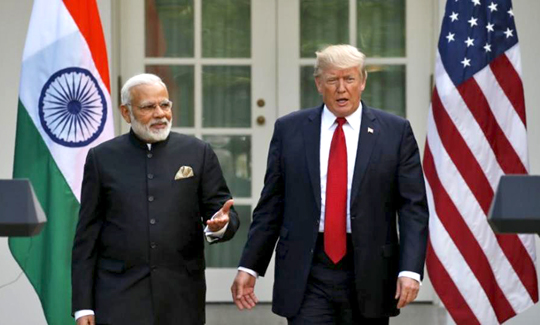
Washington, Jun 27: Sending out a strong message to Pakistan, India and the US today urged the country to ensure that its territory is not used to launch cross-border terror strikes and to "expeditiously" bring to justice the perpetrators of the 26/11 Mumbai and Pathankot attacks.
mt

Prime Minister Narendra Modi and President Donald Trump also vowed to strengthen efforts to fight terrorism and eliminate safe havens for terrorists.

"Eliminating terrorism is among the topmost priorities for us," Modi told reporters in his joint address with Trump at the White House.

The joint statement issued after the meeting between the leaders said the two sides "called on Pakistan to ensure that its territory is not used to launch terror attacks on other countries."

It further called on Pakistan to "expeditiously bring to justice the perpetrators of the 26/11 Mumbai, Pathankot attacks and other cross-border terrorist attacks perpetrated by Pakistan-based groups."

The prime minister said, "We talked about terrorism, extremism and radicalisation and agreed to cooperate on this. Fighting terrorism and doing away with the safe shelters, sanctuaries, and safe havens will be an important part of our cooperation."

Trump said both nations are "determined" to destroy terrorist organisations and the radical ideology that drives them.

"The security partnership between the US and India is incredibly important. Both our nations have been struck by the evils of terrorism and we are both determined to destroy terrorist organisations and the radical ideology that drives them. We will destroy radical Islamic terrorism," he said.

Foreign Secretary S Jaishankar said the two nations noted that in their joint statement that terrorism is a global scourge that must be fought in every part of the world, and the US and India would do it together.

"Our militaries are working every day to enhance cooperation between our military forces, and next month they will join together with the Japanese navy to take part in the largest maritime exercise ever conducted in the Indian Ocean," Trump said.

In their address at the White House Rose Garden, the two leaders also touched on trade, security, bilateral co- operation and instability in Afghanistan, among other issues.

Modi termed his talks with Trump, the first between the two leaders, as an "important page in the history of India-US relationship". He said he discussed in detail with Trump defence and security cooperation between the two nations. The two leaders have spoken over phone thric before this meeting.

Describing both countries as "global engines of growth", the prime minister said trade, commerce and investment are key areas of mutual co-operation. "Technology, innovation and knowledge economy are also areas were are actively looking at," he said.

Trump said he is keen to work with Modi on creating a "fair and reciprocal" trade relationship between the two nations and called for the removal of "barriers" for the export of US goods into Indian markets. "It is important that that we reduce our trade deficit with your country," he added.

The US president said that ties between India and US have never been stronger and better. Before their meeting began, he thanked India for ordering military equipment from the US.

He expressed pleasure about an order by an Indian airline company for 100 new American planes, calling it one of the largest orders of it is kind, which will support thousands and thousands of American jobs.

"We're also looking forward to exporting more American energy to India as your economy grows, including major long- term contracts to purchase American natural gas, which are right now being negotiated, and we will sign them. Trying to get the price up a little bit," he said.

Referring to the GST reform to be implemented across India starting next month, Trump said it was "the largest tax overhaul in your country's history".

"We're doing that also, by the way. Creating great new opportunities for your citizens. You have a big vision for improving infrastructure, and you are fighting government corruption, which is always a grave threat to democracy," he said.

India is the fastest growing economy in the world Trump said and added, "We hope we will be catching up you very soon."

Both leaders also expressed concern over rising instability in Afghanistan caused by terrorism, and agreed to continue strengthening coordination for ensuring peace and stability in the war-torn country.

Trump also called for the threat posed by North Korea's nuclear and ballistic programs to be "rapidly" tackled, and thanked Modi for "joining us in applying new sanctions against Pyongyang."

"The North Korean regime is causing tremendous problems and is something that has to be dealt with, and probably dealt with rapidly," Trump said.

Comments

Add new comment

  • Coastaldigest.com reserves the right to delete or block any comments.
  • Coastaldigset.com is not responsible for its readers’ comments.
  • Comments that are abusive, incendiary or irrelevant are strictly prohibited.
  • Please use a genuine email ID and provide your name to avoid reject.
News Network
April 10,2020

Melbourne, Apr 10: Scientists have identified six drug candidates from more than 10,000 compounds that may help treat COVID-19.

The research, published in the journal Nature, tested the efficacy of approved drugs, drug candidates in clinical trials and other compounds.

"Currently there are no targeted therapeutics or effective treatment options for COVID-19," said Professor Luke Guddat from the University of Queensland in Australia.

"In order to rapidly discover lead compounds for clinical use, we initiated a programme of high-throughput drug screening, both in laboratories and also using the latest computer software to predict how different drugs bind to the virus," Guddat said.

The project targeted the main COVID-19 virus enzyme, known as the main protease or Mpro, which plays a pivotal role in mediating viral replication, the researchers said.

This makes it an attractive drug target for this virus, and as people don't naturally have this enzyme, compounds that target it are likely to have low toxicity, they said.

"We add the drugs directly to the enzyme or to cell cultures growing the virus and assess how much of each compound is required to stop the enzyme from working or to kill the virus. If the amount is small, then we have a promising compound for further studies," said Guddat.

After assaying thousands of drugs, researchers found of the six that appear to be effective in inhibiting the enzyme, one is of particular interest.

"We're particularly looking at several leads that have been subjected to clinical trials including for the prevention and treatment of various disorders such as cardiovascular diseases, arthritis, stroke, atherosclerosis and cancer," Guddat said.

Researchers said compounds that are already along the pipeline to drug discovery are preferred, as they can be further tested as antivirals at an accelerated rate compared to new drug leads that would have to go through this process from scratch.

"With continued and up-scaled efforts we are optimistic that new candidates can enter the COVID-19 drug discovery pipeline in the near future," Guddat said.

Comments

Add new comment

  • Coastaldigest.com reserves the right to delete or block any comments.
  • Coastaldigset.com is not responsible for its readers’ comments.
  • Comments that are abusive, incendiary or irrelevant are strictly prohibited.
  • Please use a genuine email ID and provide your name to avoid reject.
News Network
February 26,2020

Feb 26: Looking out over the world’s largest cricket stadium, the seats jammed with more than 100,000 people, India’s prime minister heaped praise on his American visitor.

“The leadership of President Trump has served humanity,” Prime Minister Narendra Modi said Monday, highlighting Trump’s fight against terrorism and calling his 36-hour visit to India a watershed in India-U.S. relations.

The crowds cheered. Trump beamed.

“The ties between India and the U.S. are no longer just any other partnership,” Modi said. “It is a far greater and closer relationship.”

India, it seems, loves Donald Trump. It seemed obvious from the thousands who turned out to wave as his motorcade snaked through the city of Ahmedabad, and from the tens of thousands who filled the city’s new stadium. It seemed obvious from the hug that Modi gave Trump after he descended from Air Force One, and from the hundreds of billboards proclaiming Trump’s visit.

But it’s not so simple.

Because while Trump is genuinely popular in India, his clamorous and carefully choreographed welcome was also about Asian geopolitics, China’s growing power and a masterful Indian politician who gave his American visitor exactly what he wanted.

Modi “is doing this not necessarily because he loves Trump,” said Tanvi Madan, the director of the India Project at the Brookings Institution in Washington, D.C. “It’s very much about Trump as the leader of the U.S. and recognizing what it is that Trump himself likes.”

Trump likes crowds — big crowds — and the foot soldiers of India’s political parties have long known how to corral enough people to make any politician look popular. In a city like Ahmedabad, the capital of Modi’s home state of Gujarat and the center of his power base, it wouldn’t take much effort to fill a cavernous sports stadium. It was more surprising that a handful of seats remained empty, and that some in the stands had left even before Trump had finished his speech.

For India, good relations with the U.S. are deeply important: They signal that India is a serious global player, an issue that has long been important to New Delhi, and help cement an alliance that both nations see as a counterweight to China’s rise.

“For both countries, their biggest rival is China,” said John Echeverri-Gent, a professor at the University of Virginia whose research often focuses on India. “China is rapidly expanding its presence in the Indian Ocean, which India has long considered its backyard and its exclusive realm for security concerns.”

“It’s very clearly a major concern for both India and the United States,” he said.

Trump isn’t the first U.S. president that Modi has courted. In 2015, then-President Barack Obama was the first American chief guest at India’s Republic Day parade, a powerful symbolic gesture. Obama also got a Modi hug, and the media in both countries were soon writing about the two leaders’ “bromance.”

Trump is popular in India, even if some of that is simply because he’s the U.S. president. A 2019 Pew Research Center poll showed that 56% of Indians had confidence in Trump’s abilities in world affairs, one of only a handful of countries where he has that level of approval. But Obama was also popular: Before he left office, he had 58% approval in world affairs among Indians.

The Pew poll also indicated that Trump’s support was higher among supporters of Modi’s Hindu nationalist party.

That’s not surprising. Both men have fired up their nationalist bases with anti-Muslim rhetoric and government policies, from Trump’s travel bans to Modi’s crackdown in Kashmir, India’s only Muslim-majority state.

And Trump’s Indian support is far from universal. Protests against his trip roiled cities from New Delhi to Hyderabad to the far northeastern city of Gauhati, although those demonstrations were mostly overshadowed by protests over a new Indian citizenship law that Modi backs.

Modi, who is widely popular in India, has faced weeks of protests over the law, which provides fast track naturalization for some foreign-born religious minorities — but not Muslims. While Trump talked about ties with India on Tuesday, Hindus and Muslims fought in violent clashes that left at least 10 people dead over two days.

In some ways, Modi and Trump are powerful echoes of each other.

They have overlapping political styles. Both are populists who see themselves as brash, rule-breaking outsiders who disdain their countries’ traditional elites. Both are seen by their critics as having authoritarian leanings. Both surround themselves with officials who rarely question their decisions.

But are they friends?

Trump says yes. “Really, we feel very strongly about each other,” he said at a New Delhi press briefing.

But many observers aren’t so sure.

“The question is how much of this is real chemistry, as opposed to what I’d call planned chemistry” orchestrated for diplomatic reasons, said Madan. “It’s so hard to know if you’re not in the room.”

Certainly, Modi understands America’s importance to India. While the two countries continue to bicker about trade issues, the prime minister organized a welcome that impressed even India’s news media, which have watched countless choreographed mass political rallies.

“There is no other country for whose leader India would hold such an event, and for which an Indian prime minister would lavish such rhetoric,” the Hindustan Times said in an editorial.

“The spectacle and the sound were worth a thousand agreements.”

Comments

Add new comment

  • Coastaldigest.com reserves the right to delete or block any comments.
  • Coastaldigset.com is not responsible for its readers’ comments.
  • Comments that are abusive, incendiary or irrelevant are strictly prohibited.
  • Please use a genuine email ID and provide your name to avoid reject.
News Network
May 20,2020

May 20: The novel coronavirus is behaving differently in patients in northeast China who have contracted it recently compared with early cases, indicating it is changing as it spreads, a prominent doctor said.

China, which has largely brought the virus under control, has found new clusters of infections in the northeastern border provinces of Jilin and Heilongjiang in recent weeks, raising concern about a second wave.

Qiu Haibo, an expert in critical care medicine who is part of a National Health Commission expert group, said the incubation period of the virus in patients in the northeast was longer than that of patients in Wuhan, the central city, where the virus emerged late last year.

COVID-19 Pandemic Tracker: 15 countries with the highest number of coronavirus cases, deaths

"This causes a problem, as they don't have any symptoms. So when they gather with their families they don't care about this issue and we see family cluster infections," Qiu told state broadcaster CCTV in a programme broadcast late on Tuesday.

Patients in the northeastern clusters were also carrying the virus for longer than earlier cases in Wuhan, and they were taking longer to recover, as defined by a negative nucleic acid test, he said.

Patients in the northeast also rarely exhibited fever and tended to suffer damage to the lungs rather than across multiple organs, he said.

He said the virus found in the northeastern clusters was probably imported from abroad, which could account for the differences.

He did not say where he though they might have come from but both Jilin and Heilongjiang border Russia.

China reported five new coronavirus cases on Wednesday, down from six a day earlier.

Four of the new cases were local transmissions and one was imported by a traveller coming from abroad, the commission said in a statement, compared with three imported cases reported the previous day.

China's total number of coronavirus infections stands at 82,965, while the death toll 4,634. 

Comments

Add new comment

  • Coastaldigest.com reserves the right to delete or block any comments.
  • Coastaldigset.com is not responsible for its readers’ comments.
  • Comments that are abusive, incendiary or irrelevant are strictly prohibited.
  • Please use a genuine email ID and provide your name to avoid reject.