


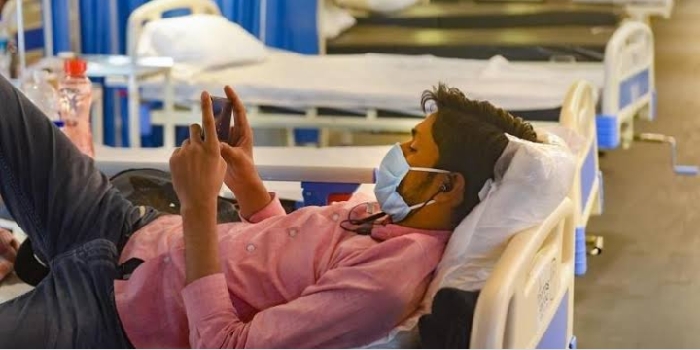
Centre asks states to allow hospitalised covid patients use smartphones to interact with kin

Agencies
August 2, 2020

New Delhi, Aug 2: The Centre has written to all states and Union Territories stating that smartphones and tablet devices should be allowed for hospitalised Covid-19 patients so that they can interact with family and friends through video conferencing, which would provide them psychological support.

Though mobile phones are allowed in hospital wards, the missive was issued following some representation from the kin of patients alleging otherwise.

Director-General of Health Services (DGHS) in the Health Ministry Dr Rajiv Garg in the letter to the principal secretaries of health and medical education of states and Union territories said appropriate protocols for disinfecting devices and allotting timeslots can be developed by the hospital concerned to facilitate contact between patients and their family.

He underlined that administrative and medical teams should be responsive to the psychological needs of patients admitted in Covid-19 wards and ICUs of various hospitals.

"Social connection can calm down patients and also reinforce the psychological support given by the treating team. Please instruct all concerned that they should allow smartphones and tablet devices in patient areas so that the patient can video conference with their family and friends," stated the letter issued on July 29.

"Though mobile phones are allowed in the wards to enable a patient stay in touch with his or her family, we received representations from the patient families from some states stating mobile phones are not being allowed by hospital administrations because of which they were not being able to stay in contact with the patient," said Dr Garg.

Comments

Add new comment

  • Coastaldigest.com reserves the right to delete or block any comments.
  • Coastaldigset.com is not responsible for its readers’ comments.
  • Comments that are abusive, incendiary or irrelevant are strictly prohibited.
  • Please use a genuine email ID and provide your name to avoid reject.
Agencies
July 21,2020

The Retailers Association of India (RAI) has said that ad hoc lockdowns by state governments are impacting the businesses of already-stressed retailers, along with hurting the economic revival of the country.

In a statement, the body of the organised retail industry said that the long road to recovery for the Indian retail industry continues to meet stumbling blocks with numerous restrictions being imposed at the state and local levels.

"Total lockdowns in some places and limited operational hours and days in several others are creating setbacks for retailers as the already stressed retail businesses are getting further interrupted and in turn, dampening consumer sentiment," it said.

According to RAI, although the intentions are that of citizen safety and social distancing, the recent instances of local lockdowns and ad hoc restrictions being imposed in Uttar Pradesh, Maharashtra, Andhra Pradesh and Karnataka are having a distressing impact on retail businesses.

Retailers are already facing huge setbacks in terms of payment of wages and rentals due to very low sales of about 40 per cent as compared to last year, thanks to the extended lockdown, it said.

Contesting the restrictions on operating hours, Sandeep Kataria, CEO, Bata India said: "Restricted shopping time can lead to unnecessary overcrowding of stores, which is unfavourable towards the personal safety of both store staff and customers. Longer operational hours will support recovery for retailers as well as help adhering to social distancing norms."

Arvind Mediratta, MD and CEO, METRO Cash & Carry India said that these lockdowns will create severe inconvenience for all citizens as they also bar operations of food and grocery retail and wholesale stores.

Such hastily-implemented decisions by states undermine investor confidence and would come in the way of making the country "aatmanirbhar" or self-reliant, he said.

Voicing the concerns of retailers, the RAI has submitted representations to various state and local authorities that puts forth recommendations to get businesses and life of consumers on the track to recovery.

It has said that authorities should mandatorily allow essential shops including kiranas, general trade shops, supermarkets, hypermarkets and wholesalers to operate every day of the week until 9 p.m. to cater to the daily needs of the customers.

It has also sought ensuring uniform and regular opening of all categories of retail for full working hours while following stringent hygiene practices and adhering to social distancing norms. This will help avoid overcrowding outside stores as demand will get distributed over all days of the week, it said.

The industry body has also asked the local authorities to open malls in all states. Malls can ensure a safe shopping experience wherein safety measures are taken by both, the mall authorities and the retailers, it said.

Kumar Rajagopalan, CEO, RAI, said: "The need of the hour is concerted efforts by all stakeholders. While retailers are doing their bit by following stringent hygiene practices, the policymakers too need to support to ensure economic revival across the country. Consumption is important for the country and supports the business environment."

Comments

Add new comment

  • Coastaldigest.com reserves the right to delete or block any comments.
  • Coastaldigset.com is not responsible for its readers’ comments.
  • Comments that are abusive, incendiary or irrelevant are strictly prohibited.
  • Please use a genuine email ID and provide your name to avoid reject.
News Network
May 22,2020

New Delhi, May 22: Reserve Bank Governor Shaktikanta Das on Friday extended the moratorium on payment of loans by another three months till August to provide much-needed relief to borrowers whose income has been hit due to the coronavirus crisis.

In March, the central bank had allowed a three-month moratorium on payment of all term loans due between March 1, 2020, and May 31, 2020.

Accordingly, the repayment schedule and all subsequent due dates, as also the tenor for such loans, were shifted across the board by three months.

As a result of this moratorium, individuals’ EMI repayments of loans taken were not deducted from their bank accounts, providing much-needed liquidity.

The EMI payments will restart only once the moratorium time period expires on August 31.

Comments

Add new comment

  • Coastaldigest.com reserves the right to delete or block any comments.
  • Coastaldigset.com is not responsible for its readers’ comments.
  • Comments that are abusive, incendiary or irrelevant are strictly prohibited.
  • Please use a genuine email ID and provide your name to avoid reject.
Agencies
July 18,2020

New Delhi, Jul 18: National carrier Air India on Friday said that it is in a ‘very challenging financial’ situation and is taking recourse to several initiatives, with a view to ensuring the continuance of its operations.

The airline, in a statement, noted that it has introduced the partially voluntary 'Leave Without Pay' (LWP) scheme on July 14.

"The scheme primarily enables employees to avail the benefits of proceeding on leave without pay on a voluntary basis. The LWP scheme has been introduced for grant of leave without pay and allowances for permanent employees for a period of six months or two years, which is extendable upto 5 years," the statement said.

"Air India had brought out similar scheme earlier... Several hundred employees have, in the past, availed of the LWP Scheme."

As per the statement, in the wake of the ongoing Covid-19 pandemic, there may be employees who are unable to attend their office duties in person on account of personal reasons.

"The LWP scheme enables employees to take a break from their office responsibility for a defined period of time with the approval of the management, while retaining their employment with the company," the statement said.

"They will continue to avail facilities such as passage, medical and housing at specified rates."

Accordingly, the LWP scheme provides the opportunity to employees to take up alternative employment with the approval of the management during the period of the said leave, the airline said.

"The LWP scheme is a win-win situation for both the management as well as employees as it provides flexibility to employees and simultaneously reduces the wage bill for the company," the statement said.

"It is important to note here that the Covid-19 outbreak has very seriously impacted the airline sector and currently, the airline operations of the company are a small fraction of the prior Covid level operations."

The airline said that employees are encouraged to apply for availing the benefit of the scheme, in the prescribed format, by August 15.

"The only addition in this scheme as compared to the earlier LWP scheme is that the management can pass an order requiring the employees to go on leave for a period of six months or two years (extendable upto 5 years) compulsorily taking into consideration 'Suitability, Efficiency, Competence, Quality of performance, Health, Non-availability of employee and Redundancy'," the statement said.

Furthermore, the airline said that this provision has been introduced for use, "very sparingly", with a view to ensuring that the overall efficiency of the organisation, improves and the management will ensure that this will be implemented with complete fairness and transparency as per prescribed procedure.

Consequent to the announcement of the scheme, Air India unions are discussing their strategy against the move which might involve legal recourse.

An Air India union leader on Friday told IANS: "This is going to affect the livelihood of many. Why not every employee of AI take LWP a few days every month. This way the burden can be shared."

"The motive of the top management is to save their money by snatching money from lower employees."

According to Air India PIM document, as on November 1, 2019, the airline, on a standalone basis (without subsidiaries), had around 14,000 employees, including fixed term contract staff.

The development comes as the Centre has re-initiated the airline's divestment plan with new norms.

Interestingly, this time, it has sweetened the deal by substantially reducing the debt on the airline's account books and offered a 100 per cent stake in the loss-making airline.

The last date for bid submission to acquire Air India has also been extended to August 31.

Comments

Add new comment

  • Coastaldigest.com reserves the right to delete or block any comments.
  • Coastaldigset.com is not responsible for its readers’ comments.
  • Comments that are abusive, incendiary or irrelevant are strictly prohibited.
  • Please use a genuine email ID and provide your name to avoid reject.