


Indian Air Force fighters make first staging visit to Saudi Arabia

[email protected] (Saudi Gazette)
August 4, 2015

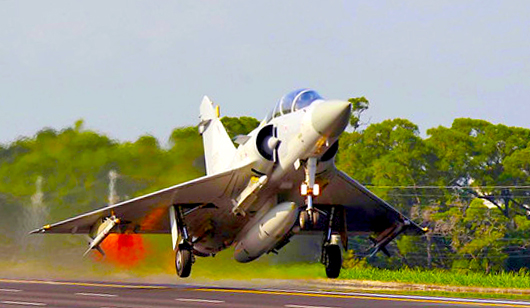
Jeddah, Aug 4: A flying contingent of the Indian Air Force (IAF) are on a maiden visit to the Kingdom of Saudi Arabia from August 1-4.

Indian Embassy Charge d’Affaires Hemant Kotalwar, while addressing a press conference, called the visit significant, and yet another feature that is set to give the Indo-Saudi relations a boost.
Air Force

“The visit underscored the close defense ties between India and Saudi Arabia, which received a fillip following Custodian of the Two Holy Mosques King Salman’s visit to New Delhi, when he was Crown Prince in February 2014, to sign a Bilateral Defense Cooperation Agreement,” he said.

Kotalwar thanked King Salman and Deputy Crown Prince Mohammad Bin Salam, minister of defense, for the support and cooperation rendered during the visit.

The contingent consisting of 110 IAF officers and airmen onboard Sukhoi 30MKI fighter aircraft, C-17 Globe Masters, C-130 Super Hercules and IL-78 aircraft while en route to United Kingdom for a multinational exercise landed at King Fahd airbase in Taif.

The inaugural staging visit that the IAF pilots called very interactive and fruitful. They will be leaving for Athens prior to the UK for the multinational exercise.

Earlier, RAF Coningsby welcomed the international visitors from the IAF, who had traveled to the UK to support Exercise Indradhanush IV, with a C130, C17 and 4 IAF SU30MKI aircraft till the end of July.

The aim of the exercise, that began on July 21 and ended on July 31, was to enhance mutual operational understanding between the two Air Forces and to provide ample opportunity for exchange of ideas relating to concept of operations in a dynamic warfare environment.

The fighter aircraft, according to a press release, were based at 3(F) Squadron and worked with Typhoon fighter aircraft. 3(F) Squadron, one of the Typhoon squadrons based at RAF Coningsby, was the first Operational Typhoon Squadron.

The SU30MKI aircraft are part of No. 2 Squadron (Winged Arrows) a unit dedicated to close air support based at Kalaikunda Air Force Station, an IAF Base near Kharagpur. The squadron has as its emblem an arrow with spread wings, with the No. 2 attached to the shaft. On a scroll below this crest is inscribed "Amogh Lakshya" (Unwavering Aim).

The RAF and IAF fighter pilots, who participated in Exercise Indradanush, said they were full of admiration for each other’s capabilities and aircraft.

The two-week exercise provided a rare opportunity for RAF pilots to test themselves against the fourth generation Russian built fighter. Over the course of two weeks the complexity of the training sorties increased, starting from 1 v 1 dogfight to sorties involving up to 20 fighters.

Wing Commander Chris Moon, the Officer Commanding 3(F) Squadron, said: “First impressions of the Flanker are very positive. It is a superb airplane and it’s a privilege to operate our Typhoon alongside it.

“The RAF and IAF both pride ourselves on operating some of the leading edge technical equipment in the world. However, without the people to support that we are nothing so that’s where our real strength lies.”

His views were echoed by Squadron Leader Avi Arya, a Qualified Weapons Instructor responsible for training pilots on the radar and weapons systems of the Su-30. He said: “Both are fourth generation aircraft and so are matched evenly, so the learning value comes from the person to person contact, it’s the man behind the machine which matters. All fighter pilots speak the same language, that’s the common thing we have and it’s very comfortable to learn from each other.”

Speaking shortly after his first encounter with the thrust vector equipped Su-30, Typhoon pilot Flight Lieutenant Mike Highmoor had no doubt about the values of the bilateral exercise: “This is fantastic. It’s the first time I’ve flown against a Flanker this morning and it’s fascinating to see another air force do its thing in a different airplane. Flying against an aircraft which is equally comparable to the Typhoon isn’t something we get to fight against on a regular basis in the UK. It’s very exciting. It’s an incredibly impressive fighter but the Typhoon is a good match for it.”

Opposing Flt Lt Highmoor on that first sortie was Squadron Leader Amit Gehani, who trained with the RAF in the UK. He said: “It’s going well. We’re flying a lot of missions that are proving our air combat missions. We brief on the ground, we go up there, set up the fights and thereafter it’s a free for all.

“The Typhoon is a good aircraft, a very powerful aircraft. The RAF pilots here are really amazing and flying with the Typhoon we’re learning a lot of new lessons from the RAF, which we will take back to India. Of course we’re also giving some good points to the Typhoon pilots.”

On training sorties the fighters are being refueled in mid-air by tanker aircraft from their respective countries operating from RAF Brize Norton. C-130J Hercules aircraft are undertaking joint parachute drops of RAF Regiment and IAF Garud troops while RAF and IAF C-17 crews are also training together.

Comments

Mariano
 - 
Friday, 15 Apr 2016

Impressive Post!Has come to an essential and vibrant point
where I am actually cutting everything down by the POUNDS.
I ran into an ex-partner of a business who
still owes cash and set up a magnificent dining establishment
... but stressed as hell.QualtyLikeLike

Also visit my web site; claim easily: http://www.google.com

Roseann
 - 
Monday, 11 Apr 2016

I just need to state Tim you are one dam motivating guy, I like the fact that you do not simply blindly
follow the advice of any individual but you get to the people that count and implement solid action plans.

I would say that this would be absolutley vital in the present market and if
you have no idea in investing, get one!RichLikeLike

Also visit my site :: selling
a business - announcing 3 easy methods to excel in selling your business: http://www.google.com

Add new comment

  • Coastaldigest.com reserves the right to delete or block any comments.
  • Coastaldigset.com is not responsible for its readers’ comments.
  • Comments that are abusive, incendiary or irrelevant are strictly prohibited.
  • Please use a genuine email ID and provide your name to avoid reject.
News Network
July 29,2020

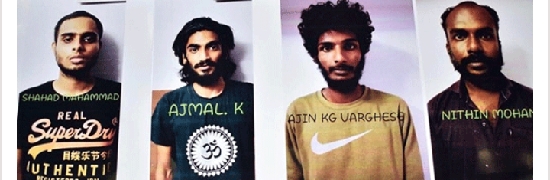
Bengaluru, July 29: The Central Crime Branch arrested four international drug peddlers belonging to Kerala and recovered drugs worth Rs 1.25 crore from them, said Karnataka Home Minister Basavaraj Bommai on Wednesday.

"We have started a war on drugs. Our agenda is to curb the drug mafia not only in Bengaluru, but in entire Karnataka. Many people are involved in the drug mafia. They are targeting students, other states, and international students who can spend and afford to become victims," said Bommai.

The recovered items include 2,000 kg LSD strips, 110 grams MDMA Cristol, 10 ecstasy tablets, 5 kg Ganja, five cell phones, weighing machine and pouches.

"When we raided a house in Soladevanahally police station area, we arrested Shahad Mohammed, Azmal, Ajin KG Verghese and Nitin Mohan. All are from Kerala and we will arrest their contacts as well. They are involved in the dark web mafia," Bommai said.

He said the peddlers were using post offices and couriers for their business.

"I'll speak to the central government, the home ministry and postal department, and other issues related to this mafia. Canada, Netherlands, and other nations are also involved in this mafia," said the state home minister.

"People from influential backgrounds are also involved in this mafia, but our objective is zero tolerance. We are using our intelligence. Drugs are coming from other states like AP, Goa, and other states," he said.
Bommai said he was personally addressing this case and appealed for support from parents, schools and colleges.

"I'm addressing this issue personally because it's important to curb the drug mafia. I need support from schools and college managements and parents. I'll also call college and hostel managements before colleges start. We will make managements responsible," he said.

Comments

Add new comment

  • Coastaldigest.com reserves the right to delete or block any comments.
  • Coastaldigset.com is not responsible for its readers’ comments.
  • Comments that are abusive, incendiary or irrelevant are strictly prohibited.
  • Please use a genuine email ID and provide your name to avoid reject.
News Network
May 28,2020

Bengaluru, May 28: In a first of its kind initiative, the Karnataka government will soon launch 'Statewide Health Register', a project to maintain the health database of all its citizens, announced Medical Education Minister Dr K Sudhakar on Wednesday.

The project will kick start from Chikkaballapura and Dakshina Kannada districts.

"With a vision to efficiently deliver quality healthcare to every citizen, Karnataka will soon have a Statewide Health Register. The pilot project will be implemented in Chikkaballapura & Dakshina Kannada dist shortly and completed in 3-4 months. @CMofKarnataka @PMOIndia @JPNadda," tweeted the Minister.

The government plans to get the data collected with the help of a team of Primary Health Centre (PHC) officials, revenue officials, Education Department staff and ASHA (Accredited Social Health Activist) workers.

"They will visit each household and collect health data of all the members of the family. This will not just help the government to provide better health care facilities, but also build an efficient resource allocation, management and better implementation of various citizen-centric schemes in the state," the minister added.

Sudhakar also said that the COVID-19 pandemic has demonstrated the necessity of having a robust, real-time public health system.

"Very few countries in the world have taken such an initiative. It is a futuristic project which will include 50 per cent partnership of private hospitals. It would be a cumbersome process but if we do this and digitise it, the data could be used for multiple purposes. The data would help us prioritise healthcare based on geography, demography, and other targeted measures. It would also help medical professionals and scientists for innumerable studies," he said.

"We have consulted all specialists from 18 different departments, and taken their advice into account," said the minister.

Comments

Add new comment

  • Coastaldigest.com reserves the right to delete or block any comments.
  • Coastaldigset.com is not responsible for its readers’ comments.
  • Comments that are abusive, incendiary or irrelevant are strictly prohibited.
  • Please use a genuine email ID and provide your name to avoid reject.
Ram Puniyani
February 4,2020

As democracy is seeping in slowly all over the world, there is an organization which is monitoring the degree of democracy in the individual countries, The Economist Intelligence Unit. As such in each country there are diverse factors which on one hand work to deepen it, while others weaken it. Overall there is a march from theoretical democracy to substantive one. The substantive democracy will herald not just the formal equality, freedom and community feeling in the country but will be founded on the substantive quality of these values. In India while the introduction of modern education, transport, communication laid the backdrop of beginning of the process, the direction towards deepening of the process begins with Mahatma Gandhi when he led the non-cooperation movement in 1920, in which average people participated. The movement of freedom for India went on to become the ‘greatest ever mass movement’ in the World.

The approval and standards for democracy were enshrined in Indian Constitution, which begins ‘We the people of India’, and was adopted on 26th January 1950. With this Constitution and the policies adopted by Nehru the process of democratization started seeping further, the dreaded Emergency in 1975, which was lifted later restored democratic freedoms in some degree. This process of democratisation is facing an opposition since the decade of 1990s after the launch of Ram Temple agitation, and has seen the further erosion with BJP led Government coming to power in 2014. The state has been proactively attacking civil liberties, pluralism and participative political culture with democracy becoming flawed in a serious way. And this is what got reflected in the slipping of India by ten places, to 51st, in 2019. On the index of democracy India slipped down from the score of 7.23 to 6.90. The impact of sectarian BJP politics is writ on the state of the nation, country.

Ironically this lowering of score has come at a time when the popular protests, the deepening of democracy has been given a boost and is picking up with the Shaheen Bagh protests. The protest which began in Shaheen Bagh, Delhi in the backdrop of this Government getting the Citizenship amendment Bill getting converted into an act and mercilessly attacking the students of Jamia Milia Islamia, Aligarh Muslim University along with high handed approach in Jamia Nagar and neighbouring areas.  From 15th December 2019, the laudable protest is on.

It is interesting to note that the lead in this protest has been taken by the Muslim women, from the Burqa-Hijab clad to ‘not looking Muslim’ women and was joined by students and youth from all the communities, and later by the people from all the communities. Interestingly this time around this Muslim women initiated protest has contrast from all the protests which earlier had begun by Muslims. The protests opposing Shah Bano Judgment, the protests opposing entry of women in Haji Ali, the protests opposing the Government move to abolish triple Talaq. So far the maulanas from top were initiating the protests, with beard and skull cap dominating the marches and protests. The protests were by and large for protecting Sharia, Islam and were restricted to Muslim community participating.

This time around while Narendra Modi pronounced that ‘protesters can be identified by their clothes’, those who can be identified by their external appearance are greatly outnumbered by all those identified or not identified by their appearance.

The protests are not to save Islam or any other religion but to protect Indian Constitution. The slogans are structured around ‘Defence of democracy and Indian Constitution’. The theme slogans are not Allahu Akbar’ or Nara-E-Tadbeer’ but around preamble of Indian Constitution. The lead songs have come to be Faiz Ahmad Faiz’s ‘Hum Dekhenge’, a protest against Zia Ul Haq’s attempts to crush democracy in the name of religion. Another leading protest song is from Varun Grover, ‘Tanashah Aayenge…Hum Kagaz nahin Dikhayenge’, a call to civil disobedience against the CAA-NRC exercise and characterising the dictatorial nature of the current ruling regime.

While BJP was telling us that primary problem of Muslim women is Triple talaq, the Muslim women led movements has articulated that primary problem is the very threat to Muslim community. All other communities, cutting across religious lines, those below poverty line, those landless and shelter less people also see that if the citizenship of Muslims can be threatened because of lack of some papers, they will be not far behind in the victimization process being unleashed by this Government.

While CAA-NRC has acted as the precipitating factor, the policies of Modi regime, starting from failure to fulfil the tall promises of bringing back black money, the cruel impact of demonetisation, the rising process of commodities, the rising unemployment, the divisive policies of the ruling dispensation are the base on which these protest movements are standing. The spread of the protest movement, spontaneous but having similar message is remarkable. Shaheen Bagh is no more just a physical space; it’s a symbol of resistance against the divisive policies, against the policies which are increasing the sufferings of poor workers, the farmers and the average sections of society.

What is clear is that as identity issues, emotive issues like Ram Temple, Cow Beef, Love Jihad and Ghar Wapasi aimed to divide the society, Shaheen Bagh is uniting the society like never before. The democratisation process which faced erosion is getting a boost through people coming together around the Preamble of Indian Constitution, singing of Jan Gan Man, waving of tricolour and upholding the national icons like Gandhi, Bhagat Singh, Ambedkar and Maulana Azad. One can feel the sentiments which built India; one can see the courage of people to protect what India’s freedom movement and Indian Constitution gave them.

Surely the communal forces are spreading canards and falsehood against the protests. As such these protests which is a solid foundation of our democracy. The spontaneity of the movement is a strength which needs to be channelized to uphold Indian Constitution and democratic ethos of our beloved country.

Comments

Add new comment

  • Coastaldigest.com reserves the right to delete or block any comments.
  • Coastaldigset.com is not responsible for its readers’ comments.
  • Comments that are abusive, incendiary or irrelevant are strictly prohibited.
  • Please use a genuine email ID and provide your name to avoid reject.