


Indian Air Force fighters make first staging visit to Saudi Arabia

[email protected] (Saudi Gazette)
August 4, 2015

Jeddah, Aug 4: A flying contingent of the Indian Air Force (IAF) are on a maiden visit to the Kingdom of Saudi Arabia from August 1-4.

Indian Embassy Charge d’Affaires Hemant Kotalwar, while addressing a press conference, called the visit significant, and yet another feature that is set to give the Indo-Saudi relations a boost.
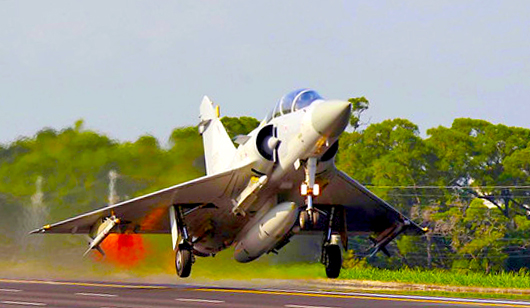
Air Force

“The visit underscored the close defense ties between India and Saudi Arabia, which received a fillip following Custodian of the Two Holy Mosques King Salman’s visit to New Delhi, when he was Crown Prince in February 2014, to sign a Bilateral Defense Cooperation Agreement,” he said.

Kotalwar thanked King Salman and Deputy Crown Prince Mohammad Bin Salam, minister of defense, for the support and cooperation rendered during the visit.

The contingent consisting of 110 IAF officers and airmen onboard Sukhoi 30MKI fighter aircraft, C-17 Globe Masters, C-130 Super Hercules and IL-78 aircraft while en route to United Kingdom for a multinational exercise landed at King Fahd airbase in Taif.

The inaugural staging visit that the IAF pilots called very interactive and fruitful. They will be leaving for Athens prior to the UK for the multinational exercise.

Earlier, RAF Coningsby welcomed the international visitors from the IAF, who had traveled to the UK to support Exercise Indradhanush IV, with a C130, C17 and 4 IAF SU30MKI aircraft till the end of July.

The aim of the exercise, that began on July 21 and ended on July 31, was to enhance mutual operational understanding between the two Air Forces and to provide ample opportunity for exchange of ideas relating to concept of operations in a dynamic warfare environment.

The fighter aircraft, according to a press release, were based at 3(F) Squadron and worked with Typhoon fighter aircraft. 3(F) Squadron, one of the Typhoon squadrons based at RAF Coningsby, was the first Operational Typhoon Squadron.

The SU30MKI aircraft are part of No. 2 Squadron (Winged Arrows) a unit dedicated to close air support based at Kalaikunda Air Force Station, an IAF Base near Kharagpur. The squadron has as its emblem an arrow with spread wings, with the No. 2 attached to the shaft. On a scroll below this crest is inscribed "Amogh Lakshya" (Unwavering Aim).

The RAF and IAF fighter pilots, who participated in Exercise Indradanush, said they were full of admiration for each other’s capabilities and aircraft.

The two-week exercise provided a rare opportunity for RAF pilots to test themselves against the fourth generation Russian built fighter. Over the course of two weeks the complexity of the training sorties increased, starting from 1 v 1 dogfight to sorties involving up to 20 fighters.

Wing Commander Chris Moon, the Officer Commanding 3(F) Squadron, said: “First impressions of the Flanker are very positive. It is a superb airplane and it’s a privilege to operate our Typhoon alongside it.

“The RAF and IAF both pride ourselves on operating some of the leading edge technical equipment in the world. However, without the people to support that we are nothing so that’s where our real strength lies.”

His views were echoed by Squadron Leader Avi Arya, a Qualified Weapons Instructor responsible for training pilots on the radar and weapons systems of the Su-30. He said: “Both are fourth generation aircraft and so are matched evenly, so the learning value comes from the person to person contact, it’s the man behind the machine which matters. All fighter pilots speak the same language, that’s the common thing we have and it’s very comfortable to learn from each other.”

Speaking shortly after his first encounter with the thrust vector equipped Su-30, Typhoon pilot Flight Lieutenant Mike Highmoor had no doubt about the values of the bilateral exercise: “This is fantastic. It’s the first time I’ve flown against a Flanker this morning and it’s fascinating to see another air force do its thing in a different airplane. Flying against an aircraft which is equally comparable to the Typhoon isn’t something we get to fight against on a regular basis in the UK. It’s very exciting. It’s an incredibly impressive fighter but the Typhoon is a good match for it.”

Opposing Flt Lt Highmoor on that first sortie was Squadron Leader Amit Gehani, who trained with the RAF in the UK. He said: “It’s going well. We’re flying a lot of missions that are proving our air combat missions. We brief on the ground, we go up there, set up the fights and thereafter it’s a free for all.

“The Typhoon is a good aircraft, a very powerful aircraft. The RAF pilots here are really amazing and flying with the Typhoon we’re learning a lot of new lessons from the RAF, which we will take back to India. Of course we’re also giving some good points to the Typhoon pilots.”

On training sorties the fighters are being refueled in mid-air by tanker aircraft from their respective countries operating from RAF Brize Norton. C-130J Hercules aircraft are undertaking joint parachute drops of RAF Regiment and IAF Garud troops while RAF and IAF C-17 crews are also training together.

Comments

Mariano
 - 
Friday, 15 Apr 2016

Impressive Post!Has come to an essential and vibrant point
where I am actually cutting everything down by the POUNDS.
I ran into an ex-partner of a business who
still owes cash and set up a magnificent dining establishment
... but stressed as hell.QualtyLikeLike

Also visit my web site; claim easily: http://www.google.com

Roseann
 - 
Monday, 11 Apr 2016

I just need to state Tim you are one dam motivating guy, I like the fact that you do not simply blindly
follow the advice of any individual but you get to the people that count and implement solid action plans.

I would say that this would be absolutley vital in the present market and if
you have no idea in investing, get one!RichLikeLike

Also visit my site :: selling
a business - announcing 3 easy methods to excel in selling your business: http://www.google.com

Add new comment

  • Coastaldigest.com reserves the right to delete or block any comments.
  • Coastaldigset.com is not responsible for its readers’ comments.
  • Comments that are abusive, incendiary or irrelevant are strictly prohibited.
  • Please use a genuine email ID and provide your name to avoid reject.
Ram Puniyani
January 14,2020

In the beginning of January 2020 two very disturbing events were reported from Pakistan. One was the attack on Nankana Sahib, the holy shrine where Sant Guru Nanak was born. While one report said that the place has been desecrated, the other stated that it was a fight between two Muslim groups. Prime Minister of Pakistan Imran Khan condemned the incident and the main accused Imran Chisti was arrested. The matter related to abduction and conversion of a Sikh girl Jagjit Kaur, daughter of Pathi (One who reads Holy Guru Granth Sahib in Gurudwara) of the Gurudwara. In another incident one Sikh youth Ravinder Singh, who was out on shopping for his marriage, was shot dead in Peshawar.

While these condemnable attacks took place on the Sikh minority in Pakistan, BJP was quick enough to jump to state that it is events like this which justify the Citizenship Amendment Act (CAA). Incidentally CAA is the Act which is discriminatory and relates to citizenship with Religion, which is not as per the norms of Indian constitution. There are constant debates and propaganda that population of Hindus has come down drastically in Pakistan and Bangla Desh. Amit Shah, the Home minister stated that in Pakistan the population of Hindus has come down from 23% at the time of partition to 3.7% at present. And in Bangla Desh it has come down from 22% to present 8%.

While not denying the fact that the religious minorities are getting a rough deal in both these countries, the figures which are presented are totally off the mark. These figures don’t take into consideration the painful migrations, which took place at the time of partition and formation of Bangla Desh later. Pakistan census figures tell a different tale. Their first census was held in 1951. As per this census the overall percentage of Non Muslim in Pakistan (East and West together) was 14.2%, of this in West Pakistan (Now Pakistan) it was 3.44 and in Eat Pakistan it was 23.2. In the census held in Pakistan 1998 it became 3.72%. As far as Bangla Desh is concerned the share of Non Muslims has gone down from 23.2 (1951) to 9.6% in 2011.

The largest minority of Pakistan is Ahmadis, (https://minorityrights.org/country/pakistan/) who are close to 4 Million and are not recognised as Muslims in Pakistan. In Bangla Desh the major migrations of Hindus from Bangla Desh took place in the backdrop of Pakistan army’s atrocities in the then East Pakistan.

As far as UN data on refugees in India it went up by 17% between 2016-2019 and largest numbers were from Tibet and Sri Lanka.  (https://www.un.org/en/development/desa/population/migration/publication…)

The state of minorities is in a way the index of strength of democracy. Most South Asian Countries have not been able to sustain democratic values properly. In Pakistan, the Republic began with Jinnah’s classic speech where secularism was to be central credo of Pakistan. This 11th August speech was in a way what the state policy should be, as per which people of all faiths are free to practice their religion. Soon enough the logic of ‘Two Nation theory” and formation of Pakistan, a separate state for Muslim took over. Army stepped in and dictatorship was to reign there intermittently. Democratic elements were suppressed and the worst came when Zia Ul Haq Islamized the state in collusion with Maulanas. The army was already a strong presence in Pakistan. The popular formulation for Pakistan was that it is ruled by three A’s, Army, America and Allah (Mullah).

Bangla Desh had a different trajectory. Its very formation was a nail in the coffin of ‘two nation theory’; that religion can be the basis of a state. Bangla Desh did begin as a secular republic but communal forces and secular forces kept struggling for their dominance and in 1988 it also became Islamic republic. At another level Myanmar, in the grip of military dictatorship, with democratic elements trying to retain their presence is also seeing a hard battle. Democracy or not, the army and Sanghas (Buddhist Sang has) are strong, in Myanmar as well. The most visible result is persecution of Rohingya Muslims.

Similar phenomenon is dominating in Sri Lanka also where Budhhist Sanghas and army have strong say in the political affairs, irrespective of which Government is ruling. Muslim and Christian minorities are a big victim there, while Tamils (Hindus, Christians etc.) suffered the biggest damage as ethnic and religious minorities. India had the best prospect of democracy, pluralism and secularism flourishing here. The secular constitution, the outcome of India’s freedom struggle, the leadership of Gandhi and Nehru did ensure the rooting of democracy and secularism in a strong way.

India so far had best democratic credentials amongst all the south Asian countries. Despite that though the population of minorities rose mainly due to poverty and illiteracy, their overall marginalisation was order of the day, it went on worsening with the rise of communal forces, with communal forces resorting to identity issues, and indulging in propaganda against minorities.

While other South Asian countries should had followed India to focus more on infrastructure and political culture of liberalism, today India is following the footsteps of Pakistan. The retrograde march of India is most visible in the issues which have dominated the political space during last few years. Issues like Ram Temple, Ghar Wapasi, Love Jihad, Beef-Cow are now finding their peak in CAA.

India’s reversal towards a polity with religion’s identity dominating the political scene was nicely presented by the late Pakistani poetess Fahmida Riaz in her poem, Tum bhi Hum Jaise Nikle (You also turned out to be like us). While trying to resist communal forces has been an arduous task, it is becoming more difficult by the day. This phenomenon has been variously called, Fundamentalism, Communalism or religious nationalism among others. Surely it has nothing to do with the religion as practiced by the great Saint and Sufi traditions of India; it resorts mainly to political mobilization by using religion as a tool.

Comments

Ashi
 - 
Tuesday, 14 Jan 2020

If Malaysia implement similar NRC/CAA, India and China are the loser.

Add new comment

  • Coastaldigest.com reserves the right to delete or block any comments.
  • Coastaldigset.com is not responsible for its readers’ comments.
  • Comments that are abusive, incendiary or irrelevant are strictly prohibited.
  • Please use a genuine email ID and provide your name to avoid reject.
News Network
April 23,2020

Bengaluru, Apr 22: Former Chief Minister and the Opposition Leader in the Karnataka Assembly Siddaramaiah appealed the state government not to discriminate the poor on political lines while distributing relief package to the COVID-19 affected people in the state.

He was speaking to newsmen after attending a grocery kits distribution programme, organised in Jayanagar Assembly constituency, which was represented by the Congress MLA and former minister Ramalinga Reddy.

Charging that there are complaints about the state government in discriminating the Congress MLAs represented constituencies in providing relief kits to distribute among the poorer sections in the society, he said that “there should not be no room for politics, while fighting the COVID-19 disease”.

Comments

Add new comment

  • Coastaldigest.com reserves the right to delete or block any comments.
  • Coastaldigset.com is not responsible for its readers’ comments.
  • Comments that are abusive, incendiary or irrelevant are strictly prohibited.
  • Please use a genuine email ID and provide your name to avoid reject.
News Network
May 14,2020

Hubballi, May 14: South Western Railway (SWR) has so far ferried about 54,000 passengers, including migrant workers, students and stranded people to 11 states to reach their home towns by Shramik Special trains.

So far 40 Shramik Specials were run one each from Kabakaputtur in Mysuru and Hubballi and remaining 38 from Chikkabanavara/Malur from Bengaluru area. About 54,000 passengers were ferried to different parts of the country. Maximum Shramik Specials trains train services were run to Lucknow (9) and Danapur (7).

Shramik Specials were run to Bihar (Bakora, Danapur, Baruni, Darbhanga), West Bengal (Purila, Bankura, New Jalpaiguri), Jharkhand (Hatia, Barkakana), Rajasthan (Jaipur, Udaipur), Uttar Pradesh (Lucknow, Gorakhpur), Orissa (Bhubaneswar), Madhya Pradesh (Gwalior), Uttarakhand (Haridwar), Himachal Pradesh (Una), Tripura (Agartala) and Jammu and Kashmir (Udhampur).

SWR is transporting passengers to their destination as per the demand of the State Government with proper protocol and the receiving State Government is ready to accept them.

Comments

Add new comment

  • Coastaldigest.com reserves the right to delete or block any comments.
  • Coastaldigset.com is not responsible for its readers’ comments.
  • Comments that are abusive, incendiary or irrelevant are strictly prohibited.
  • Please use a genuine email ID and provide your name to avoid reject.