


Indian Air Force fighters make first staging visit to Saudi Arabia

[email protected] (Saudi Gazette)
August 4, 2015

Jeddah, Aug 4: A flying contingent of the Indian Air Force (IAF) are on a maiden visit to the Kingdom of Saudi Arabia from August 1-4.

Indian Embassy Charge d’Affaires Hemant Kotalwar, while addressing a press conference, called the visit significant, and yet another feature that is set to give the Indo-Saudi relations a boost.
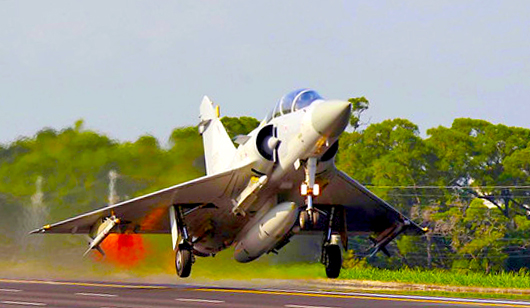
Air Force

“The visit underscored the close defense ties between India and Saudi Arabia, which received a fillip following Custodian of the Two Holy Mosques King Salman’s visit to New Delhi, when he was Crown Prince in February 2014, to sign a Bilateral Defense Cooperation Agreement,” he said.

Kotalwar thanked King Salman and Deputy Crown Prince Mohammad Bin Salam, minister of defense, for the support and cooperation rendered during the visit.

The contingent consisting of 110 IAF officers and airmen onboard Sukhoi 30MKI fighter aircraft, C-17 Globe Masters, C-130 Super Hercules and IL-78 aircraft while en route to United Kingdom for a multinational exercise landed at King Fahd airbase in Taif.

The inaugural staging visit that the IAF pilots called very interactive and fruitful. They will be leaving for Athens prior to the UK for the multinational exercise.

Earlier, RAF Coningsby welcomed the international visitors from the IAF, who had traveled to the UK to support Exercise Indradhanush IV, with a C130, C17 and 4 IAF SU30MKI aircraft till the end of July.

The aim of the exercise, that began on July 21 and ended on July 31, was to enhance mutual operational understanding between the two Air Forces and to provide ample opportunity for exchange of ideas relating to concept of operations in a dynamic warfare environment.

The fighter aircraft, according to a press release, were based at 3(F) Squadron and worked with Typhoon fighter aircraft. 3(F) Squadron, one of the Typhoon squadrons based at RAF Coningsby, was the first Operational Typhoon Squadron.

The SU30MKI aircraft are part of No. 2 Squadron (Winged Arrows) a unit dedicated to close air support based at Kalaikunda Air Force Station, an IAF Base near Kharagpur. The squadron has as its emblem an arrow with spread wings, with the No. 2 attached to the shaft. On a scroll below this crest is inscribed "Amogh Lakshya" (Unwavering Aim).

The RAF and IAF fighter pilots, who participated in Exercise Indradanush, said they were full of admiration for each other’s capabilities and aircraft.

The two-week exercise provided a rare opportunity for RAF pilots to test themselves against the fourth generation Russian built fighter. Over the course of two weeks the complexity of the training sorties increased, starting from 1 v 1 dogfight to sorties involving up to 20 fighters.

Wing Commander Chris Moon, the Officer Commanding 3(F) Squadron, said: “First impressions of the Flanker are very positive. It is a superb airplane and it’s a privilege to operate our Typhoon alongside it.

“The RAF and IAF both pride ourselves on operating some of the leading edge technical equipment in the world. However, without the people to support that we are nothing so that’s where our real strength lies.”

His views were echoed by Squadron Leader Avi Arya, a Qualified Weapons Instructor responsible for training pilots on the radar and weapons systems of the Su-30. He said: “Both are fourth generation aircraft and so are matched evenly, so the learning value comes from the person to person contact, it’s the man behind the machine which matters. All fighter pilots speak the same language, that’s the common thing we have and it’s very comfortable to learn from each other.”

Speaking shortly after his first encounter with the thrust vector equipped Su-30, Typhoon pilot Flight Lieutenant Mike Highmoor had no doubt about the values of the bilateral exercise: “This is fantastic. It’s the first time I’ve flown against a Flanker this morning and it’s fascinating to see another air force do its thing in a different airplane. Flying against an aircraft which is equally comparable to the Typhoon isn’t something we get to fight against on a regular basis in the UK. It’s very exciting. It’s an incredibly impressive fighter but the Typhoon is a good match for it.”

Opposing Flt Lt Highmoor on that first sortie was Squadron Leader Amit Gehani, who trained with the RAF in the UK. He said: “It’s going well. We’re flying a lot of missions that are proving our air combat missions. We brief on the ground, we go up there, set up the fights and thereafter it’s a free for all.

“The Typhoon is a good aircraft, a very powerful aircraft. The RAF pilots here are really amazing and flying with the Typhoon we’re learning a lot of new lessons from the RAF, which we will take back to India. Of course we’re also giving some good points to the Typhoon pilots.”

On training sorties the fighters are being refueled in mid-air by tanker aircraft from their respective countries operating from RAF Brize Norton. C-130J Hercules aircraft are undertaking joint parachute drops of RAF Regiment and IAF Garud troops while RAF and IAF C-17 crews are also training together.

Comments

Mariano
 - 
Friday, 15 Apr 2016

Impressive Post!Has come to an essential and vibrant point
where I am actually cutting everything down by the POUNDS.
I ran into an ex-partner of a business who
still owes cash and set up a magnificent dining establishment
... but stressed as hell.QualtyLikeLike

Also visit my web site; claim easily: http://www.google.com

Roseann
 - 
Monday, 11 Apr 2016

I just need to state Tim you are one dam motivating guy, I like the fact that you do not simply blindly
follow the advice of any individual but you get to the people that count and implement solid action plans.

I would say that this would be absolutley vital in the present market and if
you have no idea in investing, get one!RichLikeLike

Also visit my site :: selling
a business - announcing 3 easy methods to excel in selling your business: http://www.google.com

Add new comment

  • Coastaldigest.com reserves the right to delete or block any comments.
  • Coastaldigset.com is not responsible for its readers’ comments.
  • Comments that are abusive, incendiary or irrelevant are strictly prohibited.
  • Please use a genuine email ID and provide your name to avoid reject.
News Network
July 16,2020

Bengaluru, Jul 16: Eminent theatre personality and renowned vocalist Dr Subhadramma Mansur who had won many awards including the prestigious Karnataka Rajyotsava award died on Wednesday night, according to her family.

She was 81 and is survived by two sons and a daughter.

The family said she developed severe respiratory problems last night following which she was rushed to hospital, but died on the way.

Condoling her death, Chief Minister B S Yediyurappa said Dr Mansur had contributed to the theatre world for five decades. He also recalled her devotion to music as an eminent vocalist.

"I pray for her soul to rest in peace and strength to the family to bear the irreparable loss," the Chief Minister said in his message posted on Twitter.

The veteran theatre personality from Ballari earned recognition for her roles in mythology-based dramas.

Connoisseurs of stage performances recall her memorable portrayal of Draupadi, a character from the Mahabharata.

Her depiction of Hemareddy Mallamma left a deep imprint on the audience.

Many awards were bestowed on her including the Rajyotsava Award, Nataka Akademi and Gubbi Veeranna Award and an honorary doctorate by the Srikrishna Devaraya University

Comments

Add new comment

  • Coastaldigest.com reserves the right to delete or block any comments.
  • Coastaldigset.com is not responsible for its readers’ comments.
  • Comments that are abusive, incendiary or irrelevant are strictly prohibited.
  • Please use a genuine email ID and provide your name to avoid reject.
News Network
February 20,2020

New Delhi, Feb 20: The Supreme Court on Thursday stayed the non-bailable warrants issued against the state Director General of Police (DGP) and Inspector General of Police (IGP) by the Karnataka High Court.

A bench of Chief Justice SA Bobde stayed the non-bailable warrants while hearing a plea filed by the Karnataka government.

Earlier today, the apex court had agreed to hear the matter today itself after Solicitor General Tushar Mehta mentioned the matter before it.

Tushar Mehta had pointed that Home Secretary has been asked by the High Court to execute the non-bailable warrants and said that this order is "unusual".

Karnataka High Court had earlier issued non-bailable warrants against the top cops in a case.

Comments

Add new comment

  • Coastaldigest.com reserves the right to delete or block any comments.
  • Coastaldigset.com is not responsible for its readers’ comments.
  • Comments that are abusive, incendiary or irrelevant are strictly prohibited.
  • Please use a genuine email ID and provide your name to avoid reject.
News Network
July 28,2020

Hounde, Jul 28: Coronavirus and its restrictions are pushing already hungry communities over the edge, killing an estimated 10,000 more young children a month as meager farms are cut off from markets and villages are isolated from food and medical aid, the United Nations warned Monday.

In the call to action shared with The Associated Press ahead of publication, four UN agencies warned that growing malnutrition would have long-term consequences, transforming individual tragedies into a generational catastrophe.

Hunger is already stalking Haboue Solange Boue, an infant from Burkina Faso who lost half her former body weight of 5.5 pounds (2.5 kilograms) in just a month. Coronavirus restrictions closed the markets, and her family sold fewer vegetables. Her mother was too malnourished to nurse.

“My child,” Danssanin Lanizou whispered, choking back tears as she unwrapped a blanket to reveal her baby's protruding ribs.

More than 550,000 additional children each month are being struck by what is called wasting, according to the UN — malnutrition that manifests in spindly limbs and distended bellies. Over a year, that's up 6.7 million from last year's total of 47 million. Wasting and stunting can permanently damage children physically and mentally.

“The food security effects of the COVID crisis are going to reflect many years from now,” said Dr. Francesco Branca, the WHO head of nutrition. “There is going to be a societal effect.”

From Latin America to South Asia to sub-Saharan Africa, more poor families than ever are staring down a future without enough food.

In April, World Food Program head David Beasley warned that the coronavirus economy would cause global famines “of biblical proportions” this year. There are different stages of what is known as food insecurity; famine is officially declared when, along with other measures, 30% of the population suffers from wasting.

The World Food Program estimated in February that one Venezuelan in three was already going hungry, as inflation rendered salaries nearly worthless and forced millions to flee abroad. Then the virus arrived.

“Every day we receive a malnourished child,” said Dr. Francisco Nieto, who works in a hospital in the border state of Tachira.

In May, Nieto recalled, after two months of quarantine, 18-month-old twins arrived with bodies bloated from malnutrition. The children's mother was jobless and living with her own mother. She told the doctor she fed them only a simple drink made with boiled bananas.

“Not even a cracker? Some chicken?” he asked.

“Nothing,” the children's grandmother responded. By the time the doctor saw them, it was too late: One boy died eight days later.

The leaders of four international agencies — the World Health Organization, UNICEF, the World Food Program and the Food and Agriculture Organization — have called for at least dollar 2.4 billion immediately to address global hunger.

But even more than lack of money, restrictions on movement have prevented families from seeking treatment, said Victor Aguayo, the head of UNICEF's nutrition program.

“By having schools closed, by having primary health care services disrupted, by having nutritional programs dysfunctional, we are also creating harm,” Aguayo said. He cited as an example the near-global suspension of Vitamin A supplements, which are a crucial way to bolster developing immune systems.

In Afghanistan, movement restrictions prevent families from bringing their malnourished children to hospitals for food and aid just when they need it most. The Indira Gandhi hospital in the capital, Kabul, has seen only three or four malnourished children, said specialist Nematullah Amiri. Last year, there were 10 times as many.

Because the children don't come in, there's no way to know for certain the scale of the problem, but a recent study by Johns Hopkins University indicated an additional 13,000 Afghans younger than 5 could die.

Afghanistan is now in a red zone of hunger, with severe childhood malnutrition spiking from 690,000 in January to 780,000 — a 13% increase, according to UNICEF.

In Yemen, restrictions on movement have blocked aid distribution, along with the stalling of salaries and price hikes. The Arab world's poorest country is suffering further from a fall in remittances and a drop in funding from humanitarian agencies.

Yemen is now on the brink of famine, according to the Famine Early Warning Systems Network, which uses surveys, satellite data and weather mapping to pinpoint places most in need.

Some of the worst hunger still occurs in sub-Saharan Africa. In Sudan, 9.6 million people live from one meal to the next — a 65% increase from the same time last year.

Lockdowns across Sudanese provinces, as around the world, have dried up work and incomes for millions. With inflation hitting 136%, prices for basic goods have more than tripled.

“It has never been easy but now we are starving, eating grass, weeds, just plants from the earth,” said Ibrahim Youssef, director of the Kalma camp for internally displaced people in war-ravaged south Darfur.

Adam Haroun, an official in the Krinding camp in west Darfur, recorded nine deaths linked with malnutrition, otherwise a rare occurrence, over the past two months — five newborns and four older adults, he said.

Before the pandemic and lockdown, the Abdullah family ate three meals a day, sometimes with bread, or they'd add butter to porridge. Now they are down to just one meal of “millet porridge” — water mixed with grain. Zakaria Yehia Abdullah, a farmer now at Krinding, said the hunger is showing “in my children's faces.”

“I don't have the basics I need to survive,” said the 67-year-old, who who hasn't worked the fields since April. “That means the 10 people counting on me can't survive either.”

Comments

Add new comment

  • Coastaldigest.com reserves the right to delete or block any comments.
  • Coastaldigset.com is not responsible for its readers’ comments.
  • Comments that are abusive, incendiary or irrelevant are strictly prohibited.
  • Please use a genuine email ID and provide your name to avoid reject.