


Indian Air Force fighters make first staging visit to Saudi Arabia

[email protected] (Saudi Gazette)
August 4, 2015

Jeddah, Aug 4: A flying contingent of the Indian Air Force (IAF) are on a maiden visit to the Kingdom of Saudi Arabia from August 1-4.

Indian Embassy Charge d’Affaires Hemant Kotalwar, while addressing a press conference, called the visit significant, and yet another feature that is set to give the Indo-Saudi relations a boost.
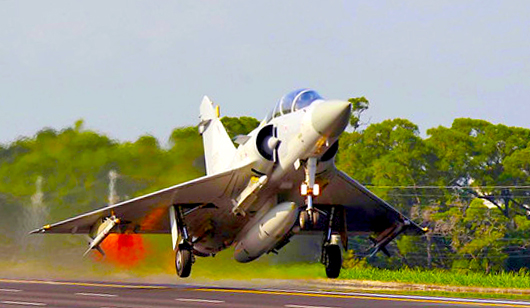
Air Force

“The visit underscored the close defense ties between India and Saudi Arabia, which received a fillip following Custodian of the Two Holy Mosques King Salman’s visit to New Delhi, when he was Crown Prince in February 2014, to sign a Bilateral Defense Cooperation Agreement,” he said.

Kotalwar thanked King Salman and Deputy Crown Prince Mohammad Bin Salam, minister of defense, for the support and cooperation rendered during the visit.

The contingent consisting of 110 IAF officers and airmen onboard Sukhoi 30MKI fighter aircraft, C-17 Globe Masters, C-130 Super Hercules and IL-78 aircraft while en route to United Kingdom for a multinational exercise landed at King Fahd airbase in Taif.

The inaugural staging visit that the IAF pilots called very interactive and fruitful. They will be leaving for Athens prior to the UK for the multinational exercise.

Earlier, RAF Coningsby welcomed the international visitors from the IAF, who had traveled to the UK to support Exercise Indradhanush IV, with a C130, C17 and 4 IAF SU30MKI aircraft till the end of July.

The aim of the exercise, that began on July 21 and ended on July 31, was to enhance mutual operational understanding between the two Air Forces and to provide ample opportunity for exchange of ideas relating to concept of operations in a dynamic warfare environment.

The fighter aircraft, according to a press release, were based at 3(F) Squadron and worked with Typhoon fighter aircraft. 3(F) Squadron, one of the Typhoon squadrons based at RAF Coningsby, was the first Operational Typhoon Squadron.

The SU30MKI aircraft are part of No. 2 Squadron (Winged Arrows) a unit dedicated to close air support based at Kalaikunda Air Force Station, an IAF Base near Kharagpur. The squadron has as its emblem an arrow with spread wings, with the No. 2 attached to the shaft. On a scroll below this crest is inscribed "Amogh Lakshya" (Unwavering Aim).

The RAF and IAF fighter pilots, who participated in Exercise Indradanush, said they were full of admiration for each other’s capabilities and aircraft.

The two-week exercise provided a rare opportunity for RAF pilots to test themselves against the fourth generation Russian built fighter. Over the course of two weeks the complexity of the training sorties increased, starting from 1 v 1 dogfight to sorties involving up to 20 fighters.

Wing Commander Chris Moon, the Officer Commanding 3(F) Squadron, said: “First impressions of the Flanker are very positive. It is a superb airplane and it’s a privilege to operate our Typhoon alongside it.

“The RAF and IAF both pride ourselves on operating some of the leading edge technical equipment in the world. However, without the people to support that we are nothing so that’s where our real strength lies.”

His views were echoed by Squadron Leader Avi Arya, a Qualified Weapons Instructor responsible for training pilots on the radar and weapons systems of the Su-30. He said: “Both are fourth generation aircraft and so are matched evenly, so the learning value comes from the person to person contact, it’s the man behind the machine which matters. All fighter pilots speak the same language, that’s the common thing we have and it’s very comfortable to learn from each other.”

Speaking shortly after his first encounter with the thrust vector equipped Su-30, Typhoon pilot Flight Lieutenant Mike Highmoor had no doubt about the values of the bilateral exercise: “This is fantastic. It’s the first time I’ve flown against a Flanker this morning and it’s fascinating to see another air force do its thing in a different airplane. Flying against an aircraft which is equally comparable to the Typhoon isn’t something we get to fight against on a regular basis in the UK. It’s very exciting. It’s an incredibly impressive fighter but the Typhoon is a good match for it.”

Opposing Flt Lt Highmoor on that first sortie was Squadron Leader Amit Gehani, who trained with the RAF in the UK. He said: “It’s going well. We’re flying a lot of missions that are proving our air combat missions. We brief on the ground, we go up there, set up the fights and thereafter it’s a free for all.

“The Typhoon is a good aircraft, a very powerful aircraft. The RAF pilots here are really amazing and flying with the Typhoon we’re learning a lot of new lessons from the RAF, which we will take back to India. Of course we’re also giving some good points to the Typhoon pilots.”

On training sorties the fighters are being refueled in mid-air by tanker aircraft from their respective countries operating from RAF Brize Norton. C-130J Hercules aircraft are undertaking joint parachute drops of RAF Regiment and IAF Garud troops while RAF and IAF C-17 crews are also training together.

Comments

Mariano
 - 
Friday, 15 Apr 2016

Impressive Post!Has come to an essential and vibrant point
where I am actually cutting everything down by the POUNDS.
I ran into an ex-partner of a business who
still owes cash and set up a magnificent dining establishment
... but stressed as hell.QualtyLikeLike

Also visit my web site; claim easily: http://www.google.com

Roseann
 - 
Monday, 11 Apr 2016

I just need to state Tim you are one dam motivating guy, I like the fact that you do not simply blindly
follow the advice of any individual but you get to the people that count and implement solid action plans.

I would say that this would be absolutley vital in the present market and if
you have no idea in investing, get one!RichLikeLike

Also visit my site :: selling
a business - announcing 3 easy methods to excel in selling your business: http://www.google.com

Add new comment

  • Coastaldigest.com reserves the right to delete or block any comments.
  • Coastaldigset.com is not responsible for its readers’ comments.
  • Comments that are abusive, incendiary or irrelevant are strictly prohibited.
  • Please use a genuine email ID and provide your name to avoid reject.
News Network
April 10,2020

Bengaluru, Apr 10: With 10 new COVID-19 cases, Karnataka's tally of coronavirus cases has climbed to 207, the Karnataka government has said.

The 207 COVID-19 cases include 30 discharged and 6 deaths. Out of 10 new cases, 9 are close contacts of people who had earlier tested positive for coronavirus.

"10 more COVID-19 positive cases reported in Karnataka, taking the total number of positive cases in the state to 207, including 6 deaths and 30 discharged. 9 of the 10 new cases, are close contacts of people who had tested positive for the virus earlier," said the Karnataka government.

Meanwhile, the State Department of Health and Family Welfare has further notified 14 more COVID-19 dedicated hospitals in the state.

These hospitals include Bagalkot District Hospital, Chamarajanagar Institute of Medical Sciences, District Hospital Chikkaballapur, SNR District Hospital, Kandaya Bhavan Ramanagar, Tumkur District Hospital, Karwar Institute of Medical Sciences Uttara Kannada, Vijayapura District Hospital and Yadgiri District Hospital.

India's total number of coronavirus positive cases rose to 6,412 on Friday.

Out of the total cases, 5,709 are active patients and 503 of them have been cured/discharged, as per the Ministry of Health and Family Welfare.

With 30 new deaths reported in the last 12 hours, the toll stands at 199.

Comments

Add new comment

  • Coastaldigest.com reserves the right to delete or block any comments.
  • Coastaldigset.com is not responsible for its readers’ comments.
  • Comments that are abusive, incendiary or irrelevant are strictly prohibited.
  • Please use a genuine email ID and provide your name to avoid reject.
News Network
May 18,2020

Bengaluru, May 18: Indian food delivery startup Swiggy said on Monday it would lay off 1,100 employees, or nearly 14% of its workforce, to cut costs, as a weeks-long nationwide lockdown to curb the coronavirus outbreak hits demand for online food ordering.

The company, backed by South African internet giant Naspers, also said it will scale down adjacent businesses and has already shut several of its cloud kitchens - facilities that only cater to takeaway orders - temporarily or permanently.

“The core food delivery business has been severely impacted and will stay impacted over the short term, but is expected to start growing again after that,” said Sriharsha Majety, co-founder and chief executive at Bengaluru-based Swiggy.

Swiggy, one of India’s best known startups, is among many that are laying off employees and reshaping their business in response to the COVID-19 pandemic, which has forced 1.3 billion Indians indoors and crippled business.

India is currently under a two-month lockdown, and though several curbs are being eased, public places such as restaurants remain closed, hurting restaurants themselves as well as companies such as Swiggy and main rival Zomato.

Comments

Add new comment

  • Coastaldigest.com reserves the right to delete or block any comments.
  • Coastaldigset.com is not responsible for its readers’ comments.
  • Comments that are abusive, incendiary or irrelevant are strictly prohibited.
  • Please use a genuine email ID and provide your name to avoid reject.
Agencies
February 6,2020

Even more than three years after demonetisation and all-out efforts to make most transactions through electronic, cash is still king, as it thrives in a digital India, said fintech start-up Paytm founder Vijay Sekhar Sharma.

"While cashless economy is not possible in India, less cash economy will be in the future. Less cash is the only solution, not the elimination of cash," Sharma told IANS in an interview after unveiling an all-in-one payment gateway on Tuesday.

Asserting that it would take 5-10 years for India to make the transition to digital payments from the traditional mode of cash, Sharma, 41, said the e-payment industry benefitted more from the November 8, 2016 note ban and withdrawal of old Rs 1,000 and Rs 500 denominations.

"I think it (demonetisation) helped the industry despite lack of specific help. But the world has changed since then. It is about the scale of distribution of merchants that is what is propelling digital payments," said Sharma.

Most of the cash not only came back into circulation, but also remains as the mode of payment for the majority due to its convenience for the people used to such transactions.

Expounding Paytm's zero service charge, Sharma said the strategy is sustainable as it leads to acquiring more customers and merchants, enabling newer business opportunities.

Paytm also does not levy a service charge to small merchants for its payments services, unlike organised players like Uber.

"Though there is a monetisation model, the merchants who are small shopkeepers, become our financial services customers as they open a bank account, which is profitable."

Paytm secured a Payments Bank license from the Reserve Bank of India to offer a savings bank account, Rupay debit card and money transfer services.

"We are banking on payment services acquiring customers and merchants who avail banking, lending, insurance, wealth and software services like billing software and business ledger software services eventually," Sharma noted.

The mobile first bank services include zero balance and zero digital transaction charge accounts.

"Basically, payments, cloud, commerce and financial services are a cohort we follow. So, payments is our customer as well as merchant acquisition. If it breaks even, we are happy because other line items make more money, he affirmed.

Noting that in a market like India, one cannot price services at a premium unlike in a developed country like the US, the billionaire businessman said a consumer in a developing country would not be able to afford such a hefty charge.

Forbes ranked Sharma as India's youngest billionaire in 2017, with a net worth of $2.1 billion.

While several countries operate on the model of higher service charges, Sharma said newer business models have to be discovered in India, as customer lifecycle value is accounted for more stages than in other nations.

Asked about an upscale retailer like Zara not giving a wallet payment option during its recent end of season sale in Bengaluru, Sharma said Paytm was addressing such hiccups with its all-in-one payment solutions.

"It's an opportunity, because if the retailer has our all-in-one point of sale machine, where in they enter the amount, it shows both the Quick Response code (QR) and card payment options," he observed.

Sharma compared older swiping payment machine to feature phones and modern ones to feature-rich smartphones.

"If you notice, they look like feature phones and the modern day card machine is more a smartphone like. You can add the smatphone components, which can add the features," reiterated Sharma.

Though Paytm's all-in-one QR point of sale machine integrates the billing system, its chief executive said it was not ideal to have an independent QR feature.

Paytm has 16 million strong merchant user base, which Sharma aims to raise to 26 million base in the next one year.

Sharma has launched in this tech city an all-in-one payment gateway and Paytm Business Payments solution, which enable digital payments through multiple methods for small and medium enterprises (SMEs) and an Android point of sale machine.

With the new gateway solution, collecting digital payments through multiple methods can be achieved seamlessly while Paytm Business Payments solution enables automated vendor payments, including employee salaries and customer refunds among others.

The One97 Communications-owned Paytm aims to help SMEs streamline and digitise their business activities using its new solutions, which enhance the overall efficiency of both accepting and making payments.

Paytm has a data bank of over 200 million saved cards and bank accounts, a feature which enables partner apps to shorten transaction times and propel faster conversions while using the all-in-one payment gateway.

Complementing the two solutions, Sharma also launched an all-in-one Android point of sale machine, which can accept payments through all forms such as cards, wallets, UPI apps and even cash.

The device has a QR code that supports all contact and contactless payments, coming with integrated billing software customized solutions for different sectors such as catering, ticketing, parking and others.

The handheld Android device is equipped with an in-built printer, scanner and can also generate bills.

Valued at $16 billion, Paytm is not alone in the fiercely competitive Indian fintech space where a dozen players like PhonePe, MobiKwik, Kotak 811 and deep pocketed international giants Google Pay and Amazon Pay are in the fray.

Comments

Add new comment

  • Coastaldigest.com reserves the right to delete or block any comments.
  • Coastaldigset.com is not responsible for its readers’ comments.
  • Comments that are abusive, incendiary or irrelevant are strictly prohibited.
  • Please use a genuine email ID and provide your name to avoid reject.