


India's bid to join US alliance could irk China, Pak: media

August 30, 2016

Beijing, Aug 30: Attempts by India to join US' alliance could "irritate" China, Pakistan or even Russia and bring "strategic troubles" to New Delhi while making it a centre of geopolitical rivalries in Asia, China's state-run media commented today.
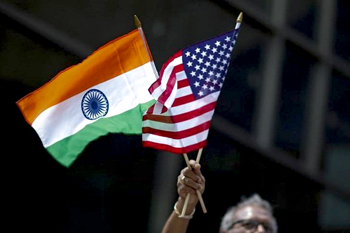
indusIn an editorial written ahead of Defence Minister Manohar Parrikar and US Defence Secretary Ashton Carter signing a logistics agreement, state-run Global Times said India may loose strategic independence if it leans towards the US.

The Logistics Exchange Memorandum of Agreement (LEMOA) allows India and US militaries to access each other's military facilities for refuelling and replenishment.

"This is undoubtedly a leap forward in US-India military cooperation. US media highly applauded this deal, with Forbes hailing it as a 'war pact' and believing that India is shifting away from Russia, its Cold War ally, toward a new alliance with the US," the editorial said.

"If India hastily joins the US alliance system, it may irritate China, Pakistan or even Russia. It may not make India feel safer, but will bring strategic troubles to itself and make itself a centre of geopolitical rivalries in Asia," it said.

"India holds dear its independence and sovereignty after squeezing out of the UK's colonialism. It views itself as a major power and is developing on the wave of the emerging countries," the editorial said.

While India has adopted a prudent attitude so far refraining from joining US alliance, some defence analysts expressed worries that India may lose strategic independence and warned that the pact may render New Delhi a "follower" of Washington, it said.

Observing that India attaches high importance to national security, the editorial said, "It feels it is an urgent task because its defence levels are a necessary condition of being a major power, rather than out of a sense of crisis that requires an intimacy to the US."

Due to its non-alignment policy, India has been given attention from all the major powers such as the US, Japan, China and Russia in recent years, it noted.

"However, in recent years, Washington has deliberately wooed New Delhi to become its quasi ally so as to impose geopolitical pressure on China. It is possible that the (Narendra) Modi administration is trying an unconventional way to lean toward the US with the logistics agreement," the editorial said.

Comments

REALITY
 - 
Tuesday, 30 Aug 2016

Liars will join hand with Liars...
Cheaters with cheaters
The world knows now that USA cheated its own people in 9/11..
The world knows now that USA cheated its own people on Iraq war..
Our indian politician are digging our own grave by joining the LIARS masters Club..

Add new comment

  • Coastaldigest.com reserves the right to delete or block any comments.
  • Coastaldigset.com is not responsible for its readers’ comments.
  • Comments that are abusive, incendiary or irrelevant are strictly prohibited.
  • Please use a genuine email ID and provide your name to avoid reject.
News Network
January 14,2020

Chennai/New Delhi, Jan 14: India's annual electricity demand in 2019 grew at its slowest pace in six years with December marking a fifth straight month of decline, government data showed, amid a broader economic slowdown that led to a drop in sales of everything from cars to cookies and also to factories cutting jobs.

Electricity demand is seen as an important indicator of industrial output in the country and a sustained decline could mean a further slowdown in the economy.

India's power demand grew at 1.1% in 2019, data from the Central Electricity Authority showed, the slowest pace of growth since a 1% uptick seen in 2013. The power demand growth slowdown in 2013 was preceded by three strong years of consumption growth of 8% or more.

In December, the country's power demand fell 0.5% from the year-earlier period, representing the fifth straight month of decline, compared with a 4.3% fall in November.

But in India's western states of Maharashtra and Gujarat, two of India's most industrialised provinces, monthly demand increased.

In October, power demand had fallen 13.2% from a year earlier, its steepest monthly decline in more than 12 years, as a slowdown in Asia's third-largest economy deepened.

Industry accounts for more than two-fifths of India's annual electricity consumption, while homes account for nearly a fourth and agriculture more than a sixth.

The slower demand growth is a blow for many debt-laden power producers, who are facing financial stress and are owed over $11 billion by state-run distribution companies.

India's overall economic growth slowed to 4.5% in the July-September quarter, government data released in November showed, the weakest pace since 2013 as consumer demand and private investment fell.

The government has estimated growth in the current financial year that runs through to March will be the slowest since the 2008 global crisis.

"This reflects overall economic slowdown, because if you look at other high frequency data like diesel consumption, everywhere you are seeing contraction," Rupa Rege Nitsure, chief economist at L&T Financial Holdings.

But India's central bank will not have much scope to cut rates to stimulate the economy because inflation has been rising sharply and reached 7.35% in December compared with 1.97% in January last year.

Economists say India's growth will continue to hover around 4.5% levels in the Oct-Dec quarter.

"In the Oct-Dec quarter as well growth (GDP) will be around the same level as July-September. My estimate for the full year is around 4.7% growth," Nitsure said.

Comments

Add new comment

  • Coastaldigest.com reserves the right to delete or block any comments.
  • Coastaldigset.com is not responsible for its readers’ comments.
  • Comments that are abusive, incendiary or irrelevant are strictly prohibited.
  • Please use a genuine email ID and provide your name to avoid reject.
Agencies
May 21,2020

Eminent river engineer and former professor of civil engineering at IIT in the Banaras Hindu University (BHU) Prof. U.K. Choudhary has said that the judicious use of river technology can help resolve the Coronavirus crisis as well as the plight of Ganga river.

Choudhary, who is also founder of Ganga Research Centre at IIT (BHU), said: "The Ganga water contains a significantly higher proportion of bacteriophages - a kind of virus that kill bacteria. Our ancient scriptures like Vedas, Puranas and Upanishads say that Ganga jal is medicinal water. Scientists later found that Ganga water has bacteriophages capable of killing pathogens."

Explaining further, he said, "Let us analyze the source of bacteriophages. If we take three rivers of Himalayan origin having sources at different heights -the Ganga (Gomukh), Yamuna (Yamunotri) and the Sone river, we find the colours of waters are different. The whitish colour of Ganga water, greenish colour of Yamuna water and the brownish colour of Sone water is also indicative. As Gomukh is the highest among the three, its water comes from lowest depth of aquifer as compared to Yamunotri and Sone river," he explained.

Thus, the quality of river water is proportional to height of origin point. This defines the genetic character of Ganga water. The balanced flow of this water in entire length of the Ganga defines the medicinal property of Ganga water," he stated.

Prof Chaudhary said that the bacteriophages in the Ganga can curb the spread of coronavirus through soil, water and air.
He suggested that the idea is to preserve the medicinal value of Ganga water and to use it to fight Corona. He said that this can be done by opening the gates of all the dams and barrages in a way that the discharge through each is similar to the water at Gomukh. In this way, the concentration of bacteriophage will be enhanced in Ganga water making it more effective against pathogens.

"With increasing diffusion of bacteriophages in water and soil, the spread of Coronavirus will be impacted and reduced. This methodology and technique can also help maintain the quality of Ganga water later when the problem of Corona ends," he said.

Comments

Add new comment

  • Coastaldigest.com reserves the right to delete or block any comments.
  • Coastaldigset.com is not responsible for its readers’ comments.
  • Comments that are abusive, incendiary or irrelevant are strictly prohibited.
  • Please use a genuine email ID and provide your name to avoid reject.
News Network
February 2,2020

Feb 2: Prime Minister Narendra Modi’s second budget in seven months disappointed investors who were hoping for big-bang stimulus to revive growth in Asia’s third-largest economy.

The fiscal plan -- delivered by Finance Minister Nirmala Sitharaman on Saturday -- proposed tax cuts for individuals and wider deficit targets but failed to provide specific steps to fix a struggling financial sector, improve infrastructure and create jobs. Stocks slumped as a proposal to scrap the dividend distribution tax for companies failed to impress investors.

"Far from being a game changer, the budget provides little in terms of short-term growth stimulus,” said Priyanka Kishore, head of India and South East Asia economics at Oxford Economics Ltd. in Singapore. “While income tax cuts will provide some relief on the consumption front, the multiplier effect is low and the overall stance of the budget is not expansionary."

India has gone from being the world’s fastest-growing major economy three years ago, expanding at 8%, to posting its weakest performance in more than a decade this fiscal year, estimated at 5%.

While the government has taken a number of steps in recent months to spur growth, they’ve fallen short of spurring demand in the consumption-driven economy. Saturday’s budget just added to the glum sentiment.

Okay Budget

“It’s an okay budget but not firing on all cylinders that the market was hoping for,” said Andrew Holland, chief executive officer at Avendus Capital Alternate Strategies in Mumbai.

The government had limited scope for a large stimulus given a huge shortfall in revenues in the current year. The slippage induced Sitharaman to invoke a never-used provision in fiscal laws, allowing the government to exceed the budget gap by 0.5 percentage points. The result: the deficit for the year ending March was widened to 3.8% of gross domestic product from a planned 3.3%.

On Friday, India’s chief economic adviser Krishnamurthy Subramanian said reviving economic growth was an “urgent priority” and deficit goals could be relaxed to achieve that. The adviser’s Economic Survey estimated growth will rebound to 6%-6.5% in the year starting April.

The fiscal gap will narrow to 3.5% next year, as the government budgeted for gross market borrowing to rise marginally to 7.8 trillion rupees from 7.1 trillion rupees in the current year. A plan to earn 2.1 trillion rupees by selling state-owned assets in the year starting April will also help plug the deficit.

Total spending in the coming fiscal year will increase to 30.4 trillion rupees, representing a 13% increase from the current year’s budget, according to latest data.

Key highlights from the budget:

* Tax on annual income up to 1.25 million rupees pared, with riders

* Dividend distribution tax to be levied on investors, instead of companies

* Farm sector budget raised 28%, transport infrastructure gets 7% more

* Spending on education raised 5%

* Fertilizer subsidy cut 10%

Analysts said the muted spending plan to keep the deficit in check will lead to more downside risks to growth in the coming months.

“It is very doubtful that the increase in expenditure will push demand much,” Chakravarthy Rangarajan, former governor at the Reserve Bank of India told BloombergQuint, adding that achieving next year’s budget deficit goal of 3.5% of GDP was doubtful.

With the government sticking to a conservative fiscal path, the focus will now turn to central bank, which is set to review monetary policy on Feb. 6. Given inflation has surged to a five-year high of 7.35%, the RBI is unlikely to lower interest rates.

What Bloomberg’s Economists Say:

The burden of recovery now falls solely on the Reserve Bank of India. With inflation breaching RBI’s target at present, any rate cuts by the central bank are likely to be delayed and contingent upon inflation falling below the upper end of its 2%-6% target range.

-- Abhishek Gupta, India economist

Governor Shaktikanta Das may instead focus on unconventional policy tools such as the Federal Reserve-style Operation Twist -- buying long-end debt while selling short-tenor bonds -- to keep borrowing costs down.

Comments

Add new comment

  • Coastaldigest.com reserves the right to delete or block any comments.
  • Coastaldigset.com is not responsible for its readers’ comments.
  • Comments that are abusive, incendiary or irrelevant are strictly prohibited.
  • Please use a genuine email ID and provide your name to avoid reject.