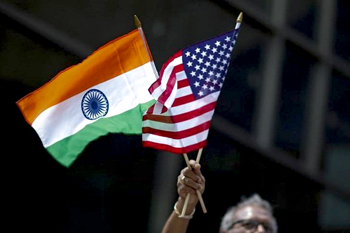
India's bid to join US alliance could irk China, Pak: media

August 30, 2016

Beijing, Aug 30: Attempts by India to join US' alliance could "irritate" China, Pakistan or even Russia and bring "strategic troubles" to New Delhi while making it a centre of geopolitical rivalries in Asia, China's state-run media commented today.

indusIn an editorial written ahead of Defence Minister Manohar Parrikar and US Defence Secretary Ashton Carter signing a logistics agreement, state-run Global Times said India may loose strategic independence if it leans towards the US.

The Logistics Exchange Memorandum of Agreement (LEMOA) allows India and US militaries to access each other's military facilities for refuelling and replenishment.

"This is undoubtedly a leap forward in US-India military cooperation. US media highly applauded this deal, with Forbes hailing it as a 'war pact' and believing that India is shifting away from Russia, its Cold War ally, toward a new alliance with the US," the editorial said.

"If India hastily joins the US alliance system, it may irritate China, Pakistan or even Russia. It may not make India feel safer, but will bring strategic troubles to itself and make itself a centre of geopolitical rivalries in Asia," it said.

"India holds dear its independence and sovereignty after squeezing out of the UK's colonialism. It views itself as a major power and is developing on the wave of the emerging countries," the editorial said.

While India has adopted a prudent attitude so far refraining from joining US alliance, some defence analysts expressed worries that India may lose strategic independence and warned that the pact may render New Delhi a "follower" of Washington, it said.

Observing that India attaches high importance to national security, the editorial said, "It feels it is an urgent task because its defence levels are a necessary condition of being a major power, rather than out of a sense of crisis that requires an intimacy to the US."

Due to its non-alignment policy, India has been given attention from all the major powers such as the US, Japan, China and Russia in recent years, it noted.

"However, in recent years, Washington has deliberately wooed New Delhi to become its quasi ally so as to impose geopolitical pressure on China. It is possible that the (Narendra) Modi administration is trying an unconventional way to lean toward the US with the logistics agreement," the editorial said.

Comments

REALITY
 - 
Tuesday, 30 Aug 2016

Liars will join hand with Liars...
Cheaters with cheaters
The world knows now that USA cheated its own people in 9/11..
The world knows now that USA cheated its own people on Iraq war..
Our indian politician are digging our own grave by joining the LIARS masters Club..

Add new comment

  • Coastaldigest.com reserves the right to delete or block any comments.
  • Coastaldigset.com is not responsible for its readers’ comments.
  • Comments that are abusive, incendiary or irrelevant are strictly prohibited.
  • Please use a genuine email ID and provide your name to avoid reject.
Agencies
July 23,2020

Jerusalem, Jul 23: Merging Israel's technological expertise with India's mass production capabilities, experts from the two countries have joined hands to develop rapid testing for Covid-19 in under 30 seconds.

Israel will soon send a high-level research delegation to India to conduct a series of "final stages of testing" as part of the joint effort to develop the rapid testing kits for Covid-19 .

A high ranking team from the Directorate of Defence Research and Development (DDR&D), in the Ministry of Defense, which has been working with India's DRDO to develop rapid testing for Covid-19 in under 30 seconds, is to leave from Tel Aviv to New Delhi on a special flight in a few days, Israel's Ministry of Defence said in a statement on Thursday.

Israel's Ministry of Foreign Affairs (MFA) and Ministry of Health are also involved in this unprecedented cooperation between the two countries which aims at "merging Israeli technology with Indian development and production capabilities to allow a swift resumption of normal life alongside the virus".

The DDR&D team will conduct a series of "final stages of testing" to determine the effectiveness of a number of rapid diagnostic solutions with their Indian counterparts.

Since the start of the pandemic, the DDR&D has tested dozens of diagnostic technologies. Some of them have matured and passed initial trials in Israel, however in order to complete testing and prove their effectiveness, these must be tested on a wide range of patients, IMoD said.

The four tech systems that will be tested are - voice test, breathalyzer test based on terra-hertz waves, isothermal test, and polyamino acids test.

"What they all have in common is the ability to detect the presence of the virus in the body quickly- usually within minutes. Developing diagnostic capabilities is a goal for the State of Israel and of many additional countries around the world. It is the most effective way to cut off 'chains of infection', prevent prolonged quarantine and enable the reopening of the global economy," the statement said.

"We hope that the research and development led by the DDR&D together with our excellent industries and academic institutions, will lead to a breakthrough that will change the way we diagnose and fight the virus, while giving the boost necessary to 'restart' our economy," Defense Minister Benny Gantz said.

Foreign Minister Gabi Ashkenazi noted that this cooperation provides a unique opportunity for scientific and technological cooperation that can assist Israel, India and the world in coping both with the pandemic and with the economic crisis that came with it.

The cooperation between Israel and India will enable the delegation and its Indian counterparts, to collect tens of thousands of samples in just ten days, and analyze them using computer systems based on artificial intelligence. This massive sampling will shorten processes and advance the approval of effective technology. All tests will be validated using PCR tests.

"The cooperation between India and Israel on Covid-19 is a good example of harnessing the scientific and technological strengths that the two countries have for larger, common good. It will also further deepen our strategic ties,” India's Ambassador Sanjeev Singla told PTI.

The flight will be carrying some breakthrough emerging Israeli technologies for combatting Covid-19, which have been donated by the Israeli foreign ministry and the private sector, in order to bolster India’s response to the virus outbreak.

The plane will also deliver mechanical ventilators which were given special permission by Israel for export to India.

Prime Minister Narendra Modi and his Israeli counterpart Benjamin Netanyahu have held three telephonic conversations since the outbreak of the pandemic and promised mutual assistance in dealing with the virus, committing to joint technological and scientific research between the countries.

The Israeli media widely reported that Modi lifted a ban on the export of Hydroxychloroquine at Netanyahu's request.

"The past few years have cemented the strategic relations between India and Israel and have included two historical visits of the Prime Ministers in Israel and in India," a press statement from the ministry of defence said.

"India seeks to integrate advanced technologies in its hospitals as they prepare to treat massive waves of Covid-19 patients on an Indian scale. The Israeli companies chosen by the MFA, MOD and Israel Defence Forces to be sent to India are potentially given unique access to one of the largest economies in the world to provide monitoring and treatment technologies while significantly reducing contact between the patients and the medical staff," it said.

"By opening the door to India’s market with its development and production capabilities, these Israeli technologies can be mass produced at a lower cost and could in future be jointly exported to third countries," it said.

"The COVID-19 pandemic is a global challenge, so it is only right that the solution be a global scientific cooperation between countries. India and Israel’s military R&D cooperation is well known for its success. I have no doubt the same will be seen in the private sector joined by brilliant scientific minds from both countries to introduce a breakthrough in swift and simple testing procedures,” said Prof. Nati Keller, an infectious diseases specialist from Sheba Medical Center, who is leading the medical side of the delegation.


Comments

Add new comment

  • Coastaldigest.com reserves the right to delete or block any comments.
  • Coastaldigset.com is not responsible for its readers’ comments.
  • Comments that are abusive, incendiary or irrelevant are strictly prohibited.
  • Please use a genuine email ID and provide your name to avoid reject.
Agencies
May 30,2020

New Delhi, May 30: The COVID-19 pandemic has left the Indian private healthcare sector in acute financial distress, a new survey said on Friday adding that the healthcare facilities in the country have witnessed at least 80 per cent fall in average revenue.

Post the lockdown from March 24, Indian hospitals have seen a large impact, especially among small and medium-sized hospitals, which are now facing existential challenges.

The survey by healthcare industry body NATHEALTH was conducted in 251 healthcare facilities across nine states and 69 cities to assess the impact of COVID-19 on the domestic healthcare industry.

The findings showed that 90 per cent of the surveyed healthcare facilities are facing financial challenges with 21 per cent facilities facing an existential threat.

"There is a need for a stimulus package to revive the Indian healthcare industry which will be crucial to provide much-needed relief to the healthcare sector which is the frontline defence in this fight against COVID-19," said Dr Sudarshan Ballal, President NATHEALTH.

According to the survey, hospitals in tier 1 and tier 2 cities are experiencing a 78 per cent reduction in OPD footfalls, and a drop of 79 per cent in in-patient admissions.

The study found that 90 per cent of organisations require some form of financial assistance.

The findings indicated that even after the lockdown lift, the situation will remain difficult for the hospitals and nursing homes as patients will hesitate from visiting hospitals.

Comments

Add new comment

  • Coastaldigest.com reserves the right to delete or block any comments.
  • Coastaldigset.com is not responsible for its readers’ comments.
  • Comments that are abusive, incendiary or irrelevant are strictly prohibited.
  • Please use a genuine email ID and provide your name to avoid reject.
News Network
March 6,2020

Mumbai, Mar 6: A Rolls Royce car, paintings of famous artists M F Hussain and Amrita Sher-Gil, designer handbags and other luxury items belonging to fugitive diamond jeweller Nirav Modi garnered over Rs 51 crore in the second auction conducted on Thursday.

As many as 40 items went under the hammer on Thursday, which marks the completion of auction of assets seized by the Enforcement Directorate.

The auction was conducted by Saffronart on behalf of the deputy director, Enforcement Directorate, and was expected to garner a minimum of Rs 40 crore in proceeds.

A collection of 112 prized assets of Modi were put up for live and online auctions from March 3 to 5, which included major artworks by contemporary and modern Indian artists, designer handbags, luxury watches and cars.

While the online auction on March 3-4 garnered Rs 2.04 crore against the expected proceeds of Rs 52 lakh, the live auction on Thursday garnered Rs 51.41 crore more.

These assets, seized by the ED, were put on auction in an attempt to recover a part of the dues Modi owes to various banks.

According to officials from Saffronart, the ED would get Rs 53.45 crore from the proceeds of these two auctions.

The lots that went under the hammer included legendary painter MF Hussain's painting of 'Battle of Ganga and Jamuna- Mahabharata 12' which went for a record 12 crore, the highest price received so far for the painter's work.

Amrita Sher-Gil's rare 1935 painting 'Boys with Lemons', which was auctioned for the first time, sold for Rs 15.7 crore ($2.24 million).

V S Gaitonde's tranquil 1972 painting was sold for Rs 9.52 crore while Manjit Bawa's Untitled 1992 sold for Rs 6.16 crore. Modi's Rolls Royce Ghost witnessed a high demand, selling for twice its estimate at Rs 1.68 crore ($240,000).

Comments

Add new comment

  • Coastaldigest.com reserves the right to delete or block any comments.
  • Coastaldigset.com is not responsible for its readers’ comments.
  • Comments that are abusive, incendiary or irrelevant are strictly prohibited.
  • Please use a genuine email ID and provide your name to avoid reject.