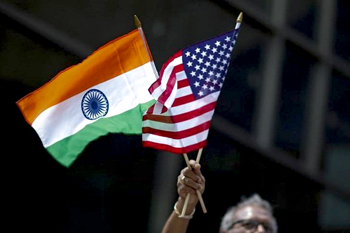
India's bid to join US alliance could irk China, Pak: media

August 30, 2016

Beijing, Aug 30: Attempts by India to join US' alliance could "irritate" China, Pakistan or even Russia and bring "strategic troubles" to New Delhi while making it a centre of geopolitical rivalries in Asia, China's state-run media commented today.

indusIn an editorial written ahead of Defence Minister Manohar Parrikar and US Defence Secretary Ashton Carter signing a logistics agreement, state-run Global Times said India may loose strategic independence if it leans towards the US.

The Logistics Exchange Memorandum of Agreement (LEMOA) allows India and US militaries to access each other's military facilities for refuelling and replenishment.

"This is undoubtedly a leap forward in US-India military cooperation. US media highly applauded this deal, with Forbes hailing it as a 'war pact' and believing that India is shifting away from Russia, its Cold War ally, toward a new alliance with the US," the editorial said.

"If India hastily joins the US alliance system, it may irritate China, Pakistan or even Russia. It may not make India feel safer, but will bring strategic troubles to itself and make itself a centre of geopolitical rivalries in Asia," it said.

"India holds dear its independence and sovereignty after squeezing out of the UK's colonialism. It views itself as a major power and is developing on the wave of the emerging countries," the editorial said.

While India has adopted a prudent attitude so far refraining from joining US alliance, some defence analysts expressed worries that India may lose strategic independence and warned that the pact may render New Delhi a "follower" of Washington, it said.

Observing that India attaches high importance to national security, the editorial said, "It feels it is an urgent task because its defence levels are a necessary condition of being a major power, rather than out of a sense of crisis that requires an intimacy to the US."

Due to its non-alignment policy, India has been given attention from all the major powers such as the US, Japan, China and Russia in recent years, it noted.

"However, in recent years, Washington has deliberately wooed New Delhi to become its quasi ally so as to impose geopolitical pressure on China. It is possible that the (Narendra) Modi administration is trying an unconventional way to lean toward the US with the logistics agreement," the editorial said.

Comments

REALITY
 - 
Tuesday, 30 Aug 2016

Liars will join hand with Liars...
Cheaters with cheaters
The world knows now that USA cheated its own people in 9/11..
The world knows now that USA cheated its own people on Iraq war..
Our indian politician are digging our own grave by joining the LIARS masters Club..

Add new comment

  • Coastaldigest.com reserves the right to delete or block any comments.
  • Coastaldigset.com is not responsible for its readers’ comments.
  • Comments that are abusive, incendiary or irrelevant are strictly prohibited.
  • Please use a genuine email ID and provide your name to avoid reject.
Agencies
April 27,2020

Thiruvananthapuram, Apr 27: Over 1.5 lakh Non-Resident Keralites (NRK)s, stranded in various countries, have registered online for returningto the state, once the Centre gives the nod and air services resume

The Norka (Non Resident Keralites Affairs) department had commenced the registration process at around 6pm on Sunday and within an hour 25,000 had registered, government sources said.

Till Monday morning, over 1.5 lakh NRKs have registered, the maximum is from UAE-- over 60,000.

The aged, pregnant women, children, critically ill patients, those with expired visas and those who had gone abroad on visiting visa are among thelarge numbers of people who are waiting to return.

Those wanting to return, have to get themselves tested for COVID-19 in the respective countries, where they are and register after getting a negative certificate for the infection.

Theregistration is for arranging quarantine facilitiesin the state, if necessary, and not for getting any priority on flight bookings,the sources said.

After the NRKs register themselves, the government would draw up a list on how to bring them back as per priority.

Comments

Add new comment

  • Coastaldigest.com reserves the right to delete or block any comments.
  • Coastaldigset.com is not responsible for its readers’ comments.
  • Comments that are abusive, incendiary or irrelevant are strictly prohibited.
  • Please use a genuine email ID and provide your name to avoid reject.
News Network
May 25,2020

New Delhi, May 25: Realtors' apex body CREDAI has written a letter to Prime Minister Narendra Modi, seeking immediate relief measures to tide over the crisis caused by the COVID-19 pandemic.

The association, which has around 15,000 developer members, has sought one-time debt restructuring, lower interest rate on home loans and tax sops to boost liquidity and demand in the sector.

In an open letter to the prime minister, the Confederation of Real Estate Developers' Associations of India (CREDAI) said, "In this distressful situation arising out of the COVID-19 calamity, we in the real estate sector seek immediate relief for our survival."

Stating that the sector contributes substantially to the country's GDP and has backward and forward linkages with almost 250 industries, CREDAI said, "Our survival, therefore, is not just desirable, it is rather crucial for the economy."

Liquidity crunch, stagnant demand and cartelization of raw materials are major impediments for the industry to kickstart, it added.

CREDAI made seven recommendations to revive the sector and sought immediate intervention from the prime minister.

Pointing out that the situation is "much worse" than global financial crisis in 2008, CREDAI said "a one-time restructuring scheme as was permitted by RBI in 2008 may be quickly instituted by all lending institutions."

Since real estate was already reeling under a cyclical downturn before COVID-19, debt restructuring needs to be allowed for all accounts which were standard as on December 31, 2019, it added.

CREDAI demanded that all banks, non-banking financial companies (NBFCs) and housing finance companies (HFCs) should be directed to provide additional credit equal to 20 per cent of the existing real estate project related advances with no additional security and without the classification of project as NPA.

The penal interest charged by banks and financial institutions should be suspended for a period of one year or until such time as it takes for the pandemic to abate.

To revive housing demand, CREDAI suggested that "government should reduce the maximum rate of interest on new home loans to 5 per cent by subsidizing the interest component of EMIs for next five years."

The limit of principal deduction on housing loan under Section 80C should be increased to 2.5 lakh.

Interest deduction under Section 24 on housing loan for homebuyers may be increased to Rs 10 lakh, it said.

There should be no capital gains for residential properties held for a period longer than one year.

CREDAI also demanded that the subvention scheme be allowed again by National Housing Bank (NHB) and the Reserve Bank.

Under the scheme, builders used to pay EMIs on behalf of homebuyers during construction of projects.

"The economic uncertainty and job insecurity at the moment would not allow purchase of residential property at this time. A scheme whereby a homebuyer would need to pay only margin money with no EMI for 24 months will address this insecurity," the letter said.

The association pointed out that prices of cement and steel have been increased during the lockdown period, and asked for crackdown on cartelisation by manufacturers.

On the GST front, CREDAI said that the current regime of GST provides a rate of 1 per cent  for affordable housing.

"The limit of Rs 45 lakh serves as a criterion of affordability for the purpose of GST. On all other housing, GST is applied at the rate of 5 per cent without input tax credit. It has been felt that the criterion of Rs 45 lakh is too low an index of affordability anywhere across the country, and especially so in the metros," the letter said.

It will serve as an inducement to buyers in the metros if the benefit of GST at the rate of 1 per cent is extended to units costing up to Rs 75 lakh, the association said.

CREDAI pointed out that the flat rate of 5 per cent GST for under construction residential housing is causing cost build up and is acting as a deterrent for sale of under construction projects since there is no GST on completed units.

It suggested that GST rate of 1 per cent and 5 per cent, without input tax credit, should continue.

"However, an option of GST @12 per cent for normal housing/ 8 per cent for affordable housing (with 1/3rd deduction for land i.e. effective GST rate of 8 per cent for normal housing and effective GST rate of 5 per cent for affordable housing) with input tax credit (ITC) benefits in line with the scheme applicable for the works contracts for government may be revived and made applicable to the real estate," the letter said.

Lastly, CREDAI demanded that a Rs 25,000 crore stress fund for completing stalled housing projects should be deployed at the earliest.

"We shall be grateful for your much-needed intervention for the above mentioned measures required to revive the real estate sector," CREDAI said in the letter to the PM.


Comments

Add new comment

  • Coastaldigest.com reserves the right to delete or block any comments.
  • Coastaldigset.com is not responsible for its readers’ comments.
  • Comments that are abusive, incendiary or irrelevant are strictly prohibited.
  • Please use a genuine email ID and provide your name to avoid reject.
News Network
March 25,2020

India will suspend all domestic flights from midnight Tuesday, the final piece of a nationwide lockdown that threatens Prime Minister Narendra Modi’s attempts to revive an economy already expanding at the slowest pace in more than a decade.

The flight ban compliments a cancellation of all passenger trains through March 31, as authorities try to halt the spread of the coronavirus in the world’s second-most populous country, which has poorly equipped hospitals and inadequate social security. Modi on Monday held a conference call with some of India’s top entrepreneurs and bankers, who urged policymakers to immediately slash interest rates by as much as a full percentage point, transfer cash to the poorest citizens, and suspend loan-repayments.

Over the past three days, state after state has declared curfews and India’s international borders have been shut for most visitors since March 11. India so far has 492 virus cases, including nine deaths. But experts say the country could be on the same trajectory as Italy, where the outbreak quickly escalated, causing hospitals to overflow.
A traveller stands outside a near-empty Delhi Junction Railway Station in Delhi, March 22.

"This is the biggest lockdown in world history,” said Raghu Raman, a former soldier with the Indian Army and founder of the National Intelligence Grid, an umbrella database aimed at countering terrorism. “This strategic pause gives decision-makers more time to arrest the exponential spread of the virus and evaluate trade-offs.”

Controlling the outbreak is crucial for Modi, who remains India’s most popular political leader currently though his economic management has faced criticism. Foreign investors are selling Indian assets at an unprecedented pace and failure to contain deaths and infections could erode some of the prime minister’s personal appeal at home.

Oxford Economics slashed India’s January-March growth forecast to 3%, a number not seen even during the worst of the global financial crisis. The main equity gauge rose about 3% on Tuesday after a record 13.2% plunge Monday, and the rupee stayed near its all-time low.

“A part of the cerebral cortex that senses fear and survival seems to have activated in the minds of investors,” said Umesh Mehta, Mumbai-based head of research at Samco Securities Ltd. “The only relief in this market can come from either policy makers and regulators, or from some positive news that a cure for the pandemic is near.”

Bloomberg Economics estimates Modi’s administration needs at least 1% of gross domestic product -- $30 billion -- to meaningfully respond to the virus outbreak. Meanwhile, the nation’s billionaires are diverting their factories to manufacture medical equipment and pledging to keep paying their staff even as production grinds to a halt. India allowed companies to use their philanthropy funds to prevent the spread of the coronavirus.

Reliance Industries Ltd., controlled by India’s richest man Mukesh Ambani, has helped equip a hospital in Mumbai dedicated to patients of Covid-19, the disease caused by the coronavirus. It will also build quarantine centers and produce 100,000 facemasks a day and other personal protective equipment for health workers. The group’s telecom unit will offer free broadband to enable work-from-home during the lockdown and will pay its lowest paid workers twice a month to protect household incomes.

Ambani joins Mahindra & Mahindra Ltd. Chairman Anand Mahindra and Vedanta Resources Ltd. Chairman Anil Agarwal -- a combined worth of more than $40 billion between the trio -- who have so far made pledges.

Indian companies are responding to Modi’s shutdown call. Maruti Suzuki India Ltd., Tata Motors Ltd., Toyota Kirloskar Motor, Hero MotoCorp., Samsung Electronics Co. and LG Electronics Inc., Mahindra Group, TVS Motor Co., Kia Motors Corp., Renault Nissan Automotive India Private Ltd., and Yamaha Motor India are among companies that have announced factory suspensions.

Policymakers are aware of the risks of such a move. India -- with a record 5.9 trillion rupees of local corporate debt maturing this year -- faces “waves of default” if cash flows aren’t maintained, the government’s principal economic adviser Sanjeev Sanyal said an interview.

Finance Minister Nirmala Sitharaman last week said the government will announce a relief package for coronavirus-affected sectors as soon as possible. The Reserve Bank of India, which is due to review interest rates April 3, announced a 1 trillion rupee cash injection on Monday.

“Let me assure, whatever it takes to keep the cash flow going in the economy will be done,” Sanyal said. “We need to make sure that when we are past the health storm, we still have an economy that has not gotten gridlocked. Because unwinding that would be more difficult.”

Comments

Add new comment

  • Coastaldigest.com reserves the right to delete or block any comments.
  • Coastaldigset.com is not responsible for its readers’ comments.
  • Comments that are abusive, incendiary or irrelevant are strictly prohibited.
  • Please use a genuine email ID and provide your name to avoid reject.