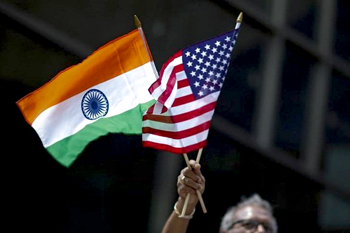
India's bid to join US alliance could irk China, Pak: media

August 30, 2016

Beijing, Aug 30: Attempts by India to join US' alliance could "irritate" China, Pakistan or even Russia and bring "strategic troubles" to New Delhi while making it a centre of geopolitical rivalries in Asia, China's state-run media commented today.

indusIn an editorial written ahead of Defence Minister Manohar Parrikar and US Defence Secretary Ashton Carter signing a logistics agreement, state-run Global Times said India may loose strategic independence if it leans towards the US.

The Logistics Exchange Memorandum of Agreement (LEMOA) allows India and US militaries to access each other's military facilities for refuelling and replenishment.

"This is undoubtedly a leap forward in US-India military cooperation. US media highly applauded this deal, with Forbes hailing it as a 'war pact' and believing that India is shifting away from Russia, its Cold War ally, toward a new alliance with the US," the editorial said.

"If India hastily joins the US alliance system, it may irritate China, Pakistan or even Russia. It may not make India feel safer, but will bring strategic troubles to itself and make itself a centre of geopolitical rivalries in Asia," it said.

"India holds dear its independence and sovereignty after squeezing out of the UK's colonialism. It views itself as a major power and is developing on the wave of the emerging countries," the editorial said.

While India has adopted a prudent attitude so far refraining from joining US alliance, some defence analysts expressed worries that India may lose strategic independence and warned that the pact may render New Delhi a "follower" of Washington, it said.

Observing that India attaches high importance to national security, the editorial said, "It feels it is an urgent task because its defence levels are a necessary condition of being a major power, rather than out of a sense of crisis that requires an intimacy to the US."

Due to its non-alignment policy, India has been given attention from all the major powers such as the US, Japan, China and Russia in recent years, it noted.

"However, in recent years, Washington has deliberately wooed New Delhi to become its quasi ally so as to impose geopolitical pressure on China. It is possible that the (Narendra) Modi administration is trying an unconventional way to lean toward the US with the logistics agreement," the editorial said.

Comments

REALITY
 - 
Tuesday, 30 Aug 2016

Liars will join hand with Liars...
Cheaters with cheaters
The world knows now that USA cheated its own people in 9/11..
The world knows now that USA cheated its own people on Iraq war..
Our indian politician are digging our own grave by joining the LIARS masters Club..

Add new comment

  • Coastaldigest.com reserves the right to delete or block any comments.
  • Coastaldigset.com is not responsible for its readers’ comments.
  • Comments that are abusive, incendiary or irrelevant are strictly prohibited.
  • Please use a genuine email ID and provide your name to avoid reject.
News Network
January 3,2020

Dhaka, Jan 3: Bangladesh's paramilitary force chief said on Thursday that a total of 445 Bangladeshi nationals returned from India in last two months following the publication of the National Register of Citizens (NRC) by the Indian government.

Border Guard Bangladesh (BGB) Director General Maj Gen Md Shafeenul Islam disclosed the figure during a press briefing here.

"About 1,000 people were arrested in 2019 for illegal border crossings from India to Bangladesh, with 445 of them returning home in November and December," he said.

After verifying their identities through local representatives, BGB came to know that all the intruders are Bangladeshis, Islam said, adding that 253 cases were lodged against them for illegal trespass, while initial investigations found that at least three of them were human traffickers.

The BGB Director said the trespassing did not create any tension between the border forces of Bangladesh and India.

Last week, Islam visited India where he said that the creation of the NRC is completely an "internal affair" of India and the cooperation between the border guarding forces of the two countries is very good.

He said the BGB will continue to do its work of preventing illegal border crossings as per its mandate.

A BGB delegation, led by Islam, was on a bilateral visit to India to hold DG-level border talks with its counterparts, the Border Security Force (BSF).

The talks took place from December 26-29, during which a host of issues related to cross-border smuggling and activities of criminals and others along the 4,096-km-long front were discussed.

Responding to a question, Islam said, "No discussion was held at the conference over the (NRC) issue".

He said during the five-day talks held in New Delhi, the BGB demanded that the BSF should take effective steps to prevent killings of Bangladeshis on frontiers as casualty figures sharply rose in 2019.

"The number of border killings in 2019 was highest in the last four years. As per our calculation, the number of such unexpected deaths was 35," the BGB chief said.

However, the BSF estimate of the casualty figure is much lower than our calculation, he said.

Islam said the BSF is following the policy of maintaining maximum restraint and minimal use of force even after being attacked by "armed border offenders".

A statement issued by the BSF last month in New Delhi after the conclusion of the DG-level talks said, "On the concern of the BGB regarding the death of Bangladeshi nationals on borders, it was informed to them that a non-lethal weapon policy is strictly followed by BSF personnel on borders.

"Firing is resorted to only in self-defence, when BSF patrols are gheraoed and attacked by ‘dah’ (a sharp-edged weapon) etc. It was specified that the BSF does not discriminate between criminals based on nationality," it said.

Comments

Add new comment

  • Coastaldigest.com reserves the right to delete or block any comments.
  • Coastaldigset.com is not responsible for its readers’ comments.
  • Comments that are abusive, incendiary or irrelevant are strictly prohibited.
  • Please use a genuine email ID and provide your name to avoid reject.
News Network
May 27,2020

May 27: At a time when India is struggling with the deadly coronavirus, huge swarms of locusts in many states has bought nightmares to the farmers.

Experts warn of extensive crop losses if authorities fail to curb the fast-spreading swarms by June when monsoon rains spur rice, cane, corn, cotton, and soybean sowing.

Locusts entered India after traveling from Africa through Yemen, Iran and Pakistan.

After massive devastation in Pakistan, t swarms of locusts entered India through Rajasthan and Gujarat. The number is so large that the farmers and authorities are feeling helpless in tackling the threat.

The situation has become more alarming as the locusts is spreading across the country at an extremely fast rate. After badly affecting the crops in Rajasthan, Gujarat, Maharashtra, and Madhya Pradesh, the swarm of locust have now entered Uttar Pradesh.

In Rajasthan alone, the locust attack has damaged 5 lakh hectares of crop and nearly 17 districts of Madhya Pradesh have also seen their terror. Earlier from May 2019 to February 2020, too, the locust swarms entered India several times.

Speaking on the current situation, Dr Ram Pravesh, District Agricultural Officer, Agra, Uttar Pradesh said the Department of Agriculture is working with farmers in dealing with the situation. He urged the farmers to inform their Mandal Krishi Adhikari if they require any help.

India's largest-ever locust attack was in 1993 when more than three lakh hectares of cultivated land were completely destroyed.

Earlier in 2020, farmers salvaged their wheat and oilseed crops from a previous locust scourge.

Comments

Add new comment

  • Coastaldigest.com reserves the right to delete or block any comments.
  • Coastaldigset.com is not responsible for its readers’ comments.
  • Comments that are abusive, incendiary or irrelevant are strictly prohibited.
  • Please use a genuine email ID and provide your name to avoid reject.
News Network
May 15,2020

New Delhi, May 15: A group of doctors from the AIIMS, Raipur has recommended restrictions on the use of mobile phones in healthcare institutions amid the COVID-19 pandemic, warning that such devices can be a potential carrier of the virus and lead to infection among healthcare workers.

In a commentary published in the BMJ Global Health journal, the doctors stated that mobile phone surfaces are a peculiar 'high-risk' surface, which can directly come in contact with the face or mouth, even if hands are properly washed and one study indicates that some healthcare workers use phones every 15 minutes to two hours.

Though there have been many significant guidelines from various health organisations like the WHO and CDC focusing on prevention and control of disease, the commentary highlighted "there is no mention of or focus on mobile phones in these guidelines, including the WHO infection control and prevention guidelines, which recommends the use of handwashing".

In healthcare facilities, phones are used to communicate with other health care workers, look up recent medical guidelines, research drug interactions, understand adverse events and side effects, conduct telemedicine appointments and track patients among others, stated the document.

The document has been authored by Dr Vineet Kumar Pathak, Dr Sunil Kumar Panigrahi, Dr M Mohan Kumar, Dr Utsav Raj and Dr Karpaga Priya P from the Department of Community and Family Medicine.

"In their tendency to come in direct contact with the face, nose or eyes in healthcare settings, mobile phones are perhaps second only to masks, caps or goggles," the authors said.

"However, they are neither disposable nor washable like these other three, thus warranting disinfection. Mobile phones can effectively negate hand hygiene... There is growing evidence that mobile phones are a potential vector for pathogenic organisms," they said.

It is the need of the hour to address proper hygienic use of mobile phones in healthcare settings. In a study in India, almost 100 per cent of health workers of a tertiary care hospital used mobile phones in the hospital, but only 10 per cent of them had at any time wiped their mobile phones clean, the commentary published on April 22 said.

"The safest thing to do is to consider your phone as an extension of your hand, so remember you are transferring whatever is on your phone to your hand," Dr Pathak said.

Amidst the ongoing pandemic, two biggest mobile phone companies have uploaded their user support guidelines, saying that 70 pc isopropyl alcohol or Clorox Disinfecting Wipes can be used to gently wipe the exterior surface of phones in switched-off mode.

However, in doing so, the use of bleach or entry of moisture through any of the openings must be avoided, and any harsh chemical may damage the oleophobic screen, leading to damage in the touch screen sensitivity of the phone, the article stated.

Mobile phones are one of the most highly touched surfaces according to the Centers for Disease Control and Prevention (CDC), along with counters, tabletops, doorknobs, bathroom fixtures, toilets, keyboards, tablets and bedside tables.

The doctors recommended restriction on mobile phone usage in healthcare settings like hospital wards, ICUs and operation theatres, while advocating the use of headphones to prevent contact with the face while talking.

There should be no sharing of mobile phones, headphones or headsets of any kind. In addition, where available, the use of interdepartmental intercom facility may be promoted.

"Although hand hygiene and mobile phone use by a person are not mutually exclusive, it is high time to acknowledge the potential role of mobile phones in disease transmission cascade and to take evidence-based appropriate actions. This is especially important, given the ongoing COVID-19 pandemic," the authors said.

They said it is necessary for government agencies and the WHO to generate public awareness and to formulate suitable information, education and communication material on mobile phone hygiene, especially in healthcare settings.

AIIMS, New Delhi, Resident Doctors' Association (RDA) General Secretary, Dr Srinivas Rajkumar T said even outside health care settings, people should pay special attention to the usage of mobile phones as they carry them to all places.

"Phone and computer peripherals like keyboard, mouse, etc. should be covered with transparent plastic covers which can be cleaned without interfering with their function. Cleaning hands by soap or alcohol-based hand sanitizer before and after contact with phone and between contact with other surfaces can decrease the risk of potential transmission.

"Using a handsfree headset, dedicated operator/assistant per ward handling the communication via common line in hospitals while on duty can enable communication without compromising safety," Dr Srinivas said.


Comments

Add new comment

  • Coastaldigest.com reserves the right to delete or block any comments.
  • Coastaldigset.com is not responsible for its readers’ comments.
  • Comments that are abusive, incendiary or irrelevant are strictly prohibited.
  • Please use a genuine email ID and provide your name to avoid reject.