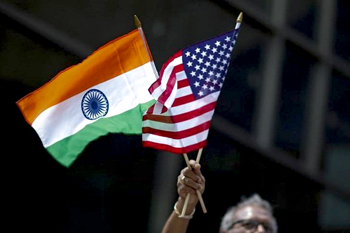
India's bid to join US alliance could irk China, Pak: media

August 30, 2016

Beijing, Aug 30: Attempts by India to join US' alliance could "irritate" China, Pakistan or even Russia and bring "strategic troubles" to New Delhi while making it a centre of geopolitical rivalries in Asia, China's state-run media commented today.

indusIn an editorial written ahead of Defence Minister Manohar Parrikar and US Defence Secretary Ashton Carter signing a logistics agreement, state-run Global Times said India may loose strategic independence if it leans towards the US.

The Logistics Exchange Memorandum of Agreement (LEMOA) allows India and US militaries to access each other's military facilities for refuelling and replenishment.

"This is undoubtedly a leap forward in US-India military cooperation. US media highly applauded this deal, with Forbes hailing it as a 'war pact' and believing that India is shifting away from Russia, its Cold War ally, toward a new alliance with the US," the editorial said.

"If India hastily joins the US alliance system, it may irritate China, Pakistan or even Russia. It may not make India feel safer, but will bring strategic troubles to itself and make itself a centre of geopolitical rivalries in Asia," it said.

"India holds dear its independence and sovereignty after squeezing out of the UK's colonialism. It views itself as a major power and is developing on the wave of the emerging countries," the editorial said.

While India has adopted a prudent attitude so far refraining from joining US alliance, some defence analysts expressed worries that India may lose strategic independence and warned that the pact may render New Delhi a "follower" of Washington, it said.

Observing that India attaches high importance to national security, the editorial said, "It feels it is an urgent task because its defence levels are a necessary condition of being a major power, rather than out of a sense of crisis that requires an intimacy to the US."

Due to its non-alignment policy, India has been given attention from all the major powers such as the US, Japan, China and Russia in recent years, it noted.

"However, in recent years, Washington has deliberately wooed New Delhi to become its quasi ally so as to impose geopolitical pressure on China. It is possible that the (Narendra) Modi administration is trying an unconventional way to lean toward the US with the logistics agreement," the editorial said.

Comments

REALITY
 - 
Tuesday, 30 Aug 2016

Liars will join hand with Liars...
Cheaters with cheaters
The world knows now that USA cheated its own people in 9/11..
The world knows now that USA cheated its own people on Iraq war..
Our indian politician are digging our own grave by joining the LIARS masters Club..

Add new comment

  • Coastaldigest.com reserves the right to delete or block any comments.
  • Coastaldigset.com is not responsible for its readers’ comments.
  • Comments that are abusive, incendiary or irrelevant are strictly prohibited.
  • Please use a genuine email ID and provide your name to avoid reject.
News Network
April 27,2020

New Delhi, Apr 27: A private hospital here claimed that a coronavirus patient, who was administered plasma therapy for the first time in the facility, was discharged on Sunday after being completely cured.

The 49-year-old man had tested positive for COVID-19 on April 4 and was admitted to Max Hospital, Saket, it said in a statement.

As his condition deteriorated, he was put on ventilator support on April 8, the hospital added.

When the patient showed no signs of improvement, his family requested for administration of plasma therapy on compassionate grounds, it said, adding that the family arranged a donor for extracting plasma.

The patient was administered fresh plasma as a treatment modality as a side-line to standard treatment protocols on the night of April 14, the statement said.

Subsequently, the patient showed improvement and by the fourth day, was weaned off ventilator support and continued on supplementary oxygen. He was shifted to a room with round-the-clock monitoring on Monday after testing negative twice within 24 hours, it said.

He has now fully recovered and was discharged, the hospital said, adding that he will stay at home for another two weeks.

Group medical director of Max Healthcare and senior director of the Institute of Internal Medicine Dr Sandeep Budhiraja said, "We can say that plasma therapy could have worked as a catalyst in speeding up his recovery. We cannot attribute 100 per cent recovery to plasma therapy only, as there are multiple factors which carved his path to recovery."

Comments

Add new comment

  • Coastaldigest.com reserves the right to delete or block any comments.
  • Coastaldigset.com is not responsible for its readers’ comments.
  • Comments that are abusive, incendiary or irrelevant are strictly prohibited.
  • Please use a genuine email ID and provide your name to avoid reject.
Agencies
January 16,2020

New Delhi, Jan 16: United Forum of Bank Unions has decided to observe a two-day strike on January 31 and February 1, demanding early wage revision settlement which has been due since November 1, 2017, said the All India Bank Employees Association.

Union Finance Minister Nirmala Sitharaman will present her second Union Budget on February 1.

Banks will also hold a strike on March 11, 12 and 13. Also, an indefinite strike will be held from April 1.

General Secretary, All India Bank Officers' Confederation West Bengal Sanjay Das has stated that the nationwide strike has been called over several demands.

"The demands include--wage revision settlement at 20 per cent hike on payslip components with adequate loading thereof and scrapping off New Pension Scheme (NPS)," said Das.

There are several demands to hold the strike including the merger of special allowance with basic pay, updation of pension, improvement in the family pension system, five-day banking, allocation of staff welfare fund based on operating profits and exemption from income tax on retiral benefits without a ceiling.

"Other demands include-- a uniform definition of business hours, lunch hour etc in the branches, introduction of leave bank, defined working hours for the officers and equal wage for equal work for the contract employee," said Das.

Comments

Add new comment

  • Coastaldigest.com reserves the right to delete or block any comments.
  • Coastaldigset.com is not responsible for its readers’ comments.
  • Comments that are abusive, incendiary or irrelevant are strictly prohibited.
  • Please use a genuine email ID and provide your name to avoid reject.
News Network
January 13,2020

Jan 13: For the first time in years, the government of India’s Prime Minister Narendra Modi is playing defense. Protests have sprung up across the country against an amendment to India’s laws — which came into effect on Friday — that makes it easier for members of some religions to become citizens of India. The government claims this is simply an attempt to protect religious minorities in the Muslim-majority countries that border India; but protesters see it as the first step toward a formal repudiation of India’s constitutionally guaranteed secularism — and one that must be resisted.

Modi was re-elected prime minister last year with an enhanced majority; his hold over the country’s politics is absolute. The formal opposition is weak, discredited and disorganized. Yet, somehow, the anti-Citizenship Act protests have taken hold. No political party is behind them; they are generally arranged by student unions, neighborhood associations and the like.

Yet this aspect of their character is precisely what will worry Modi and his right-hand man, Home Minister Amit Shah. They know how to mock and delegitimize opposition parties with ruthless efficiency. Yet creating a narrative that paints large, flag-waving crowds as traitors is not quite that easy.

For that is how these protests look: large groups of young people, many carrying witty signs and the national flag. They meet and read the preamble to India’s Constitution, into which the promise of secularism was written in the 1970’s.

They carry photographs of the Constitution’s drafter, the Columbia University-trained economist and lawyer B. R. Ambedkar. These are not the mobs the government wanted. They hoped for angry Muslims rampaging through the streets of India’s cities, whom they could point to and say: “See? We must protect you from them.” But, in spite of sometimes brutal repression, the protests have largely been nonviolent.

One, in Shaheen Bagh in a Muslim-dominated sector of New Delhi, began simply as a set of local women in a square, armed with hot tea and blankets against the chill Delhi winter. It has now become the focal point of a very different sort of resistance than what the government expected. Nothing could cure the delusions of India’s Hindu middle class, trained to see India’s Muslims as dangerous threats, as effectively as a group of otherwise clearly apolitical women sipping sweet tea and sharing their fears and food with anyone who will listen.

Modi was re-elected less than a year ago; what could have changed in India since then? Not much, I suspect, in most places that voted for him and his party — particularly the vast rural hinterland of northern India. But urban India was also possibly never quite as content as electoral results suggested. India’s growth dipped below 5% in recent quarters; demand has crashed, and uncertainty about the future is widespread. Worse, the government’s response to the protests was clearly ill-judged. University campuses were attacked, in one case by the police and later by masked men almost certainly connected to the ruling party.

Protesters were harassed and detained with little cause. The courts seemed uninterested. And, slowly, anger began to grow on social media — not just on Twitter, but also on Instagram, previously the preserve of pretty bowls of salad. Instagram is the one social medium over which Modi’s party does not have a stranglehold; and it is where these protests, with their photogenic signs and flags, have found a natural home. As a result, people across urban India who would never previously have gone to a demonstration or a political rally have been slowly politicized.

India is, in fact, becoming more like a normal democracy. “Normal,” that is, for the 2020’s. Liberal democracies across the world are politically divided, often between more liberal urban centers and coasts, and angrier, “left-behind” hinterlands. Modi’s political secret was that he was that rare populist who could unite both the hopeful cities and the resentful countryside. Yet this once magic formula seems to have become ineffective. Five of India’s six largest cities are not ruled by Modi’s Bharatiya Janata Party in any case — the financial hub of Mumbai changed hands recently. The BJP has set its sights on winning state elections in Delhi in a few weeks. Which way the capital’s voters will go is uncertain. But that itself is revealing — last year, Modi swept all seven parliamentary seats in Delhi.

In the end, the Citizenship Amendment Act is now law, the BJP might manage to win Delhi, and the protests might die down as the days get unmanageably hot and state repression increases. But urban India has put Modi on notice. His days of being India’s unifier are over: From now on, like all the other populists, he will have to keep one eye on the streets of his country’s cities.


Comments

Add new comment

  • Coastaldigest.com reserves the right to delete or block any comments.
  • Coastaldigset.com is not responsible for its readers’ comments.
  • Comments that are abusive, incendiary or irrelevant are strictly prohibited.
  • Please use a genuine email ID and provide your name to avoid reject.