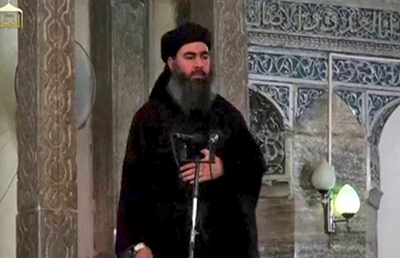
ISIS chief Abu Bakr al-Baghdadi ill after assassin ‘poisons' food: Report

October 4, 2016

Baghdad, Oct 4: The IS terrorist group ringleader was reportedly seriously ill after having his food poisoned by an assassin, a media report said.

abu-bakrMeals prepared for Baghdadi and three other commanders of the terrorist organisation were allegedly poisoned in Nineveh's Be'aaj district, the Daily Mail reported on Monday.

It quoted an Iraqi news agency as saying that four militants, including Baghdadi, were suffering from “severe poisoning” and “have been transferred to an unknown location under strict measures”.

The IS terror group has reportedly launched a campaign of arrests to track down those responsible for poisoning the food.

The identities of the three other commanders is unknown.

Baghdadi is credited with transforming the breakaway al-Qaeda group and turning it into the independent IS group that is arguably the most powerful and wealthiest jihadi organisation in the world.

Al-Baghdadi's movements are known only by his inner circle, and the Caliph, as he is known to his followers, is constantly on the move, changing locations in Iraq and Syria to avoid airstrikes.

Under the leadership of Baghdadi, the group spearheaded a militant offensive that expanded into Syria in 2013 and overran much of Iraq's Arab heartland.

Baghdadi has been wounded multiple times in air strikes and been reported dead, but has re-surfaced each time.

Earlier this year, there were reports he had been killed by US-led coalition air strikes, but they turned out to be inaccurate, the Daily Mail reported.

Baghdadi — whose real name is Ibrahim Awad Ibrahim — is thought to have been born in Samarra, north of Baghdad, in 1971.

In October 2011, the US officially designated Baghdadi as “terrorist” and offered a $10 million reward for information leading to his capture or death.

Under Baghdadi's leadership, IS militants have shocked the world with their sadistic beheadings of captured foreign journalists and civilians.

Comments

Add new comment

  • Coastaldigest.com reserves the right to delete or block any comments.
  • Coastaldigset.com is not responsible for its readers’ comments.
  • Comments that are abusive, incendiary or irrelevant are strictly prohibited.
  • Please use a genuine email ID and provide your name to avoid reject.
News Network
June 15,2020

Jun 15: Oil prices fell on Monday, with U.S. oil dropping more than 2%, as a spike in new coronavirus cases in the United States raised concerns over a second wave of the virus which would weigh on the pace of fuel demand recovery.

Brent crude futures fell 66 cents, or 1.7%, at $38.07 a barrel as of 0016 GMT, while U.S. West Texas Intermediate (WTI) crude futures fell 81 cents, or 2.2%, to $35.45 a barrel.

Both benchmarks ended down about 8% last week, their first weekly declines since April, hit by the U.S. coronavirus concerns: More than 25,000 new cases were reported on Saturday alone as more states, including Florida and Texas, reported record new infection highs.

"Concerns about the recent uptick in COVID-19 infections in the U.S. and a potential 'second wave' are weighing on oil at the moment," said Stephen Innes, chief global market strategist at AxiCorp.

Meanwhile, an OPEC-led monitoring panel will meet on Thursday to discuss ongoing record production cuts to see whether countries have delivered their share of the reductions, but will not make any decision, according to five OPEC+ sources.

The Organization of the Petroleum Exporting Countries (OPEC) and its allies, collectively known as OPEC+, have been reducing supplies by 9.7 million barrels per day (bpd), about 10% of pre-pandemic demand, and agreed in early June to extend the cuts for a month until end-July.

Iraq, one of the laggards in complying with the curbs, agreed with its major oil companies to cut crude production further in June, Iraqi officials working at the fields told Reuters on Sunday.

Comments

Add new comment

  • Coastaldigest.com reserves the right to delete or block any comments.
  • Coastaldigset.com is not responsible for its readers’ comments.
  • Comments that are abusive, incendiary or irrelevant are strictly prohibited.
  • Please use a genuine email ID and provide your name to avoid reject.
Agencies
May 17,2020

Washington, May 17: The overall number of global coronavirus cases has increased to over 4.6 million, while the death toll has surpassed 311,000, according to the Johns Hopkins University.

As of Sunday morning, the total number of cases stood at 4,634,068, while the death toll increased to 311,781, the University's Center for Systems Science and Engineering (CSSE) revealed in its latest update.

The US currently accounts for the world's highest number of cases and deaths at 1,467,796 and 88,754, respectively.

In terms of cases, Russia has the second highest number of infections at 272,043, followed by the UK (241,461), Brazil (233,142), Spain (230,698), Italy (224,760), France (179,630), Germany (175,752), Turkey (148,067) and Iran (118,392), the CSSE figures showed.

Meanwhile, the UK accounted for the second highest COVID-19 deaths worldwide at 34,546.

The other countries with over 10,000 deaths are Italy (31,763), Spain (27,563), France (27,532), and Brazil (15,662).

Comments

Add new comment

  • Coastaldigest.com reserves the right to delete or block any comments.
  • Coastaldigset.com is not responsible for its readers’ comments.
  • Comments that are abusive, incendiary or irrelevant are strictly prohibited.
  • Please use a genuine email ID and provide your name to avoid reject.
News Network
June 26,2020

Washington, Jun 26: The US is reviewing its global deployment of forces to ensure it is postured appropriately to counter the People's Liberation Army, given the increasing threat posed by China to Asian countries like India, Malaysia, Indonesia, and the Philippines, Secretary of State Mike Pompeo said on Thursday.

Mr Pompeo made those remarks in response to a question during the virtual Brussels Forum 2020 of the German Marshall Fund.

"We're going to make sure we're postured appropriately to counter the PLA. We think that the challenge of our times, and we're going to make sure we have resources in place to do that," Mr Pompeo said.
 
The force posture review is being done at the direction of President Donald Trump, as part of which the US is reducing the number of its troops in Germany from about 52,000 to 25,000, he said.

Mike Pompeo said that the force posture would be dictated by the ground realities.

"In certain places there will be fewer American resources. There'll be other places - I just talked about the threat from the Chinese Communist Party, so now threats to India, threats to Vietnam, threats to Malaysia, Indonesia, South China Sea challenges, the Philippines," he said.

"To the extent that that changed, the difference in what the US decided to do impacts adversely a threat some place, it may be that other nations need to step up and take responsibility for their own defense in ways that they hadn't done previously. So, we want to do this in full consultation with all of our partners all around the world, and certainly our friends in Europe," Mr Pompeo said.

President Trump is being criticised for reducing troops from Germany. His critics say that this will increase the threat from Russia to Europe.

Mike Pompeo, however, did not agree with that argument.

It has been a long time since there has been a strategic review of our force posture all across the world. The US undertook that starting about 2.5 years ago, whether that was our forces in Africa, our forces in Asia, the force we have in the Middle East and in Europe, he said.

"We began to say these are often decisions that were made in a different time. Should we reallocate those a different way? Should we have a different composition of those forces? Everyone always wants to talk about ground troops. I get it. I was a young tank officer. You described that. There's nothing I like as much as a good M1 tank.

"But it's often the case that the capacity to deter Russia or other adversaries isn''t determined any longer by just having a bunch of folks garrisoned someplace. So, we really went to back fundamentally relook, what is the nature of the conflict, what''s the nature of the threat, and how should we allocate our resources, whether that''s our resources in the intelligence community, our resources from the Air Force or the Marines and Army," Mr Pompeo said.

Last week, Mike Pompeo criticised the Chinese Army for "escalating" the border tension with India and militarising the strategic South China Sea. He also described the ruling Communist Party of China (CPC) as a "rogue actor".

"Our broad set of allocation of security apparatus, our ability to counter cyber threats, how do we allocate them? What''s the best way to do this? And the decision that you see the president made with respect to Germany is an outcome from a collective set of decisions about how we''re going to posture our resources around the world," said the top American diplomat on Thursday.

Changes in force posture is being taken in consultations with allies and friends, Mr Pompeo said.

"President Trump has spoken to this. (Defense) Secretary (Mark) Esper will be in London today and in Brussels tomorrow. We''ll talk about our plan and how we''re thinking about delivering it," he said.

"But you should understand this, and I hope our European partners will understand this as well. When you see what we ultimately conclude, how we ultimately deliver on the statements of the president made, that they''re aimed squarely at what we believe to be democracies'' fundamental interest and certainly America's most fundamental interest," Mr Pompeo said.

Earlier this month, Mike Pompeo had said that China's actions, be it on the India border, or in Hong Kong or in the South China Sea, were part of the behaviour of the ruling Communist Party in Beijing in the recent past.

China has been fast expanding military and economic influence in the Indo-Pacific region, triggering concern in various countries of the region and beyond.

China is engaged in hotly contested territorial disputes in both the South China Sea and the East China Sea. Beijing has built up and militarised many of the islands and reefs it controls in the region. Both areas are stated to be rich in minerals, oil and other natural resources and are vital to global trade.


Comments

Add new comment

  • Coastaldigest.com reserves the right to delete or block any comments.
  • Coastaldigset.com is not responsible for its readers’ comments.
  • Comments that are abusive, incendiary or irrelevant are strictly prohibited.
  • Please use a genuine email ID and provide your name to avoid reject.