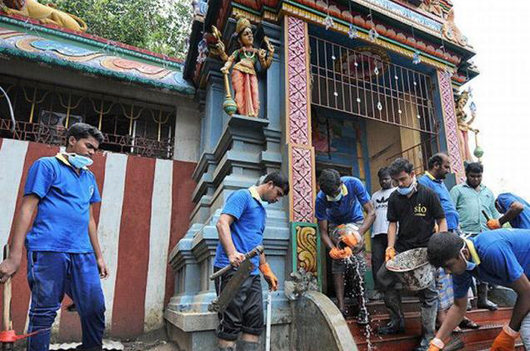
Islamic organisation activists clean flood-hit temples in Chennai

[email protected] (The Hindu)
December 11, 2015

Chennai, Dec 11: Among the heart-warming stories to have emerged from the Chennai floods is a cleaning drive undertaken by a Muslim organisation.

muslims

Around 50 members of Jammat E Islami Hind, a non-governmental organisation (NGO), have been quietly cleaning mosques as well as temples in the flood-hit areas of the city.

In the last two days, they meticulously cleaned two temples, in Kotturpuram and Saidapet.

“We find Hindus are unable to worship at temples in some areas because they have been severely affected owing to floods. So, we cleaned the mosques and temples and the streets badly damaged in the two areas. In the coming week, we will do similar work in other areas of the city,” Peer Mohammed, postgraduate in engineering and a student wing secretary (social service) of Jammat E Islami Hind, said.

“Throughout the process, people there helped us and were very happy that the cleaning was done,” he added.

Jalaludeen, secretary of the group, said they took utmost care while cleaning the temples in both areas.

Amir Mahal, the official residence of Mohammed Abdul Ali, the prince of Arcot, had become a warehouse of sorts with relief material pouring in.

Mr. Ali commended the people of Chennai for coming together irrespective of caste, creed or religion to serve flood victims.

Comments

Fanny
 - 
Wednesday, 13 Jan 2016

Next time I read a website, I really hope that it doesnt disappoint me around that one.
I mean, I understand it was my decision to see, but I actually thought youd have something interesting to say.

Take a look at my weblog ... marvel contest of champions
hack ios (Sergio: http://Www.Realhacks24.com/marvel-contest-of-champions-hack/)

Add new comment

  • Coastaldigest.com reserves the right to delete or block any comments.
  • Coastaldigset.com is not responsible for its readers’ comments.
  • Comments that are abusive, incendiary or irrelevant are strictly prohibited.
  • Please use a genuine email ID and provide your name to avoid reject.
Agencies
May 8,2020

Washington D.C., May 8: The prime time for brain development in a child's life is the first year, where the infant spends most of the time asleep. It is the time when neural connections form and sensory memories are encoded.

However, when sleep is disrupted, as occurs more often among children with autism, brain development may be affected, too.

New research led by the University of Washington finds that sleep problems in a baby's first 12 months may not only precede an autism diagnosis but also may be associated with altered growth trajectory in a key part of the brain, the hippocampus.

The study, which was published in the American Journal of Psychiatry, researchers report that in a sample of more than 400 taken of 6- to 12-month-old infants, those who were later diagnosed with autism were more likely to have had difficulty falling asleep.

It also states that this sleep difficulty was associated with altered growth trajectories in the hippocampus.

"The hippocampus is critical for learning and memory, and changes in the size of the hippocampus have been associated with poor sleep in adults and older children.

As many as 80 per cent of the children with autism spectrum disorder have sleep problems," said Annette Estes, director of the UW Autism Center and senior author of the study.

"In our clinical experience, parents have a lot of concerns about their children's sleep, and in our work on early autism intervention, we observed that sleep problems were holding children and families back," added Estes, who is also a UW professor of speech and hearing sciences.

"It could be that altered sleep is part-and-parcel of autism for some children. One clue is that behavioural interventions to improve sleep don't work for all children with autism, even when their parents are doing everything just right. This suggests that there may be a biological component to sleep problems for some children with autism," said Estes.

To consider links among sleep, brain development, and autism, researchers at the IBIS Network looked at MRI scans of 432 infants, surveyed parents about sleep patterns, and measured cognitive functioning using a standardized assessment.

At the outset of the study, infants were classified according to their risk for developing autism: Those who were at higher risk of developing autism -- about two-thirds of the study sample -- had an older sibling who had already been diagnosed.

Infant siblings of children with autism have a 20 per cent chance of developing autism spectrum disorder -- a much higher risk than children in the general population.

In the current study, 127 of the 432 infants were identified as "low risk" at the time the MRI scans were taken because they had no family history of autism.

They later evaluated all the participants at 24 months of age to determine whether they had developed autism. Of the roughly 300 children originally considered "high familial risk," 71 were diagnosed with autism spectrum disorder at that age.

Problems with sleep were more common among the infants later diagnosed with an autism spectrum disorder, as were larger hippocampi. No other subcortical brain structures were affected, including the amygdala, which is responsible for certain emotions and aspects of memory, or the thalamus, a signal transmitter from the spinal cord to the cerebral cortex.

The authors note that while parents reported more sleep difficulties among infants who developed autism compared to those who did not, the differences were very subtle and only observed when looking at group averages across hundreds of infants.

Sleep patterns in the first years of life change rapidly as infants transition from sleeping around the clock to a more adult-like sleep/wake cycle. Until further research is completed, Estes said, it is not possible to interpret challenges with sleep as an early sign of increased risk for autism.


Comments

Add new comment

  • Coastaldigest.com reserves the right to delete or block any comments.
  • Coastaldigset.com is not responsible for its readers’ comments.
  • Comments that are abusive, incendiary or irrelevant are strictly prohibited.
  • Please use a genuine email ID and provide your name to avoid reject.
News Network
February 1,2020

New Delhi, Feb 1: The budget is a little more demanding of the non-resident Indian. Firstly, to be categorized a non-resident, an Indian now has to stay abroad for 240 days, against 182 previously. In other words, an Indian national, to claim the non-resident status, can’t stay in India for 120 days or more in a year.

“We've made changes in Income Tax Act where if an Indian citizen stays out of the country for more than 182 days, he becomes non-resident,” said Revenue Secy Ajay Bhushan Pandey. “Now in order to become non-resident, he has to stay out of the country for 240 days.”

The second rule is more deadly: a non-resident Indian, who is not taxed in the foreign country, will become taxable in India.

“If any Indian citizen is not a resident of any country in the world, he'll be deemed to be a resident of India and his worldwide income will be taxed,” said Pandey.

"It's a very big disadvantage for Indians residing overseas only to save on tax,"  said Dinesh Kanabar of Dhruva Advisors. He expects that many Indians stay abroad in countries, where the income tax is low or nil such as Dubai. Now they will be taxed in India if they are in the income tax bracket.

For Indians, finance minister Nirmala Sitharaman revised income tax rats and proposed new tax slabs.

The new income tax rates will, however, not allow exemptions under Section 80C. Home loan exemption, insurance exemptions, the standard deduction will also not stay under the regime.

"The new tax regime will be optional and the taxpayers will be given the choice to either remain in the old regime with exemptions and deductions or opt for the new reduced tax rate without those exemptions," Sitharaman said while unveiling Budget.

Comments

Kannadiga
 - 
Saturday, 1 Feb 2020

Good news NRIs vote for modi . 

Add new comment

  • Coastaldigest.com reserves the right to delete or block any comments.
  • Coastaldigset.com is not responsible for its readers’ comments.
  • Comments that are abusive, incendiary or irrelevant are strictly prohibited.
  • Please use a genuine email ID and provide your name to avoid reject.
coastaldigest.com news network
June 21,2020

Udupi, June 21: An entrepreneur lost his life after the car he was driving veered off the road and plunged into a roadside tank near Barkuru in Brahmavar taluk of Udupi district today.

The deceased has been identified as Santosh Shetty, a resident of Vakwadi in Kundapur taluk. He is the proprietor of Laxmi Glass and Plywood, Koteshwara. 

A woman, identified as Shweta, who was also on board the car suffered critical injuries.  

The mishap occurred when the duo was heading to Vakwadi from Brahmavar in Hyundai Car sedan car. 

Shetty lost control over his vehicle while negotiating a curve at Chaulikere and the car plunged off the road as there was no barricade. 

Even though local residents began rescue operation immediately, Shetty breathed his last on the spot. Shweta was rescued and shifted to a hospital in Manipal for treatment.

Comments

Add new comment

  • Coastaldigest.com reserves the right to delete or block any comments.
  • Coastaldigset.com is not responsible for its readers’ comments.
  • Comments that are abusive, incendiary or irrelevant are strictly prohibited.
  • Please use a genuine email ID and provide your name to avoid reject.