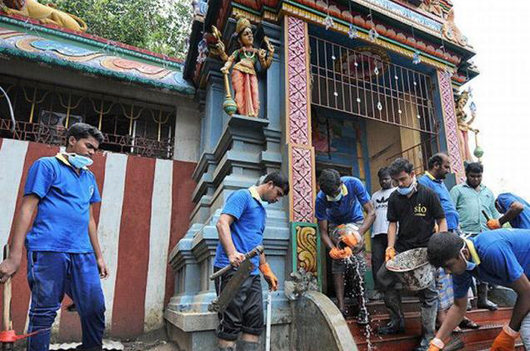
Islamic organisation activists clean flood-hit temples in Chennai

[email protected] (The Hindu)
December 11, 2015

Chennai, Dec 11: Among the heart-warming stories to have emerged from the Chennai floods is a cleaning drive undertaken by a Muslim organisation.

muslims

Around 50 members of Jammat E Islami Hind, a non-governmental organisation (NGO), have been quietly cleaning mosques as well as temples in the flood-hit areas of the city.

In the last two days, they meticulously cleaned two temples, in Kotturpuram and Saidapet.

“We find Hindus are unable to worship at temples in some areas because they have been severely affected owing to floods. So, we cleaned the mosques and temples and the streets badly damaged in the two areas. In the coming week, we will do similar work in other areas of the city,” Peer Mohammed, postgraduate in engineering and a student wing secretary (social service) of Jammat E Islami Hind, said.

“Throughout the process, people there helped us and were very happy that the cleaning was done,” he added.

Jalaludeen, secretary of the group, said they took utmost care while cleaning the temples in both areas.

Amir Mahal, the official residence of Mohammed Abdul Ali, the prince of Arcot, had become a warehouse of sorts with relief material pouring in.

Mr. Ali commended the people of Chennai for coming together irrespective of caste, creed or religion to serve flood victims.

Comments

Fanny
 - 
Wednesday, 13 Jan 2016

Next time I read a website, I really hope that it doesnt disappoint me around that one.
I mean, I understand it was my decision to see, but I actually thought youd have something interesting to say.

Take a look at my weblog ... marvel contest of champions
hack ios (Sergio: http://Www.Realhacks24.com/marvel-contest-of-champions-hack/)

Add new comment

  • Coastaldigest.com reserves the right to delete or block any comments.
  • Coastaldigset.com is not responsible for its readers’ comments.
  • Comments that are abusive, incendiary or irrelevant are strictly prohibited.
  • Please use a genuine email ID and provide your name to avoid reject.
News Network
April 19,2020

Kasaragod, Apr 19: Kasaragod, Kerala's COVID-19 hotspot, is the only district in the southern state lacking adequate health infrastructure.

In spite of treating the highest number of COVID-19 patients in the state with meagre infrastructural facilities and even without the support of a medical college in the north Kerala district, no deaths have been reported due to coronavirus.

The state health department views the performance of M Kunhiraman and his team, consisting of Janardhana Naik and Krishna Naik, at the General hospital in Kasaragod as a success story.

"Not only did they control the situation quickly with minimum infrastructure, they also started turning out a large number of negative cases within a few weeks and creditably ensured zero mortality.

This can be showcased as a best global model," Chairman of the Information Education and Communication (IEC) Committee and Project Director Kerala State Aids Control Society, R Ramesh said.

Recalling the ordeal, Janardhana Naik said his first major challenge was the physical examination of a patient with suspected COVID-19.

"Even with the PPE kit, nobody knew how effective they were and it took a whole 30 minutes to wear them properly.

But as time passed, we got accustomed to it," he said.

The traditional method of dealing with a patient involved knowing his or her history, observation and physical examination.

For hundreds of years, the hands-on body approach has been the soul of the doctor-patient relationship -- taking the pulse, tapping on and listening to the chest, feeling lumps.

With the onset of COVID-19 all that has changed.

"In fact, the whole exercise was fraught with grave risks because everything connected with COVID-19 was new.

Doctors have to keep a distance even though the physical examination wearing a Personal Protective Equipment (PPE) is difficult.

Sounds from the body are inaudible, vision is blurred through the smog-covered goggles and a stethoscope seldom has any use," Janardhana Naik said.

It was from March 15 that the hospital started receiving COVID-19 patients, primarily from Dubai.

By the time the first person came, the hospital was ready for him.

Soon, patient numbers began to swell and in a couple of weeks they reached about 91.

From then on, it was teamwork.

Committees were formed for each and every task, including the help desk, IT, treatment, medical board, training, food, waste disposal and data maintenance.

Initially, patients had many misgivings about the hospital.

"Some were disillusioned and even aggressive. Some were not happy with the facilities the hospital had to offer.

But gradually through good treatment and counselling by a psychiatrist, who visited the hospital on alternate days, the confidence and mood of the patients changed and they became friendly with the staff," Naik elaborated.

Counselling was also given to the concerned family members of the patients.

Besides treatment, the medical staff had to spend a considerable amount of time clearing the doubts of patients.

When they got discharged some patients insisted on seeing the faces of the medical staff, who till then were anonymous entities covered from head to toe.

Some even wanted to take selfies with them.

However, the medical team politely turned down their requests and preferred to remain hidden in their work attires.

The mood of the patients also rubbed off on the doctors and hospital staff.

All the physicians and hospital staff are now more confident of dealing with contagious diseases after treating COVID-19 patients.

"Our previous experience of treating H1N1, Chikungunya and Dengue cases helped us a lot.

Words of encouragement from the Health Minister K K Shailaja, Health Principal Secretary Dr Rajan N Khobragade and Health Services Director Dr Sarita R L gave us the impetus to build up confidence.

Moreover, the field health workers did a wonderful job in containing the viral spread," Naik added.

As the number of coronavirus cases rose, the state government on April 5 deputed a 26-member medical team from Thiruvananthapuram to set up a COVID-19 hospital in the district.

They turned a block of the under construction Government Medical College as a hospital-like facility, setting up a 200 bed facility to treat coronavirus patients.


Comments

Add new comment

  • Coastaldigest.com reserves the right to delete or block any comments.
  • Coastaldigset.com is not responsible for its readers’ comments.
  • Comments that are abusive, incendiary or irrelevant are strictly prohibited.
  • Please use a genuine email ID and provide your name to avoid reject.
coastaldigest.com news network
July 11,2020

Bengaluru, Jul 11: Amidst the mounting number of covid-19 cases, Karnataka is witnessing another disturbing trend of increasing number of people ending their life. After the lockdown was relaxed, the state saw a worrying jump in the number of suicides.

According to statistics, as many as 2,211 suicide cases have been registered in just two months. The number of suicides rose by 23% in May to 1,127, and by another 18% in June to 1,084, from an average of 912 suicides in the first three months of the year. 

In April, however, the number nearly halved to 477. But April was also the month during which the lockdown (announced on March 24) was complete, and everyone was at home -- which, experts say, could have prevented people with suicidal tendencies from taking their own lives.

Shockingly, number of teenagers including school children committing suicide also increased in the state in past couple of months.

With the pandemic still accelerating and impacting people in multiple ways, the World Health Organisation has urged people to pay greater attention to mental health and suicide prevention. 

Dr Poonam Khetrapal Singh, Regional Director, World Health Organisation (WHO), South-East Asia Region, said stigma related to Covid-19 infection may lead to feelings of isolation and depression. Another precipitating factor impacting mental health amidst Covid-19 could be domestic violence, which is reported to have increased globally as several countries imposed lockdowns, she said.

“Hitting lives and livelihoods, the pandemic is causing fear, anxiety, depression and stress among people. Social distancing, isolation and coping with perpetually evolving and changing information about the virus has both triggered and aggravated existing and pre-existing mental health conditions, which need urgent attention,” she said.

Dr H Chandrashekar, professor and head of the department of psychiatry at Victoria Hospital, said reasons for suicide are always multi-factored, combined, cumulative, unresolving and interrelated.

“There is grief everywhere now due to deaths related to Covid-19, and it may have an adverse effect on some. But people should be watchful of their family members, especially those who are in depression and have a history of suicide attempts. One should never ignore signs, like when someone says they feel like ending their life. They should not be left alone, and unconditional support needs to be given. Also, objects that could be used to commit suicide must be kept away from them,” Dr Chandrashekar said.

Comments

Add new comment

  • Coastaldigest.com reserves the right to delete or block any comments.
  • Coastaldigset.com is not responsible for its readers’ comments.
  • Comments that are abusive, incendiary or irrelevant are strictly prohibited.
  • Please use a genuine email ID and provide your name to avoid reject.
News Network
March 21,2020

New Delhi, Mar 21: The Indian Railways has cancelled all train services on Sunday in view of the Janata Curfew called by prime minister Narendra Modi. All mail and express trains will stop services from 4 am to 10 pm on Sunday while all suburban train services will be reduced to a bare minimum.

Around 1,300 long-distance, mail express services will also stand cancelled in light of the curfew to bat Covid-19. These long distance trains will remain cancelled between 4 am to 10 pm on Sunday.

All passenger trains originating between the midnight of Saturday-Sunday will not be run till 10 pm, Sunday, a railway ministry official said.

However, the passenger train services already on run at 7 am on the day will be allowed to run to the destinations, a railway ministry circular to zonal railways issued on Friday said.

The Indian Railways operates around 9,000 passenger trains and 3,500 mail express services each day.

“We have sent a directive to all zonal railways, and they will get back with the total number of train services affected, by Saturday afternoon,” an official ET spoke with, said.

In his address to the nation on Thursday, the Prime Minister called for a ‘janta curfew’ between 7 am to 9 pm on Sunday, in a social-distancing drive amid the coronavirus outbreak.

Passengers alighting at enroute stations from trains already on run, and desirous of staying at the station, may be accommodated in the waiting rooms at railway stations, without overcrowding them, the circular said.

The ministry has advised zonal railways to arrange for hassle-free refund to passengers affected because of cancelled trains, while regulating train services on Sunday.

Meanwhile, to contain the spread of Covid-19, all the food plazas, jan aahar stalls have been advised to be shut until further notice by IRCTC.

The on-board catering services in mail express trains are to be closed until further advice, while static units supplying meals to prepaid trains in operation, will continue to function.

Comments

Add new comment

  • Coastaldigest.com reserves the right to delete or block any comments.
  • Coastaldigset.com is not responsible for its readers’ comments.
  • Comments that are abusive, incendiary or irrelevant are strictly prohibited.
  • Please use a genuine email ID and provide your name to avoid reject.