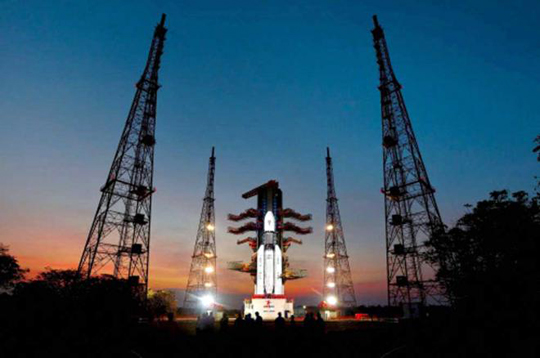
ISRO launches GSLV Mark III with GSAT-19 communication satellite

June 5, 2017

Chennai, Jun 5: Taking a big leap forward in the space technology, the Indian Space Research Organisation (ISRO) successfully launched its heaviest rocket GSLV-Mk-III carrying communication satellite at country's spaceport in Sriharikota near here.

sat

GSLV-Mk-III, the first of its kind mission, is capable launching four ton class of satellites to Geosynchronous Transfer Orbit (GTO). The GSLV rocket is the first developmental flight, carrying 3,136 kg GSAT-19 satellite to a GTO.

The GSLV rocket took off from the second launch pad at SDSC SHAR in Sriharikota about 90 kilometres from north Chennai at 5.28 pm. After about 16 minutes into its flight, the rocket successfully placed GSAT-19 in its intended orbit.

Soon after the GSLV-Mk-III mission success Indian Space Research Organisation (ISRO) Chairman A.S.Kiran Kumar said it was a historic day.

Stating that the heavy rocket was designed in 2002, Kiran Kumar said that after a gap of 15 years, the ISRO team were able to achieve the successful launch of GSLV-Mk-III.

He congratulated the entire ISRO team which worked hard on the GSLV mission.

ISRO sources said that the design and development of GSLV Mk III is based on ISRO's rich experience in handling solid, liquid and cryogenic rocket propulsion technologies. The first suborbital test flight of GSLV Mk- III was successfully conducted on December 18, 2014.

GSAT-19 satellite with a lift-off mass of 3136 kg, is the communication satellite of India, configured around the ISRO"s standard I-3K bus.

GSAT-19 carries Ka/Ku-band high throughput communication transponders. Besides, it carries a Geostationary Radiation Spectrometer (GRASP) payload to monitor and study the nature of charged particles and the influence of space radiation on satellites and their electronic components.

GSAT-19 also features certain advanced spacecraft technologies including miniaturised heat pipe, fibre optic gyro, Micro Electro-Mechanical Systems (MEMS) accelerometer, Ku-band TTC transponder, as well an indigenous Lithium-ion Battery.

Comments

Add new comment

  • Coastaldigest.com reserves the right to delete or block any comments.
  • Coastaldigset.com is not responsible for its readers’ comments.
  • Comments that are abusive, incendiary or irrelevant are strictly prohibited.
  • Please use a genuine email ID and provide your name to avoid reject.
Agencies
June 8,2020

Washington DC, Jun 8: Astronomers acting on a hunch have likely resolved a mystery about young, still-forming stars and regions rich in organic molecules closely surrounding some of them.

They used the National Science Foundation's Karl G Jansky Very Large Array (VLA) to reveal one such region that previously had eluded detection and that revelation answered a longstanding question.

The regions around the young protostars contain complex organic molecules which can further combine into prebiotic molecules that are the first steps on the road to life.

The regions, dubbed "hot corinos" by astronomers, are typically about the size of our solar system and are much warmer than their surroundings, though still quite cold by terrestrial standards.

The first hot corino was discovered in 2003 and only about a dozen have been found so far. Most of these are in binary systems, with two protostars forming simultaneously.

Astronomers have been puzzled by the fact that, in some of these binary systems, they found evidence for a hot corino around one of the protostars but not the other.

"Since the two stars are forming from the same molecular cloud and at the same time, it seemed strange that one would be surrounded by a dense region of complex organic molecules and the other wouldn't," said Cecilia Ceccarelli, of the Institute for Planetary Sciences and Astrophysics at the University of Grenoble (IPAG) in France.

The complex organic molecules were found by detecting specific radio frequencies, called spectral lines, emitted by the molecules. Those characteristic radio frequencies serve as "fingerprints" to identify the chemicals.

The astronomers noted that all the chemicals found in hot corinos had been found by detecting these "fingerprints" at radio frequencies corresponding to wavelengths of only a few millimetres.

"We know that dust blocks those wavelengths, so we decided to look for evidence of these chemicals at longer wavelengths that can easily pass through dust," said Claire Chandler of the National Radio Astronomy Observatory, and principal investigator on the project.

"It struck us that dust might be what was preventing us from detecting the molecules in one of the twin protostars," added Chandler.

The astronomers used the VLA to observe a pair of protostars called IRAS 4A, in a star-forming region about 1,000 light-years from Earth. They observed the pair at wavelengths of centimetres.

At those wavelengths, they sought radio emissions from methanol, CH3OH (wood alcohol, not for drinking). This was a pair in which one protostar clearly had a hot corino and the other did not, as seen using the much shorter wavelengths.

The result confirmed their hunch. "With the VLA, both protostars showed strong evidence of methanol surrounding them. This means that both protostars have hot corinos. The reason we did not see the one at shorter wavelengths was because of dust," said Marta de Simone, a graduate student at IPAG who led the data analysis for this object.

The astronomers cautioned that while both hot corinos now are known to contain methanol, there still may be some chemical differences between them. That, they said, can be settled by looking for other molecules at wavelengths not obscured by dust.

"This result tells us that using centimetre radio wavelengths is necessary to properly study hot corinos," Claudio Codella of Arcetri Astrophysical Observatory in Florence, Italy, said.

"In the future, planned new telescopes such as the next-generation VLA and SKA, will be very important to understanding these objects," added Codella.

Comments

Add new comment

  • Coastaldigest.com reserves the right to delete or block any comments.
  • Coastaldigset.com is not responsible for its readers’ comments.
  • Comments that are abusive, incendiary or irrelevant are strictly prohibited.
  • Please use a genuine email ID and provide your name to avoid reject.
Agencies
June 24,2020

New Delhi, Jun 24: The Centre has made it mandatory for sellers to enter the 'Country of Origin' while registering all new products on government e-marketplace (GeM).

The e-marketplace is a special purpose vehicle (SPV) under the Ministry of Commerce and Industry which facilitates the entry of small local sellers in public procurement, while implementing 'Make in India' and MSE Purchase Preference Policies of the Centre.

Accordingly, the ministry said the move has been made to promote 'Make in India' and 'Atma Nirbhar Bharat'.

The provision has been enabled via the introduction of new features on GeM.

Besides the registration process, the new feature also reminds sellers who have already uploaded their products, to disclose their products' 'Country of Origin' details.

The ministry further said that failing to disclose the detail will lead to removal of the products from the e-marketplace.

"GeM has taken this significant step to promote 'Make in India' and 'Aatmanirbhar Bharat'," the ministry said in a statement.

"GeM has also enabled a provision for indication of the percentage of local content in products. With this new feature, now, the 'Country of Origin' as well as the local content percentage are visible in the marketplace for all items. More importantly, the 'Make in India' filter has now been enabled on the portal. Buyers can choose to buy only those products that meet the minimum 50 per cent local content criteria."

In case of bids, the ministry said that buyers can now reserve any bid for a "Class I Local suppliers. For those bids below Rs 200 crore, only Class I and Class II Local Suppliers are eligible to bid, with Class I supplier getting purchase preference".

In addition to this, the Department for Promotion of Industry and Internal Trade (DPIIT) has reportedly called for a meeting with all e-commerce companies such as Amazon and Flipkart to display the country of origin on the products sold on their platform, as well as the extent of value added in India.

Comments

Add new comment

  • Coastaldigest.com reserves the right to delete or block any comments.
  • Coastaldigset.com is not responsible for its readers’ comments.
  • Comments that are abusive, incendiary or irrelevant are strictly prohibited.
  • Please use a genuine email ID and provide your name to avoid reject.
Agencies
March 8,2020

Consumer watchdog Which? has claimed that more than one billion Android phones and tablets are vulnerable to hackers as they no longer supported by security updates.

According to the research report, the most at-risk phones are any that run Android 4 or older and those smartphones running Android 7.0 which can not be updated are also at risk.

Based on data from Google analysed by Which?, two in five android device users around the world are no longer receiving the important updates. Currently, those devices are unlikely to have issues, but the lack of security leaves them open to attack.

"It is very concerning that expensive Android devices have such a short shelf life before they lose security support, leaving millions of users at risk of serious consequences if they fall victim to hackers," Kate Bevan editor Which? said in a statement.

"Google and phone manufacturers need to be upfront about security updates with clear information about how long they will last and what customers should do when they run out. The government must also push ahead with planned legislation to ensure manufacturers are far more transparent about security updates for smart devices and their impact on consumers," Kate added.

Android phone released around 2012 or earlier, including popular models like the Samsung Galaxy S3 and Sony Xperia S, are particularly at risk to hackers.

Which? has made suggestions to Android users on what to consider if they have an older phone that may be at risk.

Any Android device which is more than two years old, check whether it can be updated to a newer version of the operating system. If it is on an earlier version than Android 7.0 Nougat, try to update via Settings> System>Advanced System update.

In case a user is not able tto update the phone, the device could be at risk of being hacked if it is running a version of Android 4 or lower.

A user also need to be careful about downloading apps outside the Google Play store and should also install a mobile anti-virus via an app.

Comments

Add new comment

  • Coastaldigest.com reserves the right to delete or block any comments.
  • Coastaldigset.com is not responsible for its readers’ comments.
  • Comments that are abusive, incendiary or irrelevant are strictly prohibited.
  • Please use a genuine email ID and provide your name to avoid reject.