


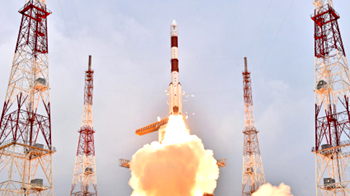
ISRO launches record 20 satellites in one go

June 22, 2016

satellites1

Sriharikota (AP), Jun 22: Setting a record in its space programme, India today successfully launched 20 satellites, including its earth observation Cartosat-2 series, in a single mission on board ISRO's workhorse PSLV-C34 from the spaceport here.

In a precision launch, PSLV-C34 took off from the second launch pad of Satish Dhawan Space Centre here, about 110 km from Chennai at 9.26 AM and placed the Cartosat-2 Series and 19 others in the designated polar Sun Synchronous Orbit (SSO) about 30 minutes later in clear skies.

The 727.5 kg Cartosat-2 series satellite will provide regular remote sensing services with its panchromatic and multispectral cameras and its imagery will be of multiple use.

Of the 19-satellites, 12 are earth imaging "Dove satellites" of USA and another American satellite. The rest are from Canada (two) and one each from Germany and Indonesia.

Two academic satellites are from Sathyabama University (Sathyabamasat) in Chennai and from College of Engineering (Swayam) at Pune.

Use of Cartosat 2 includes cartographic, urban and rural applications, coastal land use and regulation, utility management like road network monitoring and water distribution.

Also, creation of land use maps, precision study,change detection to bring out geographical and man-made features and various other Land Information System and Geographical Information System applications can be done. It is similar to the earlier Cartosat-2, 2A and 2B.

Prime Minister Narendra Modi congratulated ISRO and described today's launch as a "monumental" accomplishment.

"20 satellites in a go! @ isro continues to break new barriers. hearty congratulations to our scientists on the monumental accomplishment', he said on Twitter.

ISRO Chairman A S Kiran Kumar congratulated his team for the successful launch 'in a record time' and said "PSLV C-34 has done its job."

"We have the current generation of earth observation satellite of Cartosat 2 series," he said, adding ISRO had done a "wonderful job".

P Kunhikrishnan, Director, SDSC-SHAR, said that it was a major accomplishment by PSLV in its 35th consecutive successful mission.

"PSLV has become a success symbol for ISRO and India. ISRO is adopting more and more professionalism," he said.

D Jayakumar, Mission Director,described today's launch as a major landmark and said that the vehicle performance was "exceedingly well."

With today's launch of 20 satellites, PSLV beat its 2008 record when it placed in orbit 10 satellites in a single launch into various Low Earth Orbits.

This is the 14th flight of PSLV in "XL" configuration known for its capacity to carry more load which uses 'solid strap-on motors'.

The total weight of all the 20 satellites carried onboard PSLV-C34 is about 1288 kg.

India has 11 operational earth observation satellites, including RESOURCESAT-1 and 2, CARTOSAT-1, 2, 2A, 2B, RISAT-1 and 2, OCEANSAT-2 are in orbit.

Beginning in 1988, ISRO had launched many remote sensing satellites (for earth observation) and the data are for varied use including agriculture, water and ocean resources besides disaster management.

Comments

Add new comment

  • Coastaldigest.com reserves the right to delete or block any comments.
  • Coastaldigset.com is not responsible for its readers’ comments.
  • Comments that are abusive, incendiary or irrelevant are strictly prohibited.
  • Please use a genuine email ID and provide your name to avoid reject.
News Network
January 22,2020

Jan 22: Microsoft Corp’s chief executive officer said he worries that mistrust between the US and China will increase technology costs and hurt economic growth at a critical time.

Using the $470 billion semiconductor industry as an example of a sector that is already globally interconnected, Satya Nadella said the two countries will have to find ways to work together, rather than creating different supply chains for each country.

“All you are doing is increasing transaction costs for everybody if you completely separate,” Nadella said in an interview with Bloomberg News Editor-in-Chief John Micklethwait at Bloomberg’s The Year Ahead conference in Davos. That’s a concern as the executive said the world is on the cusp of a revolution around technology and artificial intelligence.

“If we take steps back in trust or increase transaction costs around technology, all we are doing is sacrificing global economic growth,” he said.

The agreement signed last week between the US and China was “not sufficient,” said Nadella, but represented “progress” on the issue of intellectual property protections for US technology companies working with China.

Nadella said he worries about the development of two separate internets, noting that to some degree they already exist “and they will get amplified in the future” with massive technology companies already in place in China.

The viewpoint clashes with Microsoft co-founder Bill Gates, who has been sceptical about the idea that ongoing US-China trade tensions could ever lead to a bifurcated system of two internets.

China and the US are the two leading AI superpowers, however the cooling political relations between them have slowed the international collaboration.

Nadella also warned that countries that fail to attract immigrants will lose out as the global tech industry continues to grow. The CEO has previously voiced concern about India’s Citizenship Amendment Act, calling it “sad.”

“However, Nadella said he remained hopeful.

“The fact that there is a 70-year history of nation-building, I think it’s a very strong foundation. I grew up in that country. I’m proud of that heritage. I’m influenced by that experience.”

Comments

Add new comment

  • Coastaldigest.com reserves the right to delete or block any comments.
  • Coastaldigset.com is not responsible for its readers’ comments.
  • Comments that are abusive, incendiary or irrelevant are strictly prohibited.
  • Please use a genuine email ID and provide your name to avoid reject.
News Network
April 27,2020

New Delhi, Apr 27: A private hospital here claimed that a coronavirus patient, who was administered plasma therapy for the first time in the facility, was discharged on Sunday after being completely cured.

The 49-year-old man had tested positive for COVID-19 on April 4 and was admitted to Max Hospital, Saket, it said in a statement.

As his condition deteriorated, he was put on ventilator support on April 8, the hospital added.

When the patient showed no signs of improvement, his family requested for administration of plasma therapy on compassionate grounds, it said, adding that the family arranged a donor for extracting plasma.

The patient was administered fresh plasma as a treatment modality as a side-line to standard treatment protocols on the night of April 14, the statement said.

Subsequently, the patient showed improvement and by the fourth day, was weaned off ventilator support and continued on supplementary oxygen. He was shifted to a room with round-the-clock monitoring on Monday after testing negative twice within 24 hours, it said.

He has now fully recovered and was discharged, the hospital said, adding that he will stay at home for another two weeks.

Group medical director of Max Healthcare and senior director of the Institute of Internal Medicine Dr Sandeep Budhiraja said, "We can say that plasma therapy could have worked as a catalyst in speeding up his recovery. We cannot attribute 100 per cent recovery to plasma therapy only, as there are multiple factors which carved his path to recovery."

Comments

Add new comment

  • Coastaldigest.com reserves the right to delete or block any comments.
  • Coastaldigset.com is not responsible for its readers’ comments.
  • Comments that are abusive, incendiary or irrelevant are strictly prohibited.
  • Please use a genuine email ID and provide your name to avoid reject.
News Network
May 15,2020

New Delhi, May 15: A group of doctors from the AIIMS, Raipur has recommended restrictions on the use of mobile phones in healthcare institutions amid the COVID-19 pandemic, warning that such devices can be a potential carrier of the virus and lead to infection among healthcare workers.

In a commentary published in the BMJ Global Health journal, the doctors stated that mobile phone surfaces are a peculiar 'high-risk' surface, which can directly come in contact with the face or mouth, even if hands are properly washed and one study indicates that some healthcare workers use phones every 15 minutes to two hours.

Though there have been many significant guidelines from various health organisations like the WHO and CDC focusing on prevention and control of disease, the commentary highlighted "there is no mention of or focus on mobile phones in these guidelines, including the WHO infection control and prevention guidelines, which recommends the use of handwashing".

In healthcare facilities, phones are used to communicate with other health care workers, look up recent medical guidelines, research drug interactions, understand adverse events and side effects, conduct telemedicine appointments and track patients among others, stated the document.

The document has been authored by Dr Vineet Kumar Pathak, Dr Sunil Kumar Panigrahi, Dr M Mohan Kumar, Dr Utsav Raj and Dr Karpaga Priya P from the Department of Community and Family Medicine.

"In their tendency to come in direct contact with the face, nose or eyes in healthcare settings, mobile phones are perhaps second only to masks, caps or goggles," the authors said.

"However, they are neither disposable nor washable like these other three, thus warranting disinfection. Mobile phones can effectively negate hand hygiene... There is growing evidence that mobile phones are a potential vector for pathogenic organisms," they said.

It is the need of the hour to address proper hygienic use of mobile phones in healthcare settings. In a study in India, almost 100 per cent of health workers of a tertiary care hospital used mobile phones in the hospital, but only 10 per cent of them had at any time wiped their mobile phones clean, the commentary published on April 22 said.

"The safest thing to do is to consider your phone as an extension of your hand, so remember you are transferring whatever is on your phone to your hand," Dr Pathak said.

Amidst the ongoing pandemic, two biggest mobile phone companies have uploaded their user support guidelines, saying that 70 pc isopropyl alcohol or Clorox Disinfecting Wipes can be used to gently wipe the exterior surface of phones in switched-off mode.

However, in doing so, the use of bleach or entry of moisture through any of the openings must be avoided, and any harsh chemical may damage the oleophobic screen, leading to damage in the touch screen sensitivity of the phone, the article stated.

Mobile phones are one of the most highly touched surfaces according to the Centers for Disease Control and Prevention (CDC), along with counters, tabletops, doorknobs, bathroom fixtures, toilets, keyboards, tablets and bedside tables.

The doctors recommended restriction on mobile phone usage in healthcare settings like hospital wards, ICUs and operation theatres, while advocating the use of headphones to prevent contact with the face while talking.

There should be no sharing of mobile phones, headphones or headsets of any kind. In addition, where available, the use of interdepartmental intercom facility may be promoted.

"Although hand hygiene and mobile phone use by a person are not mutually exclusive, it is high time to acknowledge the potential role of mobile phones in disease transmission cascade and to take evidence-based appropriate actions. This is especially important, given the ongoing COVID-19 pandemic," the authors said.

They said it is necessary for government agencies and the WHO to generate public awareness and to formulate suitable information, education and communication material on mobile phone hygiene, especially in healthcare settings.

AIIMS, New Delhi, Resident Doctors' Association (RDA) General Secretary, Dr Srinivas Rajkumar T said even outside health care settings, people should pay special attention to the usage of mobile phones as they carry them to all places.

"Phone and computer peripherals like keyboard, mouse, etc. should be covered with transparent plastic covers which can be cleaned without interfering with their function. Cleaning hands by soap or alcohol-based hand sanitizer before and after contact with phone and between contact with other surfaces can decrease the risk of potential transmission.

"Using a handsfree headset, dedicated operator/assistant per ward handling the communication via common line in hospitals while on duty can enable communication without compromising safety," Dr Srinivas said.

Comments

Add new comment

  • Coastaldigest.com reserves the right to delete or block any comments.
  • Coastaldigset.com is not responsible for its readers’ comments.
  • Comments that are abusive, incendiary or irrelevant are strictly prohibited.
  • Please use a genuine email ID and provide your name to avoid reject.