


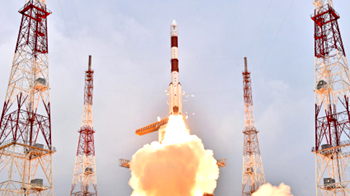
ISRO launches record 20 satellites in one go

June 22, 2016

satellites1

Sriharikota (AP), Jun 22: Setting a record in its space programme, India today successfully launched 20 satellites, including its earth observation Cartosat-2 series, in a single mission on board ISRO's workhorse PSLV-C34 from the spaceport here.

In a precision launch, PSLV-C34 took off from the second launch pad of Satish Dhawan Space Centre here, about 110 km from Chennai at 9.26 AM and placed the Cartosat-2 Series and 19 others in the designated polar Sun Synchronous Orbit (SSO) about 30 minutes later in clear skies.

The 727.5 kg Cartosat-2 series satellite will provide regular remote sensing services with its panchromatic and multispectral cameras and its imagery will be of multiple use.

Of the 19-satellites, 12 are earth imaging "Dove satellites" of USA and another American satellite. The rest are from Canada (two) and one each from Germany and Indonesia.

Two academic satellites are from Sathyabama University (Sathyabamasat) in Chennai and from College of Engineering (Swayam) at Pune.

Use of Cartosat 2 includes cartographic, urban and rural applications, coastal land use and regulation, utility management like road network monitoring and water distribution.

Also, creation of land use maps, precision study,change detection to bring out geographical and man-made features and various other Land Information System and Geographical Information System applications can be done. It is similar to the earlier Cartosat-2, 2A and 2B.

Prime Minister Narendra Modi congratulated ISRO and described today's launch as a "monumental" accomplishment.

"20 satellites in a go! @ isro continues to break new barriers. hearty congratulations to our scientists on the monumental accomplishment', he said on Twitter.

ISRO Chairman A S Kiran Kumar congratulated his team for the successful launch 'in a record time' and said "PSLV C-34 has done its job."

"We have the current generation of earth observation satellite of Cartosat 2 series," he said, adding ISRO had done a "wonderful job".

P Kunhikrishnan, Director, SDSC-SHAR, said that it was a major accomplishment by PSLV in its 35th consecutive successful mission.

"PSLV has become a success symbol for ISRO and India. ISRO is adopting more and more professionalism," he said.

D Jayakumar, Mission Director,described today's launch as a major landmark and said that the vehicle performance was "exceedingly well."

With today's launch of 20 satellites, PSLV beat its 2008 record when it placed in orbit 10 satellites in a single launch into various Low Earth Orbits.

This is the 14th flight of PSLV in "XL" configuration known for its capacity to carry more load which uses 'solid strap-on motors'.

The total weight of all the 20 satellites carried onboard PSLV-C34 is about 1288 kg.

India has 11 operational earth observation satellites, including RESOURCESAT-1 and 2, CARTOSAT-1, 2, 2A, 2B, RISAT-1 and 2, OCEANSAT-2 are in orbit.

Beginning in 1988, ISRO had launched many remote sensing satellites (for earth observation) and the data are for varied use including agriculture, water and ocean resources besides disaster management.

Comments

Add new comment

  • Coastaldigest.com reserves the right to delete or block any comments.
  • Coastaldigset.com is not responsible for its readers’ comments.
  • Comments that are abusive, incendiary or irrelevant are strictly prohibited.
  • Please use a genuine email ID and provide your name to avoid reject.
News Network
February 14,2020

London, Feb 14: Liquor tycoon Vijay Mallya once again asked the Indian banks to take back 100 per cent of the principal amount owed to them at the end of his three-day British High Court appeal on Thursday against an extradition order to India.

The 64-year-old former Kingfisher Airlines boss, wanted in India on charges of fraud and money laundering amounting to an alleged Rs 9,000 crores in unpaid bank loans, said the Enforcement Directorate (ED) and the Central Bureau of Investigation (CBI) are fighting over the same assets and not treating him reasonably in the process.

“I request the banks with folded hands, take 100 per cent of your principal back, immediately,” he said outside the Royal Courts of Justice in London.

“The Enforcement Directorate attached the assets on the complaint by the banks that I was not paying them. I have not committed any offenses under the PMLA (Prevention of Money Laundering Act) that the Enforcement Directorate should suo moto attach my assets," he said.

"I am saying, please banks take your money. The ED is saying no, we have a claim over these assets. So, the ED on the one side and the banks on the other are fighting over the same assets,” he added.

Asked about heading back to India, he noted: “I should be where my family is, where my interests are.

"If the CBI and the ED are going to be reasonable, it’s a different story. What all they are doing to me for the last four years is totally unreasonable.”

Lord Justice Stephen Irwin and Justice Elisabeth Laing, the two-member bench presiding over the appeal, concluded hearing the arguments in the case and said they will be handing down their verdict at a later date after considering the oral as well as written submissions in the “very dense” case over the next few weeks.

On a day of heated arguments between Mallya’s barrister, Clare Montgomery, and Crown Prosecution Service (CPS) counsel Mark Summers, arguing on behalf of the Indian government, both sides clashed over the prima facie case of fraud and deception against Mallya.

“We submit that he lied to get the loans, then did something with the money he wasn’t supposed to and then refused to give back the money. All this could be perceived by a jury as patently dishonest conduct,” said Summers.

“What they [Kingfisher Airlines] were saying [to the banks] about profitability going forward was knowingly wrong,” he said, as he took the High Court through evidence to counter Mallya’s lawyers’ claims that Westminster Magistrates Court Judge Emma Arbuthnot had fallen into error when she found a case to answer in the Indian courts against Mallya.

Mallya, who remains on bail on an extradition warrant, is not required to attend the hearings but has been in court to observe the proceedings since the three-day appeal opened on Tuesday. A key defence to disprove a prima facie case of fraud and misrepresentation on his part has revolved around the fact that Kingfisher Airlines was the victim of economic misfortune alongside other Indian airlines.

However, the CPS has argued that “there is enough in the 32,000 pages of overall evidence to fulfil the [extradition] treaty obligations that there is a case to answer”. “There is not just a prima facie case but overwhelming evidence of dishonesty… and given the volume and depth of evidence the District Judge [Arbuthnot] had before her, the judgment is comprehensive and detailed with the odd error but nothing that impacts the prima facie case,” said Summers.

At the start of the appeal, Mallya’s counsel claimed Arbuthnot did not look at all of the evidence because if she had, she would not have fallen into the multiple errors that permeate her judgment. The High Court must establish if the magistrates’ court had in fact fallen short on a point of law in its verdict in favour of extradition.

Representatives from the Enforcement Directorate (ED) and Central Bureau of Investigation (CBI), as well as the Indian High Commission in London, have been present in court to take notes during the course of the appeal hearing.

Mallya had received permission to appeal against his extradition order signed off by former UK home secretary Sajid Javid last February only on one ground, which challenges the Indian government's prima facie case against him of fraudulent intentions in acquiring bank loans.

At the end of a year-long extradition trial at Westminster Magistrates’ Court in London in December 2018, Judge Arbuthnot had found “clear evidence of dispersal and misapplication of the loan funds” and accepted a prima facie case of fraud and a conspiracy to launder money against Mallya, as presented by the CPS on behalf of the Indian government.

Mallya remains on bail since his arrest on an extradition warrant in April 2017 involving a bond worth 650,000 pounds and other restrictions on his travel while he contests that ruling.

Comments

Add new comment

  • Coastaldigest.com reserves the right to delete or block any comments.
  • Coastaldigset.com is not responsible for its readers’ comments.
  • Comments that are abusive, incendiary or irrelevant are strictly prohibited.
  • Please use a genuine email ID and provide your name to avoid reject.
News Network
June 25,2020

India has jumped past 4.5 lakh coronavirus cases and 14,476 people have succumbed to the viral infection so far. In this backdrop, speaking to IANS in an exclusive interview, AIIMS Director Randeep Guleria said India is also vulnerable to second wave of coronavirus and people should continue to follow social distancing, wearing mask and other precautions, after cases begin to decline.

He added that in order to contain the outbreak of Covid-19, a limited lockdown in hotspots, where volume of cases is very high, may be considered along with a micro-plan to prevent leakage of cases from these areas to other non-containment areas. Excerpts of the interview are below:

Q: Reports say China and South Korea are witnessing a second wave of coronavirus infection, what is this second wave, is India also vulnerable to this?

A: When cases come down significantly, people tend to drop their guard against the viral infection, and this leads to the second wave (which means a sudden increase in the number of cases). After cases begin to decline, people should continue to follow the precautions -- continue to maintain social distancing and wear masks regularly. See what happened in Singapore, it was struck by a second wave of coronavirus. Look, what happened in the 1918 pandemic, people dropped their guard and the second wave of viral infection struck back. If people do not follow social distancing then the spike in cases is apparent. We need to take these precautions at least for one year. India is also vulnerable to this second wave.

Q: If Covid-19 cases continue to rise rapidly, do you think we need another lockdown in areas where volume of cases are very high?

A: A large volume of cases is concentrated in specific areas like hotspots, and in order to maintain things in order, we may need a limited lockdown in these areas. This should be followed by a micro-plan which entails extensive testing of people and also extensive contact tracing of people who have got in touch with positive people. Need to ensure there is no leakage of cases from these areas. People from these areas should not mix with others in non-containment areas. This will aid in containing the outbreak of the virus. People who have developed symptoms should get themselves tested, especially in the containment areas.

Q: With more than 4.5 lakh cases and close to 14,500 deaths, do you think India has reached its peak and a decline in cases is prominent?

A: The cases will continue to increase for some time. The doubling time of cases has also increased. But, the cases will also begin to flatten. Though, it is difficult to give an exact time period in this viral infection, it seems, the growth in cases will flatten in the end of July or beginning of August. A decline will come to this viral infection, but it does not mean that people should drop their guard. As a measure, we need to decrease community participation and citizens should continue to follow social distancing. People should get themselves tested. All these efforts will help in preventing people from contracting this virus. These precautions will also prevent us from the second wave, and we must continue to take precautions. The virus has not gone away, it is still lurking.

Q: India has crossed the 4.5 lakh coronavirus cases so far, although our recovery rate is good, but still 10,000 to 15,000 cases are reported daily. Why do cases continue to spiral, what is the reason?

A: We have to remember a few things -- the bulk of cases are in 10 cities, nearly 70 per cent, and if we take into account cases per million population, the number is not very high, as compared with countries including countries in Europe. Many European countries put together still do not add up to the Indian population. Do not compare India to countries like Italy, Spain etc. We need to focus on hotspots, which contribute to between 70 -80 per cent of cases, and we have to identify cases in these areas at an early stage. The population density is very high in these cities. People in lower socio-economic status are highly vulnerable to the viral infection, as many live together in small spaces and there is a lot of mixing of people happening there. Look at the market places, people are not following social distancing and not wearing masks. In fact, many are in close vicinity of each other.

Comments

Add new comment

  • Coastaldigest.com reserves the right to delete or block any comments.
  • Coastaldigset.com is not responsible for its readers’ comments.
  • Comments that are abusive, incendiary or irrelevant are strictly prohibited.
  • Please use a genuine email ID and provide your name to avoid reject.
Agencies
July 15,2020

New Delhi, Jul 15: Air India has started the process of identifying employees, based on various factors like efficiency, health and redundancy, who will be sent on compulsory leave without pay (LWP) for up to five years, according to an official order.

The airline's board of directors have authorised its Chairman and Managing Director Rajiv Bansal to send employees on LWP "for six months or for a period of two years extendable upto five years, depending upon the following factors - suitability, efficiency, competence, quality of performance, health of the employee, instance of non-availability of the employee for duty in the past as a result of ill health or otherwise and redundancy", the order said on Tuesday.

The departmental heads in the headquarter as well as regional directors are required to assess each employee "on the above mentioned factors and identify the cases where option of compulsory LWP can be exercised", stated the order dated July 14.

"Names of such employees need to be forwarded to the General Manager (Personnel) in headquarter for obtaining necessary approval of CMD," the order added.

In response to queries regarding this matter, Air India spokesperson said,"We would not like to make any comment on the issue."

Aviation sector has been significantly impacted due to the travel restrictions imposed in India and other countries due to the coronavirus pandemic. All airlines in India have taken cost-cutting measures such as pay cuts, LWP and firings of employees in order to conserve cash flow.

For example, GoAir has put most of its employees on compulsory LWP since April.

India resumed domestic passenger flights from May 25 after a gap of two months due to the coronavirus pandemic.

However, the airlines have been allowed to operate only a maximum of 45 per cent of their pre-COVID domestic flights. Occupancy rate in Indian domestic flights has been around 50-60 per cent since May 25.

Scheduled international passenger flights continue to remain suspended in India since March 23.

The passenger demand for air travel will contract by 49 per cent in 2020 for Indian carriers in comparison to 2019 due to COVID-19 crisis, said global airlines body IATA on Monday.

Comments

Add new comment

  • Coastaldigest.com reserves the right to delete or block any comments.
  • Coastaldigset.com is not responsible for its readers’ comments.
  • Comments that are abusive, incendiary or irrelevant are strictly prohibited.
  • Please use a genuine email ID and provide your name to avoid reject.