



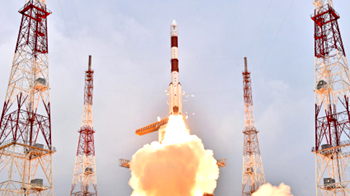
ISRO launches record 20 satellites in one go

June 22, 2016

satellites1

Sriharikota (AP), Jun 22: Setting a record in its space programme, India today successfully launched 20 satellites, including its earth observation Cartosat-2 series, in a single mission on board ISRO's workhorse PSLV-C34 from the spaceport here.

In a precision launch, PSLV-C34 took off from the second launch pad of Satish Dhawan Space Centre here, about 110 km from Chennai at 9.26 AM and placed the Cartosat-2 Series and 19 others in the designated polar Sun Synchronous Orbit (SSO) about 30 minutes later in clear skies.

The 727.5 kg Cartosat-2 series satellite will provide regular remote sensing services with its panchromatic and multispectral cameras and its imagery will be of multiple use.

Of the 19-satellites, 12 are earth imaging "Dove satellites" of USA and another American satellite. The rest are from Canada (two) and one each from Germany and Indonesia.

Two academic satellites are from Sathyabama University (Sathyabamasat) in Chennai and from College of Engineering (Swayam) at Pune.

Use of Cartosat 2 includes cartographic, urban and rural applications, coastal land use and regulation, utility management like road network monitoring and water distribution.

Also, creation of land use maps, precision study,change detection to bring out geographical and man-made features and various other Land Information System and Geographical Information System applications can be done. It is similar to the earlier Cartosat-2, 2A and 2B.

Prime Minister Narendra Modi congratulated ISRO and described today's launch as a "monumental" accomplishment.

"20 satellites in a go! @ isro continues to break new barriers. hearty congratulations to our scientists on the monumental accomplishment', he said on Twitter.

ISRO Chairman A S Kiran Kumar congratulated his team for the successful launch 'in a record time' and said "PSLV C-34 has done its job."

"We have the current generation of earth observation satellite of Cartosat 2 series," he said, adding ISRO had done a "wonderful job".

P Kunhikrishnan, Director, SDSC-SHAR, said that it was a major accomplishment by PSLV in its 35th consecutive successful mission.

"PSLV has become a success symbol for ISRO and India. ISRO is adopting more and more professionalism," he said.

D Jayakumar, Mission Director,described today's launch as a major landmark and said that the vehicle performance was "exceedingly well."

With today's launch of 20 satellites, PSLV beat its 2008 record when it placed in orbit 10 satellites in a single launch into various Low Earth Orbits.

This is the 14th flight of PSLV in "XL" configuration known for its capacity to carry more load which uses 'solid strap-on motors'.

The total weight of all the 20 satellites carried onboard PSLV-C34 is about 1288 kg.

India has 11 operational earth observation satellites, including RESOURCESAT-1 and 2, CARTOSAT-1, 2, 2A, 2B, RISAT-1 and 2, OCEANSAT-2 are in orbit.

Beginning in 1988, ISRO had launched many remote sensing satellites (for earth observation) and the data are for varied use including agriculture, water and ocean resources besides disaster management.

Comments

Add new comment

  • Coastaldigest.com reserves the right to delete or block any comments.
  • Coastaldigset.com is not responsible for its readers’ comments.
  • Comments that are abusive, incendiary or irrelevant are strictly prohibited.
  • Please use a genuine email ID and provide your name to avoid reject.
News Network
March 29,2020

Mumbai, Mar 29: Virologist Minal Dakhave Bhosale led from the front to create India's first coronavirus testing kit even when she was in the last stage of her pregnancy.

Bhosale's efforts paid the price with her team delivering the testing kit in a record time of six weeks.

Bhosale gave birth to a baby girl just a day before submitting the kit to the authorities for evaluation.

"It was like giving birth to two babies," Bhosale told PTI over the phone.

The virologist said both the journeys - that happened in parallel - were not without challenges.

"There were complications in the pregnancy while work on the test kit was on. The baby was delivered through cesarean," she said.

Bhosale said she felt that it was the right time to serve the people to help them in combating the coronavirus threat.

"I had been working for five years in this field and if I don't work in emergency situations when my services are needed the most, then what is the use?" she said.

Though Bhosale was not able to visit the office due to the pregnancy, she was guiding a team of 10 persons working on the project at Mylab Discovery in Pune.

The strong bonds forged with the team over the years and their support made it possible, she said.

Company's co-founder Shrikant Patole said just like drug discovery, test kits too go through a lot of quality checks to improve the precision.

He credited Bhosale for the success of the project.

The COVID-19 testing kit delivered by Bhosale's team will reduce the time taken for delivering a result to 2.5 hours from the prevalent practice of eight hours.

A pioneering approach to testing without compromising on the results was adopted, Bhosale said.

The Maylab test kit will cost Rs1,200, a quarter of Rs 4,500 per kit that the government has been spending on testing so far.

"I'm happy that I could do something for the country," Bhosale said.

As of Friday, only 27,000 of the 1.3 billion people were tested for the virus in the country.

According to experts, high scale testing is essential because it alone can ensure an early diagnosis of COVID-19 and lower down the fatalities.

The company is confident of ramping up the capacity at its plant in Lonavala to deliver 100,000 kits a week, Patole said.

He said the authorities are helping the company, including giving priority for shipping of the raw materials.

Comments

Add new comment

  • Coastaldigest.com reserves the right to delete or block any comments.
  • Coastaldigset.com is not responsible for its readers’ comments.
  • Comments that are abusive, incendiary or irrelevant are strictly prohibited.
  • Please use a genuine email ID and provide your name to avoid reject.
coastaldigest.com news network
August 8,2020

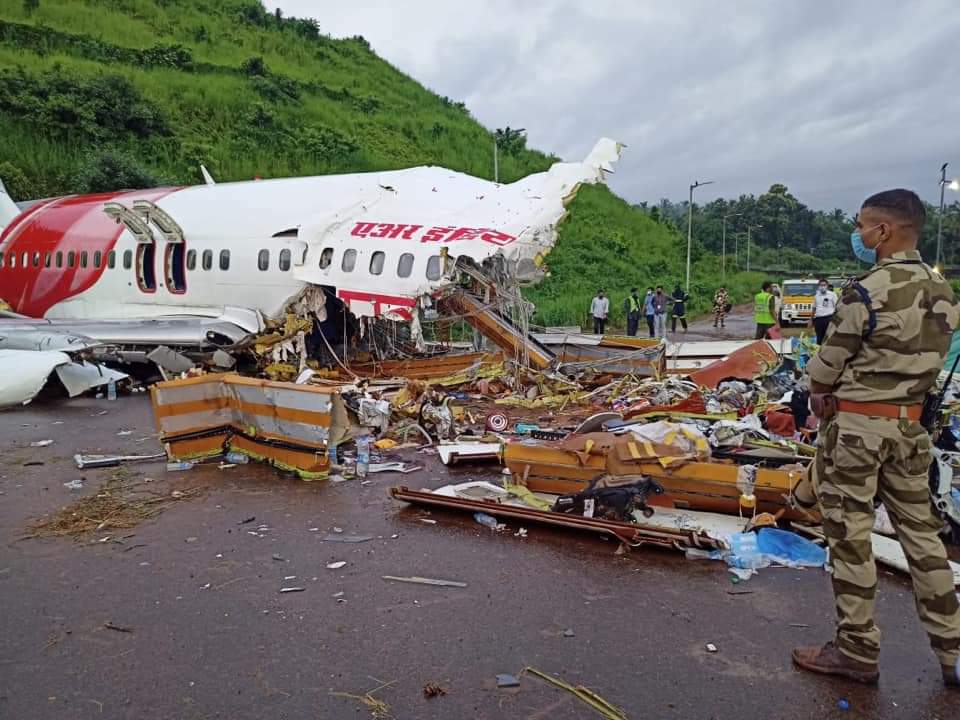
Kozhikode, Aug 8: A tailwind or crosswind could be the reason for the Air India Express flight mishap at Kozhikode international airport in Kerala, according to some aviation experts. 

Team of DGCA and AIE already reached the spot. With the death of the captain and co-pilot in the mishap, the investigation would be focusing mainly on the voice recorders and other technical aspects.

It is learnt that the ill-fated aircraft, IX 1344 with 190 onboard including crew, was initially planning to land on runway-28 of the airport. But later the pilot opted runway-10 which is toward the other direction. Pilots would be taking the decisions on the basis of inputs from ATC.

The questions now doing the rounds are what made the pilot opt runway-10 and whether the tabletop runway lacked adequate safety parameters.

An aviation expert, who didn't want to be quoted, said that Capt Deepak Sathe, who was commandeering the aircraft, was a well-experienced pilot and was also familiar with the terrains. Hence the chances of any error from his part was very unlikely. Hence a fair in-depth probe was required to find the exact cause.

Though the Kozhikode airport has an Instrument Landing System, it was of category-I for which pilot's visibility is very crucial toward a touchdown. Since it is a tabletop airport and rough weather prevailing in the region, the chances of tailwind was also high, said sources.

There had been safety concerns about the airport over quite some time. In 2011 aviation safety consultant captain Mohan Ranganathan reportedly gave a report citing the safety issues, especially the buffer zones at the end of the runway.

However, an AAI officer said that rectification steps were already done by last year by widening the Runway End Safety Area (RESA) from 90 metre to 240 metre. However, the length of the runway had to be reduced to 2,700 metre from 2,850. The AAI was also constantly pressing for increasing the runway length to 3,150 metres. But that was getting delayed due to land acquisition issues pending with the state government.

stm88 info live rtp slot

slot auto scatter hitam

Comments

Add new comment

  • Coastaldigest.com reserves the right to delete or block any comments.
  • Coastaldigset.com is not responsible for its readers’ comments.
  • Comments that are abusive, incendiary or irrelevant are strictly prohibited.
  • Please use a genuine email ID and provide your name to avoid reject.
News Network
April 4,2020

Mumbai, Apr 4: As many as six Central Industrial Security Force (CISF) personnel stationed at Mumbai airport in Maharashtra have tested positive for coronavirus, taking the total number of positive cases among the central force to 11. The first case of a CISF jawan being diagnosed with the viral disease was reported on March 28. 

After the first case, the armed police force reported four more cases of COVID-19 among the personnel stationed at the airport on Thursday. On the same day, the CISF collected samples of 146 staff and sent them to Kasturba hospital for testing. The results, which arrived on Friday, recorded six more COVID-19 cases among, reported news agency.

The personnel were posted at Kharghar adjoining Mumbai, a senior official told news agency.

As of now, there are 14 COVID-19 cases in Panvel Municipal Corporation (PMC) area in Mumbai. Kharghar comes under the civic body's jurisdiction.

All the 146 CISF personnel were shifted to a quarantine centre at a facility at Kamothe reported the Times of India.

Maharashtra reported 67 new COVID-19 cases, taking the total tally to 490. A total of 26 deaths have been reported in the state.  

In the meantime, the Centre on Friday said there is no shortage of medical supplies across the country to fight COVID-19 outbreak.

"The government of India is making sure that all the essential medical supplies are in place to fight COVID-19. Sixty-two lifeline Udan flights transported over 15.4 tons of essential medical supplies in the last five days," Union Minister for Chemical and Fertilisers DV Sadanada Gowda said in a tweet.

The government is also paying full attention to the manufacturing activities of essential items like pharmaceuticals and hospital devices. For this, over 200 units in Special Economic Zones (SEZs)  are operational, he added.

"A Central Control Room has also been set up for close monitoring of the distribution of essential medical items and to address logistic related issues," Gowda said.

Comments

Add new comment

  • Coastaldigest.com reserves the right to delete or block any comments.
  • Coastaldigset.com is not responsible for its readers’ comments.
  • Comments that are abusive, incendiary or irrelevant are strictly prohibited.
  • Please use a genuine email ID and provide your name to avoid reject.