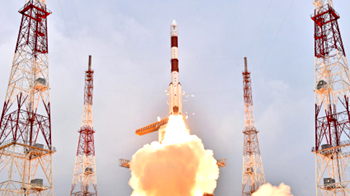
ISRO launches record 20 satellites in one go

June 22, 2016

satellites1

Sriharikota (AP), Jun 22: Setting a record in its space programme, India today successfully launched 20 satellites, including its earth observation Cartosat-2 series, in a single mission on board ISRO's workhorse PSLV-C34 from the spaceport here.

In a precision launch, PSLV-C34 took off from the second launch pad of Satish Dhawan Space Centre here, about 110 km from Chennai at 9.26 AM and placed the Cartosat-2 Series and 19 others in the designated polar Sun Synchronous Orbit (SSO) about 30 minutes later in clear skies.

The 727.5 kg Cartosat-2 series satellite will provide regular remote sensing services with its panchromatic and multispectral cameras and its imagery will be of multiple use.

Of the 19-satellites, 12 are earth imaging "Dove satellites" of USA and another American satellite. The rest are from Canada (two) and one each from Germany and Indonesia.

Two academic satellites are from Sathyabama University (Sathyabamasat) in Chennai and from College of Engineering (Swayam) at Pune.

Use of Cartosat 2 includes cartographic, urban and rural applications, coastal land use and regulation, utility management like road network monitoring and water distribution.

Also, creation of land use maps, precision study,change detection to bring out geographical and man-made features and various other Land Information System and Geographical Information System applications can be done. It is similar to the earlier Cartosat-2, 2A and 2B.

Prime Minister Narendra Modi congratulated ISRO and described today's launch as a "monumental" accomplishment.

"20 satellites in a go! @ isro continues to break new barriers. hearty congratulations to our scientists on the monumental accomplishment', he said on Twitter.

ISRO Chairman A S Kiran Kumar congratulated his team for the successful launch 'in a record time' and said "PSLV C-34 has done its job."

"We have the current generation of earth observation satellite of Cartosat 2 series," he said, adding ISRO had done a "wonderful job".

P Kunhikrishnan, Director, SDSC-SHAR, said that it was a major accomplishment by PSLV in its 35th consecutive successful mission.

"PSLV has become a success symbol for ISRO and India. ISRO is adopting more and more professionalism," he said.

D Jayakumar, Mission Director,described today's launch as a major landmark and said that the vehicle performance was "exceedingly well."

With today's launch of 20 satellites, PSLV beat its 2008 record when it placed in orbit 10 satellites in a single launch into various Low Earth Orbits.

This is the 14th flight of PSLV in "XL" configuration known for its capacity to carry more load which uses 'solid strap-on motors'.

The total weight of all the 20 satellites carried onboard PSLV-C34 is about 1288 kg.

India has 11 operational earth observation satellites, including RESOURCESAT-1 and 2, CARTOSAT-1, 2, 2A, 2B, RISAT-1 and 2, OCEANSAT-2 are in orbit.

Beginning in 1988, ISRO had launched many remote sensing satellites (for earth observation) and the data are for varied use including agriculture, water and ocean resources besides disaster management.

Comments

Add new comment

  • Coastaldigest.com reserves the right to delete or block any comments.
  • Coastaldigset.com is not responsible for its readers’ comments.
  • Comments that are abusive, incendiary or irrelevant are strictly prohibited.
  • Please use a genuine email ID and provide your name to avoid reject.
Agencies
May 27,2020

New Delhi, May 27: India’s fourth recession since Independence, first since liberalisation, and perhaps the worst to date is here, according to rating agency, Crisil.

CRISIL sees the Indian economy shrinking 5 per cent in fiscal 2021 (on-year), because of the Covid-19 pandemic. The first quarter will suffer a staggering 25 per cent contraction.

About 10 per cent of gross domestic product (GDP) in real terms could be permanently lost. "So going back to the growth rates seen before the pandemic is unlikely in the next three fiscals", Crisil said.

Crisil has revised its earlier forecast downwards. "Earlier, on April 28, we had slashed our prediction to 1.8 per cent growth from 3.5 per cent growth. Things have only gone downhill since", it said.

While we expect non-agricultural GDP to contract 6 per cent, agriculture could cushion the blow by growing at 2.5 per cent.

In the past 69 years, India has seen a recession only thrice as per available data in fiscals 1958, 1966 and 1980. The reason was the same each time a monsoon shock that hit agriculture, then a sizeable part of the economy.

"The recession staring at us today is different," it added. For one, agriculture could soften the blow this time by growing near its trend rate, assuming a normal monsoon. Two, the pandemic-induced lockdowns have affected most non-agriculture sectors. And three, the global disruption has upended whatever opportunities India had on the exports front.

Economic conditions have slid precipitously since the April-end forecast of 1.8 per cent GDP growth for fiscal 2021 (baseline), Crisil said.

On the lockdown extension, it said that the government has extended the lockdown four times to deal with the rising number of cases, curtailing economic activity severely (lockdown 4.0 is ending on May 31).

The first quarter of this fiscal will be the worst affected. June is unlikely to see major relaxations as the Covid-19 affliction curve is yet to flatten in India.

"Not only will the first quarter be a washout for the non-agricultural economy, services such as education, and travel and tourism among others, could continue to see a big hit in the quarters to come. Jobs and incomes will see extended losses as these sectors are large employers," Crisil said.

CRISIL also foresees economic activity in states with high Covid-19 cases to suffer prolonged disruption as restrictions could continue longer.

A rough estimate based on a sample of eight states, which contribute over half of India's GDP, shows that their 'red zones' (as per lockdown 3.0) contributed 42 per cent to the state GDP on average regardless of the share of such red zones.

On average, the orange zones contribute 46 per cent, while the green zones where activity is allowed to be close to normal contribute only 12 per cent to state GDP.

The economic costs are higher than earlier expectations, according to Crisil. The economic costs now beginning to show up in the hard numbers are far worse than initial expectations.

Industrial production for March fell by over 16%. The purchasing managers indices for the manufacturing and services sectors were at 27.4 and 5.4, respectively, in April, implying extraordinary contraction. That compares with 51.8 and 49.3, respectively, in March.

Exports contracted 60.3 per cent in April, and new telecom subscribers declined 35 per cent, while railway freight movement plunged 35 per cent on-year.

"Indeed, given one of the most stringent lockdowns in the world, April could well be the worst performing month for India this fiscal," it said.

Added to that is the economic package without enough muscle. The government recently announced a Rs 20.9 lakh crore economic relief package to support the economy. The package has some short-term measures to cushion the economy, but sets its sights majorly on reforms, most of which will have payoffs only over the medium term.

"We estimate the fiscal cost of this package at 1.2 per cent of GDP, which is lower than what we had assumed in our earlier estimate (when we foresaw a growth in GDP)," it said.

"We believe a catch-up to the pre-crisis trend level of GDP growth will not be possible in the next three fiscals despite policy support. Under the base case, we estimate a 10 per cent permanent loss to real GDP (from the decadal-trend level), assuming average growth of about 7 per cent between fiscals 2022 and 2024," Crisil said.

Interestingly, after the Global Financial Crisis (GFC), a sharp growth spurt helped catch up with the trend within two years. GDP grew 8.2 per cent on average in the two fiscals following the GFC. Massive fiscal spending, monetary easing and swift global recovery played a role in a V-shaped recovery.

To catch-up would require average GDP growth to surge to 11 per cent over the next three fiscals, something that has never happened before.

The research said that successive lockdowns have a non-linear and multiplicative effect on the economy a two-month lockdown will be more than twice as debilitating as a one-month imposition, as buffers keep eroding.

Partial relaxations continue to be a hindrance to supply chains, transportation and logistics. Hence, unless the entire supply chain is unlocked, the impact of improved economic activity will be subdued.

Therefore, despite the stringency of lockdown easing a tad in the third and the fourth phases, their negative impact on GDP is expected to massively outweigh the benefits from mild fiscal support and low crude oil prices, especially in the April-June quarter. "Consequently, we expect the current quarter's GDP to shrink 25 per cent on-year," it said.

Counting lockdown 4.0, Indians have had 68 days of confinement. S&P Global estimates that one month of lockdown shaves 3 per cent off annual GDP on average across Asia-Pacific.

Since India's lockdown has been the most stringent in Asia, the impact on economic growth will be correspondingly larger.

Google's Community Mobility Reports show a sharp fall in movement of people to places of recreation, retail shops, public transport and workplace travel. While data for May shows some improvement in India, mobility trends are much below the average or baseline, and lower compared with countries such as the US, South Korea, Brazil and Indonesia.


Comments

Add new comment

  • Coastaldigest.com reserves the right to delete or block any comments.
  • Coastaldigset.com is not responsible for its readers’ comments.
  • Comments that are abusive, incendiary or irrelevant are strictly prohibited.
  • Please use a genuine email ID and provide your name to avoid reject.
Agencies
January 15,2020

New Delhi, Jan 15: Suspended Deputy Superintendent of J&K Police Davinder Singh had ferried Hizbul Mujahideen terrorist Naveed Babu to Jammu last year also and facilitated his return to Shopian after "rest and recuperation", officials interrogating him said here Tuesday.

"Meri mati maari gayi thi (I must have lost my mind to do what I did)," an interrogator quoted Singh as saying after the DSP failed to impress them with his theory of catching a big terrorist.

Singh was arrested last Saturday along with Naveed Babu alias Babar Azam, a resident of Nazneenpora in South Kashmir's Shopian district, and his associate Asif Ahmad.

He is believed to have taken Rs 12 lakh for smuggling the two to Chandigarh for providing them accommodation for a couple of months, officials said. The officials, who have been spending considerable time questioning Singh, said there have been many inconsistencies in his statements and everything was being crosschecked and corroborated with the confessions of captured militants who have been kept in different rooms at an interrogation centre in South Kashmir.

During questioning it emerged that Singh had taken them to Jammu in 2019 also, the officials said.

In a tone laced with sarcasm, they said the DSP was taking the militants for "rest and recuperation".

Naveed told the interrogators that they used to stay in the hilly regions to avoid the J&K police and left the areas to escape harsh winters, they said.

The official said the DSP's bank accounts and other assets were being verified by the police and papers were being collected, amid speculations that the case may be handed over to the National Investigation Agency (NIA).

Going into the service history of Singh, majority of retired and serving officials of the JKP spoken to referred to a proverb -- coming events cast their shadows long before -- to say that if action had been taken against the officer during his probation period, such things would not have happened.

Recruited in 1990 as a sub-inspector, Singh along with another probationary officer were subject of an internal enquiry where some narcotics had been seized from a truck. However, the contraband was sold by Singh and another sub-inspector, the officials recalled.

There was a move to dismiss them from the service which was stalled by an Inspector General rank officer purely on humanitarian ground and the duo was shifted to the Special Operations Group, a team of policemen engaged in counter-militancy offensive.

However, he could not last there for long and was shifted this time to the police lines only to be rehabilitated in 1997 again in the SOG.

During this period, he was posted in Budgam and is alleged to have indulged in extortion for which he was sent back to the police lines.

His proper rehabilitation began in 2015 by the then Director General of Police K Rajendra, who posted him in district headquarters of Shopian and Pulwama, the officials said.

However, after some alleged wrongdoing during his stint in Pulwama, the then Director General of Police S P Vaid transferred him in August 2018 to the sensitive Anti-Hijacking Unit in Srinagar, though the move was opposed by some other officers.

An advocate, Irfan Ahmad Mir, was driving the vehicle when they were caught by the police on National Highway in Kulgam district.

The advocate, who has also been arrested, had travelled to Pakistan five times on an Indian passport.

Comments

Add new comment

  • Coastaldigest.com reserves the right to delete or block any comments.
  • Coastaldigset.com is not responsible for its readers’ comments.
  • Comments that are abusive, incendiary or irrelevant are strictly prohibited.
  • Please use a genuine email ID and provide your name to avoid reject.
News Network
April 3,2020

New Delhi, Apr 3: The total number of coronavirus cases in Delhi has risen to 384, including 259 who were evacuated from Nizamuddin Markaz, Chief Minister Arvind Kejriwal said on Friday.

In last 24 hours, 91 new cases were reported in the national capital and one more person evacuated from the Markaz died due to coronavirus, taking the total number of deaths in the city to five, he said.

Of the 384 cases, 58 had recent foreign travel history and 38 contracted the virus after coming in contact with them, he added.

Kejriwal said community spread of the virus is not taking place in Delhi yet and there is no need to panic as the situation is under control.

The government has made preparations if the virus starts spreading among people, he said.

The chief minister also launched a WhatsApp helpline - 8800007722 for people to enquire about COVID-19, food banks, shelters among others.

Meanwhile, Kejriwal, deputy chief minister Manish Sisodia and experts will interact with students and answer their queries related to the virus at 3 pm on Saturday.

Comments

Add new comment

  • Coastaldigest.com reserves the right to delete or block any comments.
  • Coastaldigset.com is not responsible for its readers’ comments.
  • Comments that are abusive, incendiary or irrelevant are strictly prohibited.
  • Please use a genuine email ID and provide your name to avoid reject.