


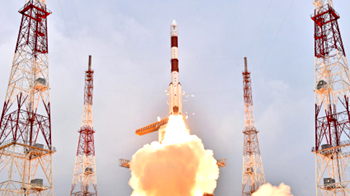
ISRO launches record 20 satellites in one go

June 22, 2016

satellites1

Sriharikota (AP), Jun 22: Setting a record in its space programme, India today successfully launched 20 satellites, including its earth observation Cartosat-2 series, in a single mission on board ISRO's workhorse PSLV-C34 from the spaceport here.

In a precision launch, PSLV-C34 took off from the second launch pad of Satish Dhawan Space Centre here, about 110 km from Chennai at 9.26 AM and placed the Cartosat-2 Series and 19 others in the designated polar Sun Synchronous Orbit (SSO) about 30 minutes later in clear skies.

The 727.5 kg Cartosat-2 series satellite will provide regular remote sensing services with its panchromatic and multispectral cameras and its imagery will be of multiple use.

Of the 19-satellites, 12 are earth imaging "Dove satellites" of USA and another American satellite. The rest are from Canada (two) and one each from Germany and Indonesia.

Two academic satellites are from Sathyabama University (Sathyabamasat) in Chennai and from College of Engineering (Swayam) at Pune.

Use of Cartosat 2 includes cartographic, urban and rural applications, coastal land use and regulation, utility management like road network monitoring and water distribution.

Also, creation of land use maps, precision study,change detection to bring out geographical and man-made features and various other Land Information System and Geographical Information System applications can be done. It is similar to the earlier Cartosat-2, 2A and 2B.

Prime Minister Narendra Modi congratulated ISRO and described today's launch as a "monumental" accomplishment.

"20 satellites in a go! @ isro continues to break new barriers. hearty congratulations to our scientists on the monumental accomplishment', he said on Twitter.

ISRO Chairman A S Kiran Kumar congratulated his team for the successful launch 'in a record time' and said "PSLV C-34 has done its job."

"We have the current generation of earth observation satellite of Cartosat 2 series," he said, adding ISRO had done a "wonderful job".

P Kunhikrishnan, Director, SDSC-SHAR, said that it was a major accomplishment by PSLV in its 35th consecutive successful mission.

"PSLV has become a success symbol for ISRO and India. ISRO is adopting more and more professionalism," he said.

D Jayakumar, Mission Director,described today's launch as a major landmark and said that the vehicle performance was "exceedingly well."

With today's launch of 20 satellites, PSLV beat its 2008 record when it placed in orbit 10 satellites in a single launch into various Low Earth Orbits.

This is the 14th flight of PSLV in "XL" configuration known for its capacity to carry more load which uses 'solid strap-on motors'.

The total weight of all the 20 satellites carried onboard PSLV-C34 is about 1288 kg.

India has 11 operational earth observation satellites, including RESOURCESAT-1 and 2, CARTOSAT-1, 2, 2A, 2B, RISAT-1 and 2, OCEANSAT-2 are in orbit.

Beginning in 1988, ISRO had launched many remote sensing satellites (for earth observation) and the data are for varied use including agriculture, water and ocean resources besides disaster management.

Comments

Add new comment

  • Coastaldigest.com reserves the right to delete or block any comments.
  • Coastaldigset.com is not responsible for its readers’ comments.
  • Comments that are abusive, incendiary or irrelevant are strictly prohibited.
  • Please use a genuine email ID and provide your name to avoid reject.
Agencies
April 14,2020

New Delhi, Apr 14: Prime Minister Narendra Modi has announced the extension of a nationwide lockdown till May 3 to contain the spread of Covid-19 as the number of novel coronavirus cases surged past 10,000-mark on Tuesday. Hinting at partial relief, however, the Prime Minister said there could be some relaxations after April 20 in places where there is no hotspot.

Lockdown 2.0 will come into force from April 14 till May 3, PM Modi said in a televised address to the nation on Tuesday. The 19-day extension of the lockdown till May 3 is an attempt to contain the spread of novel coronavirus which has affected over 10,000 people in India. 

Even before #COVID19 cases touched 100, India made it compulsory for foreign returnees to remain in 14 days isolation. We imposed 21-day lockdown when we had 550 cases: PM Narendra Modi https://t.co/qi8MgG8qPQ

— ANI (@ANI) April 14, 2020
PM Modi said the Centre will closely monitor hotspots in states across India and added that those areas where there are no hotspots will get partial relief. “Till April 20, all districts, localities, states will be closely monitored, as to how strictly they are implementing norms. States where hotspots are contained could be allowed to resume some important activities, but with certain conditions,” the PM said.

The Prime Minister, in his address to India on Tuesday, began by lauding the efforts of Indians in the fight against novel coronavirus. “Covid-19 is spreading fast but India’s fight against coronavirus is going strong. It is because of your efforts that we are able to put up a fight,” the PM said as he thanked people for their co-operation.

PM Modi said, “People have gone through hardships to save India. I know how many difficulties you faced. I respectfully bow to the people of India for their sacrifice.”

The national lockdown first came into force from March 25 when the PM took an unprecedented measure in the fight against Covid-19. The lockdown was scheduled to end today.

STATES PUSHED FOR LOCKDOWN 2.0

The decision to extend the lockdown followed after a broad consensus emerged that the national lockdown should be extended by at least two weeks following a meeting between PM Modi and state chief ministers on Saturday.

It was reportedly after this meet with the Prime Minister that it was decided that the nationwide lockdown will be extended to tackle the spread of Coivid-19. The extension request from states came despite concerns that the shutdown will put millions out of work.

PM has taken correct decision to extend lockdown. Today, India’s position is better than many developed countries because we started lockdown early. If it is stopped now, all gains would be lost. To consolidate, it is imp to extend it

— Arvind Kejriwal (@ArvindKejriwal) April 11, 2020
"If it is stopped now, all gains would be lost. To consolidate, it is imp (important) to extend it," Arvind Kejriwal had written on Twitter after the meeting while he added that PM Modi had "taken (a) correct decision to extend (the) lockdown”.

Several states had, however, pushed for resumption of some economic activities like in the farming sector in areas where no cases of the novel coronavirus have been reported.

ALL THAT HAS HAPPENED TILL NOW

Prime Minister Narendra Modi first addressed an anxious nation on March 19 as the coronavirus pandemic emerged as a serious concern for the country. In his televised address, the PM asked the people to observe ‘Janata Curfew’ for March 22.
The Prime Minister urged Indians to remain indoors as much as possible as he suggested ways to battle the coronavirus pandemic.

On March 24, the Prime Minister came back and announced a 21-day lockdown across the country. In his second address, PM Modi said the step was taken as it was the only way to break the chain of infection. The lockdown was to be in effect till April 14.

PM Modi later asked citizens to make noise at 5 pm to show their appreciation for medics, nurses and sanitation workers. This call was well received as Indians came out to clap, clang metal vessels and ring bells to cheer workers battling the spread of the coronavirus.

Ten days into the lockdown, the Prime Minister addressed the nation again and asked people to light candles, lamps and hold mobile phone torches for nine minutes from 9 pm on April 5 to demonstrate a collective will to fight coronavirus.

As of Tuesday morning, the death toll due to coronavirus has climbed to 339 with over 50 deaths within 24 hours. The number of cases in the country, meanwhile, had crossed the 10,000-mark, according to the Union Health Ministry. Over a thousand have been cured and discharged.

Comments

Add new comment

  • Coastaldigest.com reserves the right to delete or block any comments.
  • Coastaldigset.com is not responsible for its readers’ comments.
  • Comments that are abusive, incendiary or irrelevant are strictly prohibited.
  • Please use a genuine email ID and provide your name to avoid reject.
News Network
January 14,2020

Chennai/New Delhi, Jan 14: India's annual electricity demand in 2019 grew at its slowest pace in six years with December marking a fifth straight month of decline, government data showed, amid a broader economic slowdown that led to a drop in sales of everything from cars to cookies and also to factories cutting jobs.

Electricity demand is seen as an important indicator of industrial output in the country and a sustained decline could mean a further slowdown in the economy.

India's power demand grew at 1.1% in 2019, data from the Central Electricity Authority showed, the slowest pace of growth since a 1% uptick seen in 2013. The power demand growth slowdown in 2013 was preceded by three strong years of consumption growth of 8% or more.

In December, the country's power demand fell 0.5% from the year-earlier period, representing the fifth straight month of decline, compared with a 4.3% fall in November.

But in India's western states of Maharashtra and Gujarat, two of India's most industrialised provinces, monthly demand increased.

In October, power demand had fallen 13.2% from a year earlier, its steepest monthly decline in more than 12 years, as a slowdown in Asia's third-largest economy deepened.

Industry accounts for more than two-fifths of India's annual electricity consumption, while homes account for nearly a fourth and agriculture more than a sixth.

The slower demand growth is a blow for many debt-laden power producers, who are facing financial stress and are owed over $11 billion by state-run distribution companies.

India's overall economic growth slowed to 4.5% in the July-September quarter, government data released in November showed, the weakest pace since 2013 as consumer demand and private investment fell.

The government has estimated growth in the current financial year that runs through to March will be the slowest since the 2008 global crisis.

"This reflects overall economic slowdown, because if you look at other high frequency data like diesel consumption, everywhere you are seeing contraction," Rupa Rege Nitsure, chief economist at L&T Financial Holdings.

But India's central bank will not have much scope to cut rates to stimulate the economy because inflation has been rising sharply and reached 7.35% in December compared with 1.97% in January last year.

Economists say India's growth will continue to hover around 4.5% levels in the Oct-Dec quarter.

"In the Oct-Dec quarter as well growth (GDP) will be around the same level as July-September. My estimate for the full year is around 4.7% growth," Nitsure said.

Comments

Add new comment

  • Coastaldigest.com reserves the right to delete or block any comments.
  • Coastaldigset.com is not responsible for its readers’ comments.
  • Comments that are abusive, incendiary or irrelevant are strictly prohibited.
  • Please use a genuine email ID and provide your name to avoid reject.
News Network
May 24,2020

New Delhi, May 24: The Indian economy is likely to slip into recession in the third quarter of this fiscal as loss in income and jobs and cautiousness among consumers will delay recovery in consumer demand even after the pandemic, says a report.

According to Dun & Bradstreet's latest Economic Observer, the country's economic recovery will depend on the efficacy and duration of implementation of the government's stimulus package.

"The multiplier effect of the stimulus measures on the economy will depend on three key aspects i.e. the time taken for effecting the withdrawal of the lockdown, the efficacy of implementation and duration of execution of the measures announced," Dun & Bradstreet India Chief Economist Arun Singh said.

The report noted that the government's larger-than-expected stimulus package is likely to re-start economic activities.

Besides, measures taken by the Reserve Bank of India like reducing the repo rate by a further 40 basis points to 4 per cent, extending the moratorium period by three months and facilitating working capital financing will also help stimulate the momentum.

Singh said while the measures announced by the government are "positive", most of them have been directed towards strengthening the supply side of the economy, and "it is to be noted that supply needs to be matched with demand", he said.

Besides, "in the absence of cash-in-hand benefits under the government's stimulus package, demand for goods and services is expected to remain depressed", he added.

He further said the loss in income and employment opportunities, and cautiousness among consumers, will lead to a delayed recovery in consumer demand, even after the pandemic. As debt and bad loan levels increase, the banking sector might face challenges.

The report further noted that even as the monetary stimulus is expected to inject liquidity and stimulate demand for a wider section of the economy, the channelisation of funds from the financial institutions will be subjected to several constraints.

The foremost concern being increase in risk averseness, as the balance sheets of firms, households, and banks/NBFCs have weakened considerably and low demand for funds by firms as production activities have been on a standstill during the lockdown period, Singh said.

India has been under lockdown since March 25 to contain the spread of the coronavirus, resulting in supply disruptions and demand compression.

Prime Minister Narendra Modi imposed a nationwide lockdown to control the spread of coronavirus on March 25. It has been extended thrice, with some relaxations. The fourth phase of the lockdown is set to expire on May 31. 

Comments

Add new comment

  • Coastaldigest.com reserves the right to delete or block any comments.
  • Coastaldigset.com is not responsible for its readers’ comments.
  • Comments that are abusive, incendiary or irrelevant are strictly prohibited.
  • Please use a genuine email ID and provide your name to avoid reject.