


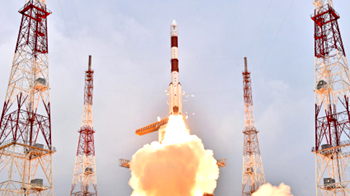
ISRO launches record 20 satellites in one go

June 22, 2016

satellites1

Sriharikota (AP), Jun 22: Setting a record in its space programme, India today successfully launched 20 satellites, including its earth observation Cartosat-2 series, in a single mission on board ISRO's workhorse PSLV-C34 from the spaceport here.

In a precision launch, PSLV-C34 took off from the second launch pad of Satish Dhawan Space Centre here, about 110 km from Chennai at 9.26 AM and placed the Cartosat-2 Series and 19 others in the designated polar Sun Synchronous Orbit (SSO) about 30 minutes later in clear skies.

The 727.5 kg Cartosat-2 series satellite will provide regular remote sensing services with its panchromatic and multispectral cameras and its imagery will be of multiple use.

Of the 19-satellites, 12 are earth imaging "Dove satellites" of USA and another American satellite. The rest are from Canada (two) and one each from Germany and Indonesia.

Two academic satellites are from Sathyabama University (Sathyabamasat) in Chennai and from College of Engineering (Swayam) at Pune.

Use of Cartosat 2 includes cartographic, urban and rural applications, coastal land use and regulation, utility management like road network monitoring and water distribution.

Also, creation of land use maps, precision study,change detection to bring out geographical and man-made features and various other Land Information System and Geographical Information System applications can be done. It is similar to the earlier Cartosat-2, 2A and 2B.

Prime Minister Narendra Modi congratulated ISRO and described today's launch as a "monumental" accomplishment.

"20 satellites in a go! @ isro continues to break new barriers. hearty congratulations to our scientists on the monumental accomplishment', he said on Twitter.

ISRO Chairman A S Kiran Kumar congratulated his team for the successful launch 'in a record time' and said "PSLV C-34 has done its job."

"We have the current generation of earth observation satellite of Cartosat 2 series," he said, adding ISRO had done a "wonderful job".

P Kunhikrishnan, Director, SDSC-SHAR, said that it was a major accomplishment by PSLV in its 35th consecutive successful mission.

"PSLV has become a success symbol for ISRO and India. ISRO is adopting more and more professionalism," he said.

D Jayakumar, Mission Director,described today's launch as a major landmark and said that the vehicle performance was "exceedingly well."

With today's launch of 20 satellites, PSLV beat its 2008 record when it placed in orbit 10 satellites in a single launch into various Low Earth Orbits.

This is the 14th flight of PSLV in "XL" configuration known for its capacity to carry more load which uses 'solid strap-on motors'.

The total weight of all the 20 satellites carried onboard PSLV-C34 is about 1288 kg.

India has 11 operational earth observation satellites, including RESOURCESAT-1 and 2, CARTOSAT-1, 2, 2A, 2B, RISAT-1 and 2, OCEANSAT-2 are in orbit.

Beginning in 1988, ISRO had launched many remote sensing satellites (for earth observation) and the data are for varied use including agriculture, water and ocean resources besides disaster management.

Comments

Add new comment

  • Coastaldigest.com reserves the right to delete or block any comments.
  • Coastaldigset.com is not responsible for its readers’ comments.
  • Comments that are abusive, incendiary or irrelevant are strictly prohibited.
  • Please use a genuine email ID and provide your name to avoid reject.
Agencies
March 15,2020

Financially troubled Yes Bank on Saturday reported a standalone net loss of ₹ 18,560.31 crore for the third quarter of the financial year 2019-20. This is amongst the biggest losses reported by the India Inc.

At present, the private lender is under a moratorium and is controlled by the office of the administrator appointed by the RBI.

The bank had reported a net profit of ₹1,001.85 crore during the corresponding period of the previous financial year.

Besides, the bank's total income fell to Rs 6,268.50 crore from Rs 8,849.81 crore earned during the October-December quarter of the previous fiscal.

On consolidated basis, Yes Bank reported a net loss of ₹18,564.24 crore for the December quarter from a net profit of Rs 1,000.57 crore in the corresponding period of the previous fiscal.

The independent auditor's review report on the consolidated results pointed out that there is a "material uncertainty related to going concern" of the bank.

"The said assumption of going concern is dependent upon the degree of success of the final reconstruction scheme, the quantum of capital infused into the bank and the bank's ability to stabalise its deposit balances post withdrawal of the moratorium by the RBI. Our conclusion is not modified in respect of this matter," the auditor said.

Furthermore, the bank recognised additional loans of ₹ 5,150.2 crore as NPAs and related provisioning requirements of ₹772.5 crore for the quarter ended December 31, 2019.

The bank has recognised an additional provisions of ₹15,422.0 crore in the quarter ended December 31, 2019.

Last week, the RBI placed Yes Bank under moratorium and capped the withdrawal limit at ₹50,000 till next Wednesday.

Additionally, the central bank also superseded Yes Bank's board of directors and appointed former SBI CFO Prashant Kumar as its administrator.

Meanwhile, Kumar has been appointed as the new Chief Executive Officer of the financially troubled lender. He will take over his new responsibilities once the moratorium on the stressed lender is lifted on Wednesday.

Apart from Kumar, Sunil Mehta, former non-executive Chairman of Punjab National Bank, will take over as the non-executive Chairman of Yes Bank.

Other board members include Mahesh Krishnamurthy and Atul Bheda, both as non-executive Directors.

Additionally, six private lenders have joined the SBI to rescue Yes Bank with Federal Bank committing ₹300 crore by subscribing to 30 crore shares of ₹2 each at a premium of ₹8 per equity share.

The six private lenders have now committed an investment of ₹3,700 crore in the cash-strapped private sector bank.

On Friday, ICICI Bank and Housing Development Finance Corporation (HDFC) Ltd had announced that they will be investing ₹1,000 crore each in Yes Bank's equity. Axis Bank and Kotak Mahindra Bank will be investing ₹ 600 crore and ₹500 crore, respectively, while Bandhan Bank will invest ₹300 crore.

The SBI board has already approved up to 49 per cent stake purchase in Yes Bank, as per the RBI's reconstruction scheme for the lender. It had said on Thursday that an investment of ₹7,250 crore would be made in Yes Bank to pick up₹ 725 crore equity shares.

Comments

Add new comment

  • Coastaldigest.com reserves the right to delete or block any comments.
  • Coastaldigset.com is not responsible for its readers’ comments.
  • Comments that are abusive, incendiary or irrelevant are strictly prohibited.
  • Please use a genuine email ID and provide your name to avoid reject.
News Network
February 19,2020

New Delhi, Feb 19: India will switch to the world's cleanest petrol and diesel from April 1 as it leapfrogs straight to Euro-VI emission compliant fuels from Euro-IV grades now - a feat achieved in just three years and not seen in any of the large economies around the globe.

India will join the select league of nations using petrol and diesel containing just 10 parts per million of sulphur as it looks to cut vehicular emissions that are said to be one of the reasons for the choking pollution in major cities.

Sanjiv Singh, Chairman of Indian Oil Corp (IOC) - the firm that controls roughly half of the country's fuel market, said almost all refineries began producing ultra-low sulphur BS-VI (equivalent to Euro-VI grade) petrol and diesel by the end of 2019 and oil companies have now undertaken the tedious task of replacing every drop of fuel in the country with the new one.

"We are absolutely on track for supplying BS-VI fuel from April 1. Almost all refineries have begun supplying BS-VI fuel and the same has reached storage depots across the country," he said.

From storage depots, the fuel has started travelling to petrol pumps and in the next few weeks all of them will only have BS-VI grade petrol and diesel, he said. "We are 100 per cent confident that fuel that will flow from nozzles at all the petrol pumps in the country on April 1 will be BS-VI emission compliant fuel."

India adopted Euro-III equivalent (or Bharat Stage-III) fuel with a sulphur content of 350 ppm in 2010 and then took seven years to move to BS-IV that had a sulphur content of 50 ppm. From BS-IV to BS-VI it took just three years.

"It was a conscious decision to leapfrog to BS-VI as first upgrading to BS-V and then shifting to BS-VI would have prolonged the journey to 4 to 6 years. Besides, oil refineries, as well as automobile manufacturers, would have had to make investments twice - first to producing BS-V grade fuel and engines and then BS-VI ones," he said.

State-owned oil refineries spent about Rs 35,000 crore to upgrade plants that could produce ultra-low sulphur fuel. This investment is on top of Rs 60,000 crore they spent on refinery upgrades in the previous switchovers.

BS-VI has a sulphur content of just 10 ppm and emission standards are as good as CNG.

Originally, Delhi and its adjoining towns were to have BS-VI fuel supplies by April 2019 and the rest of the country was to get same supplies from April 2020.

But oil marketing companies switched over to supply of BS-VI grade fuels in the national capital territory of Delhi on April 1, 2018.

The supply of BS-VI fuels was further extended to four contiguous districts of Rajasthan and eight of Uttar Pradesh in the National Capital Region (NCR) on April 1, 2019, together with the city of Agra.

BS-VI grade fuels were made available in 7 districts of Haryana from October 1, 2019.

Singh said the new fuel will result in a reduction in NOx in BS-VI compliant vehicles by 25 per cent in petrol cars and by 70 per cent in diesel cars.

The switchover, he said, is a tedious task as every drop of old, higher-sulphur content fuel has to be flushed out in depots, pipelines and tanks before being replaced by BS-VI.

"We are confident of disruption-free switchover to BS-VI supplies across the country," he said. "What we will be supplying is the best quality available anywhere in the world. You don't have any better fuel that is supplied in any part of the world. Perhaps our BS-VI fuel will be better than equivalent fuel in some parts of the US and Europe."

India adopted a fuel upgradation programme in the early 1990s. Low lead gasoline (petrol) was introduced in 1994 in Delhi, Mumbai, Kolkata and Chennai. On February 1, 2000, unleaded gasoline was mandated nationwide.

Similarly, BS-2000 (Euro-I equivalent, BS-1) vehicle emission norms were introduced for new vehicles from April 2000. BS-II (Euro-II equivalent) emission norms for new cars were introduced in Delhi from 2000 and extended to the other metro cities in 2001.

Benzene limits have been reduced progressively from 5 per cent in 2000 to 1 per cent nationwide. Lead content in gasoline was removed in phases and only unleaded gasoline is being produced and sold from February 1, 2000.

The octane number of gasoline signifies the improved performance of the engine. Loss in octane number due to phasing out of lead was made up by installing new facilities in the refinery and changes in refinery operation. RON (Research Octane Number) of gasoline for BS-2000 spec was increased to 88. This has over time been increased to 91.

Singh said sulphur reduction will reduce Particulate Matter (PM) emissions even in the in-use older generation diesel vehicles.

Comments

Add new comment

  • Coastaldigest.com reserves the right to delete or block any comments.
  • Coastaldigset.com is not responsible for its readers’ comments.
  • Comments that are abusive, incendiary or irrelevant are strictly prohibited.
  • Please use a genuine email ID and provide your name to avoid reject.
News Network
March 30,2020

New Delhi, Mar 30: Prime Minister Narendra Modi on Monday interacted with Indian ambassadors and high commissioners abroad and urged them to remain alert to developments in global efforts against COVID-19 including breakthroughs to help the country's fight against the coronavirus.

External Affairs Minister S Jaishankar and Foreign Secretary Harsh Vardhan Shringla were also present during the interaction through video-conferencing.

"Coming together for India PM interacted with Indian Ambassadors/High Commissioners abroad and urged them to remain alert to developments in global efforts against COVID-19 including breakthroughs to help our national efforts to fight COVID19," External Affairs Ministry spokesperson Raveesh Kumar said in a tweet.

"PM appreciated the efforts of our missions in helping Indians abroad, in particular, students and workers," he added.

The number of positive coronavirus cases in the country stood at 1,071 on Monday. It includes 29 deaths and 99 people, who have been cured of the highly contagious virus.

Comments

Add new comment

  • Coastaldigest.com reserves the right to delete or block any comments.
  • Coastaldigset.com is not responsible for its readers’ comments.
  • Comments that are abusive, incendiary or irrelevant are strictly prohibited.
  • Please use a genuine email ID and provide your name to avoid reject.