


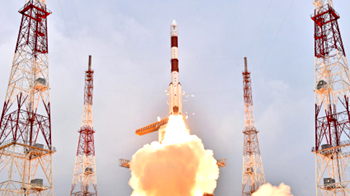
ISRO launches record 20 satellites in one go

June 22, 2016

satellites1

Sriharikota (AP), Jun 22: Setting a record in its space programme, India today successfully launched 20 satellites, including its earth observation Cartosat-2 series, in a single mission on board ISRO's workhorse PSLV-C34 from the spaceport here.

In a precision launch, PSLV-C34 took off from the second launch pad of Satish Dhawan Space Centre here, about 110 km from Chennai at 9.26 AM and placed the Cartosat-2 Series and 19 others in the designated polar Sun Synchronous Orbit (SSO) about 30 minutes later in clear skies.

The 727.5 kg Cartosat-2 series satellite will provide regular remote sensing services with its panchromatic and multispectral cameras and its imagery will be of multiple use.

Of the 19-satellites, 12 are earth imaging "Dove satellites" of USA and another American satellite. The rest are from Canada (two) and one each from Germany and Indonesia.

Two academic satellites are from Sathyabama University (Sathyabamasat) in Chennai and from College of Engineering (Swayam) at Pune.

Use of Cartosat 2 includes cartographic, urban and rural applications, coastal land use and regulation, utility management like road network monitoring and water distribution.

Also, creation of land use maps, precision study,change detection to bring out geographical and man-made features and various other Land Information System and Geographical Information System applications can be done. It is similar to the earlier Cartosat-2, 2A and 2B.

Prime Minister Narendra Modi congratulated ISRO and described today's launch as a "monumental" accomplishment.

"20 satellites in a go! @ isro continues to break new barriers. hearty congratulations to our scientists on the monumental accomplishment', he said on Twitter.

ISRO Chairman A S Kiran Kumar congratulated his team for the successful launch 'in a record time' and said "PSLV C-34 has done its job."

"We have the current generation of earth observation satellite of Cartosat 2 series," he said, adding ISRO had done a "wonderful job".

P Kunhikrishnan, Director, SDSC-SHAR, said that it was a major accomplishment by PSLV in its 35th consecutive successful mission.

"PSLV has become a success symbol for ISRO and India. ISRO is adopting more and more professionalism," he said.

D Jayakumar, Mission Director,described today's launch as a major landmark and said that the vehicle performance was "exceedingly well."

With today's launch of 20 satellites, PSLV beat its 2008 record when it placed in orbit 10 satellites in a single launch into various Low Earth Orbits.

This is the 14th flight of PSLV in "XL" configuration known for its capacity to carry more load which uses 'solid strap-on motors'.

The total weight of all the 20 satellites carried onboard PSLV-C34 is about 1288 kg.

India has 11 operational earth observation satellites, including RESOURCESAT-1 and 2, CARTOSAT-1, 2, 2A, 2B, RISAT-1 and 2, OCEANSAT-2 are in orbit.

Beginning in 1988, ISRO had launched many remote sensing satellites (for earth observation) and the data are for varied use including agriculture, water and ocean resources besides disaster management.

Comments

Add new comment

  • Coastaldigest.com reserves the right to delete or block any comments.
  • Coastaldigset.com is not responsible for its readers’ comments.
  • Comments that are abusive, incendiary or irrelevant are strictly prohibited.
  • Please use a genuine email ID and provide your name to avoid reject.
News Network
June 10,2020

New Delhi, Jun 10: India on Wednesday reported a spike of 9,985 more COVID-19 cases in the last 24 hours, taking the country's COVID-19 count to 2,76,583, according to the Union Ministry of Health and Family Welfare.

279 deaths were reported in the last 24 hours taking the total death toll to 7,745.

The total number of active cases has reached 1,33,632 while 1,35,205 patients have recovered. While one person has migrated.

With 90,787 cases, Maharashtra reported the highest number of coronavirus cases in the country followed by Tamil Nadu with 34,914 cases.

According to the Indian Council of Medical Research (ICMR), 1,45,216 samples were tested in the last 24 hours while overall 50,61,332 samples have been tested so far.

Comments

Add new comment

  • Coastaldigest.com reserves the right to delete or block any comments.
  • Coastaldigset.com is not responsible for its readers’ comments.
  • Comments that are abusive, incendiary or irrelevant are strictly prohibited.
  • Please use a genuine email ID and provide your name to avoid reject.
News Network
April 15,2020

New Delhi, Apr 15: As the world grapples with coronavirus, researchers have found the presence of a different kind of coronavirus -- bat coronavirus (BtCoV) --in two bat species from Kerala, Himachal Pradesh, Puducherry and Tamil Nadu, according to a study by the Indian Council of Medical Research (ICMR).

There is no evidence or research to claim that these bat coronaviruses can cause disease in humans, said Dr Pragya D Yadav, Scientist at the National Institute of Virology (NIV), Pune and also the first author of study.

The study has been published in the Indian Journal of Medical Research,

Twenty-five bats of Rousettus and Pteropus species from Kerala, Himachal Pradesh, Puducherry and Tamil Nadu were found positive for BtCoV in Kerala, Himachal Pradesh, Puducherry and Tamil Nadu.

"These bat coronaviruses have no relation with SARS-CoV2 responsible for the COVID-19 pandemic," Yadav said, adding that Pteropus bat species were earlier found positive for Nipah virus in 2018 and 2019 in Kerala.

"Bats are considered to be the natural reservoir for many viruses, of which some are potential human pathogens. In India, an association of Pteropus medius bats with the Nipah virus was reported in the past. It is suspected that the recently emerged severe acute respiratory syndrome coronavirus 2 (SARS-CoV-2) also has its association with bats," the objective of the study titled 'Detection of coronaviruses in Pteropus and Rousettus species of bats from different states of India' stated.

"In the present scenario of changing demography and ecological manipulations, it is challenging to have checks on the encounters of bats with other animals and humans," the study stated, highlighting that the need for active and continuous surveillance remains crucial for outbreak alerts for bat-associated viral agents with epidemic potential, which would be helpful in timely interventions.

"Although CoVs in the subfamily coronavirinae do not usually produce clinical symptoms in their natural hosts (bats), accidental transmission of these viruses to humans and other animals may result in respiratory, enteric, hepatic or neurologic diseases of variable severity. It is still not understood as to why only certain CoVs can infect people," the study said.

The scientists stressed on the need of proactive surveillance of zoonotic infections in bats.

The detection and identification of such viruses from bats also recommends cross-sectional antibody surveys (human and domestic animals) in localities where the viruses have been detected.

Similarly, if the epidemiological situation demands, evidence-based surveillance should also be conducted, the study said while emphasing on the need of developing strong mechanisms for working jointly with various stakeholders such as wildlife, poultry, animal husbandry and human health departments.

"In conclusion, our study showed detection of bat CoVs in two species of Indian bats. Continuous active surveillance is required to identify the emerging novel viruses with epidemic potential," Dr Yadav said.

Elaborating on the study, Dr Yadav said throat and rectal swab samples of two bat species -- Rousettus and Pteropus -- from seven states were screened for the bat coronvirus during which the representative samples collected from Kerala, Himachal Pradesh, Puducherry and Tamil Nadu tested positive while those from Karnataka, Chandigarh, Punjab, Telengana, Gujarat and Odisha came out negative.

The reverse-transcription polymerase chain reaction (RT-PCR) tests and sequencing were used for the confirmation of the findings.

"This is an ongoing study to understand the prevalence of the Nipah virus in bats," she said.

Comments

Add new comment

  • Coastaldigest.com reserves the right to delete or block any comments.
  • Coastaldigset.com is not responsible for its readers’ comments.
  • Comments that are abusive, incendiary or irrelevant are strictly prohibited.
  • Please use a genuine email ID and provide your name to avoid reject.
Agencies
February 5,2020

New Delhi, Feb 5: AIMIM chief Asaduddin Owaisi on Wednesday expressed his suspicion over the government using force to clear the Shaheen Bagh stretch where an agitation has been ongoing for over 50 days against Citizenship Amendment Act (CAA).

While speaking to ANI over the phone, Owaisi was asked that there are indications from the government that after February 8, Shaheen Bagh will be cleared.

In reply, he said, "Might be they will shoot them, they might turn Shaheen Bagh into Jallianwala Bagh. This might happen. BJP minister gave a statement to 'shoot a bullet'. The government must give an answer as (to) who is radicalising."

Further speaking about NPR and NRC, Owaisi said, "Government must give a clear cut answer that till 2024 NRC will not be implemented. Why are they spending Rs 3900 crore for NPR? I feel this way because I was a History student. Hitler during his reign conducted census twice and after that, he pushed the jews in a gas chamber. I don't want our country (to) go in that way."

Comments

Add new comment

  • Coastaldigest.com reserves the right to delete or block any comments.
  • Coastaldigset.com is not responsible for its readers’ comments.
  • Comments that are abusive, incendiary or irrelevant are strictly prohibited.
  • Please use a genuine email ID and provide your name to avoid reject.