


ISRO launches record 20 satellites in one go

June 22, 2016

satellites1

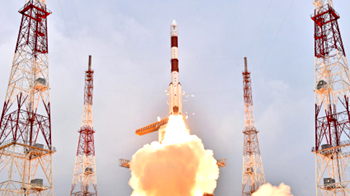
Sriharikota (AP), Jun 22: Setting a record in its space programme, India today successfully launched 20 satellites, including its earth observation Cartosat-2 series, in a single mission on board ISRO's workhorse PSLV-C34 from the spaceport here.

In a precision launch, PSLV-C34 took off from the second launch pad of Satish Dhawan Space Centre here, about 110 km from Chennai at 9.26 AM and placed the Cartosat-2 Series and 19 others in the designated polar Sun Synchronous Orbit (SSO) about 30 minutes later in clear skies.

The 727.5 kg Cartosat-2 series satellite will provide regular remote sensing services with its panchromatic and multispectral cameras and its imagery will be of multiple use.

Of the 19-satellites, 12 are earth imaging "Dove satellites" of USA and another American satellite. The rest are from Canada (two) and one each from Germany and Indonesia.

Two academic satellites are from Sathyabama University (Sathyabamasat) in Chennai and from College of Engineering (Swayam) at Pune.

Use of Cartosat 2 includes cartographic, urban and rural applications, coastal land use and regulation, utility management like road network monitoring and water distribution.

Also, creation of land use maps, precision study,change detection to bring out geographical and man-made features and various other Land Information System and Geographical Information System applications can be done. It is similar to the earlier Cartosat-2, 2A and 2B.

Prime Minister Narendra Modi congratulated ISRO and described today's launch as a "monumental" accomplishment.

"20 satellites in a go! @ isro continues to break new barriers. hearty congratulations to our scientists on the monumental accomplishment', he said on Twitter.

ISRO Chairman A S Kiran Kumar congratulated his team for the successful launch 'in a record time' and said "PSLV C-34 has done its job."

"We have the current generation of earth observation satellite of Cartosat 2 series," he said, adding ISRO had done a "wonderful job".

P Kunhikrishnan, Director, SDSC-SHAR, said that it was a major accomplishment by PSLV in its 35th consecutive successful mission.

"PSLV has become a success symbol for ISRO and India. ISRO is adopting more and more professionalism," he said.

D Jayakumar, Mission Director,described today's launch as a major landmark and said that the vehicle performance was "exceedingly well."

With today's launch of 20 satellites, PSLV beat its 2008 record when it placed in orbit 10 satellites in a single launch into various Low Earth Orbits.

This is the 14th flight of PSLV in "XL" configuration known for its capacity to carry more load which uses 'solid strap-on motors'.

The total weight of all the 20 satellites carried onboard PSLV-C34 is about 1288 kg.

India has 11 operational earth observation satellites, including RESOURCESAT-1 and 2, CARTOSAT-1, 2, 2A, 2B, RISAT-1 and 2, OCEANSAT-2 are in orbit.

Beginning in 1988, ISRO had launched many remote sensing satellites (for earth observation) and the data are for varied use including agriculture, water and ocean resources besides disaster management.

Comments

Add new comment

  • Coastaldigest.com reserves the right to delete or block any comments.
  • Coastaldigset.com is not responsible for its readers’ comments.
  • Comments that are abusive, incendiary or irrelevant are strictly prohibited.
  • Please use a genuine email ID and provide your name to avoid reject.
News Network
May 7,2020

May 7: India is projected to record the highest number of births in the 9 months since COVID-19 was declared a pandemic in March, with more than 20 million babies expected to be born in the country between March and December, according to top UN body.

The United Nations Children's Fund (UNICEF) warned that pregnant mothers and babies born during the pandemic across the world were threatened by strained health systems and disruptions in services.

An estimated 116 million babies will be born under the shadow of COVID-19 pandemic, UNICEF said on Wednesday, ahead of Mother's Day, observed on May 10.

These babies are projected to be born up to 40 weeks after COVID-19 was recognised as a pandemic on March 11.

The highest numbers of births in the 9 months since the pandemic was declared are expected to occur in India, where 20.1 million babies are projected to be born between March 11 and December 16. Other countries with the expected highest numbers of births during this period are China (13.5 million), Nigeria (6.4 million), Pakistan (5 million) and Indonesia (4 million), it said.

"Most of these countries had high neonatal mortality rates even before the pandemic and may see these levels increase with COVID-19 conditions," UNICEF said.

It is estimated that there will be 24.1 million births in India for the January-December 2020 period.

UNICEF warned that COVID-19 containment measures can disrupt life-saving health services such as childbirth care, putting millions of pregnant mothers and their babies at great risk.

Even wealthier countries are affected by this crisis. In the US, the sixth-highest country in terms of the expected number of births, over 3.3 million babies are projected to be born between March 11 and December 16.

"New mothers and newborns will be greeted by harsh realities," UNICEF said, adding they include global containment measures such as lockdowns and curfews; health centres overwhelmed with response efforts; supply and equipment shortages; and a lack of sufficient skilled birth attendants as health workers, including midwives, are redeployed to treat COVID-19 patients.

"Millions of mothers all over the world embarked on a journey of parenthood in the world as it was. They now must prepare to bring a life into the world as it has become – a world where expecting mothers are afraid to go to health centres for fear of getting infected, or missing out on emergency care due to strained health services and lockdowns," UNICEF Executive Director Henrietta Fore said.

"It is hard to imagine how much the coronavirus pandemic has recast motherhood" Fore said.

UNICEF said its analysis was based on data from World Population Prospects 2019 of the UN Population Division.

An average full-term pregnancy typically lasts a complete 9 months, or 39 to 40 weeks. For the purposes of this estimate, the number of births for a 40-week period in 2020 was calculated.

The 40-week period of March 11 to December 16 is used in this estimate based upon the WHO's March 11 assessment that COVID-19 can be characterised as a pandemic.

UNICEF warned that although evidence suggests that pregnant mothers are not more affected by COVID-19 than others, countries need to ensure they still have access to antenatal, delivery and postnatal services.

Similarly, sick newborns need emergency services as they are at high risk of death. New families require support to start breastfeeding, and to get medicines, vaccines and nutrition to keep their babies healthy, it said.

"This is a particularly poignant Mother's Day, as many families have been forced apart during the coronavirus pandemic, but it is also a time for unity, a time to bring everyone together in solidarity. We can help save lives by making sure that every pregnant mother receives the support she needs to give birth safely in the months to come," Fore said.

Issuing an urgent appeal to governments and health care providers to save lives in the coming months, UNICEF said efforts must be made to help pregnant women receive antenatal checkups, skilled delivery care, postnatal care services, and care related to COVID-19 as needed.

Ensure health workers are provided with the necessary personal protective equipment and get priority testing and vaccination once a COVID-19 vaccine becomes available so that can deliver high quality care to all pregnant women and newborn babies during the pandemic, it said.

While it is not yet known whether the virus is transmitted from a mother to her baby during pregnancy and delivery, UNICEF advised all pregnant women to follow precautions to protect themselves from exposure to the virus.

Closely monitor themselves for symptoms of COVID-19 and seek advice from the nearest designated facility if they have concerns or experience symptoms. Pregnant women should also take the same precautions to avoid COVID -19 infection as other people: practice physical distancing, avoid physical gatherings and use online health services, it said.

UNICEF said even before COVID-19 pandemic, an estimated 2.8 million pregnant women and newborns died every year, or 1 every 11 seconds, mostly of preventable causes.

The agency called for immediate investment in health workers with the right training, who are equipped with the right medicines to ensure every mother and newborn is cared for by a safe pair of hands to prevent and treat complications during pregnancy, delivery and birth.

Comments

Add new comment

  • Coastaldigest.com reserves the right to delete or block any comments.
  • Coastaldigset.com is not responsible for its readers’ comments.
  • Comments that are abusive, incendiary or irrelevant are strictly prohibited.
  • Please use a genuine email ID and provide your name to avoid reject.
News Network
June 21,2020

New Delhi, June 21: India today recorded the highest single-day spike in infections so far with 15,413 new cases reported in the last 24 hours. The total number of positive cases in India touched 4.11 lakh on Sunday.

As per the Ministry of Health data, the total number of coronavirus cases stands at 4,10,461 cases which include 1,69,451 active cases, 2,27,756 recovered/migrated cases, and 13,254 deaths as per the Ministry of Health data.

With 1,28,205 confirmed cases of COVID-19 so far, Maharashtra remains the worst-affected state in the country, followed by Tamil Nadu with 56,845 and Delhi 56,746. 

Delhi reported its highest single-day increase of 3,630 new coronavirus cases. With this, the state’s tally rose to 56,746. The toll rose to 2,112 with 77 deaths. As many as 7,725 people recovered, taking the total recoveries to 31,294.

Comments

Add new comment

  • Coastaldigest.com reserves the right to delete or block any comments.
  • Coastaldigset.com is not responsible for its readers’ comments.
  • Comments that are abusive, incendiary or irrelevant are strictly prohibited.
  • Please use a genuine email ID and provide your name to avoid reject.
Agencies
August 8,2020

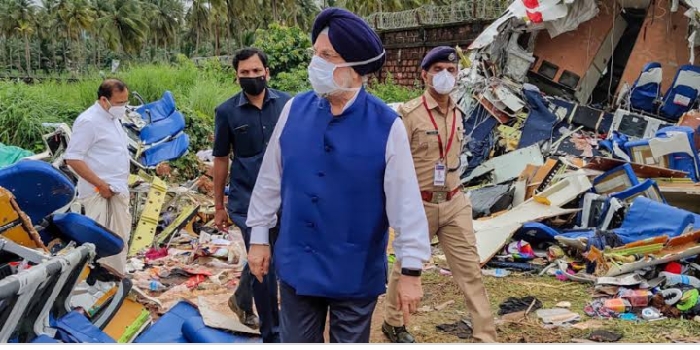
The Civil Aviation Ministry announced an initial assistance of Rs 10 lakh to the dependents of the deceased in the Kozhikode AIE plane crash, while the Kerala government also announced a compensation of Rs 10 lakh each.

Minister of Civil Aviation, Hardeep Singh Puri, who visited the mishap spot on Saturday, said that a detailed probe is already on and the pilot and co-pilot were highly experienced.

He also announced a compensation of Rs 2 lakh each to the injured and Rs. 50,000 each to those who suffered minor injuries. The other normal compensations would be decided in due course.

Puri said that Captain Deepak Vasant Sathe, aged 59, who commandeered the AIE flight, had a flying experience of 10,848 hours, while co-pilot Akhilesh Kumar, aged 32, had a flying experience of 1,723 hours.

"Deepak was one of the most distinguished and experienced pilots. He had a commanding experience of 6,662 hours and was commander of B-737 aircraft for 4,244 hours. He had also operated to Kozhikode international airport 27 times. He joined AIE in 2013 and prior to that he served with the IAF and HAL. He was a figher pilot and a recipient of prestigious sword of honour and a gold medalist," said Puri.

Puri said that even as the flight slipped down to around 35 feet, a major disaster was averted due to timely rescue operations. Local people played an exemplary role and the fire brigade's timely action of cutting the plane body and rescuing the passengers minimised the casualties, he said.

Chief Minister Pinarayi Vijayan also said that the local people and all rescue and relief agencies did a well co-ordinated job. The state government would also meet the entire treatment expenses of the injured.

Till Saturday afternoon, the total number of deaths was 18. While 149 were still in hospitals, 23 were discharged.

Comments

Add new comment

  • Coastaldigest.com reserves the right to delete or block any comments.
  • Coastaldigset.com is not responsible for its readers’ comments.
  • Comments that are abusive, incendiary or irrelevant are strictly prohibited.
  • Please use a genuine email ID and provide your name to avoid reject.